August MackeDeutschland, 1887–1914
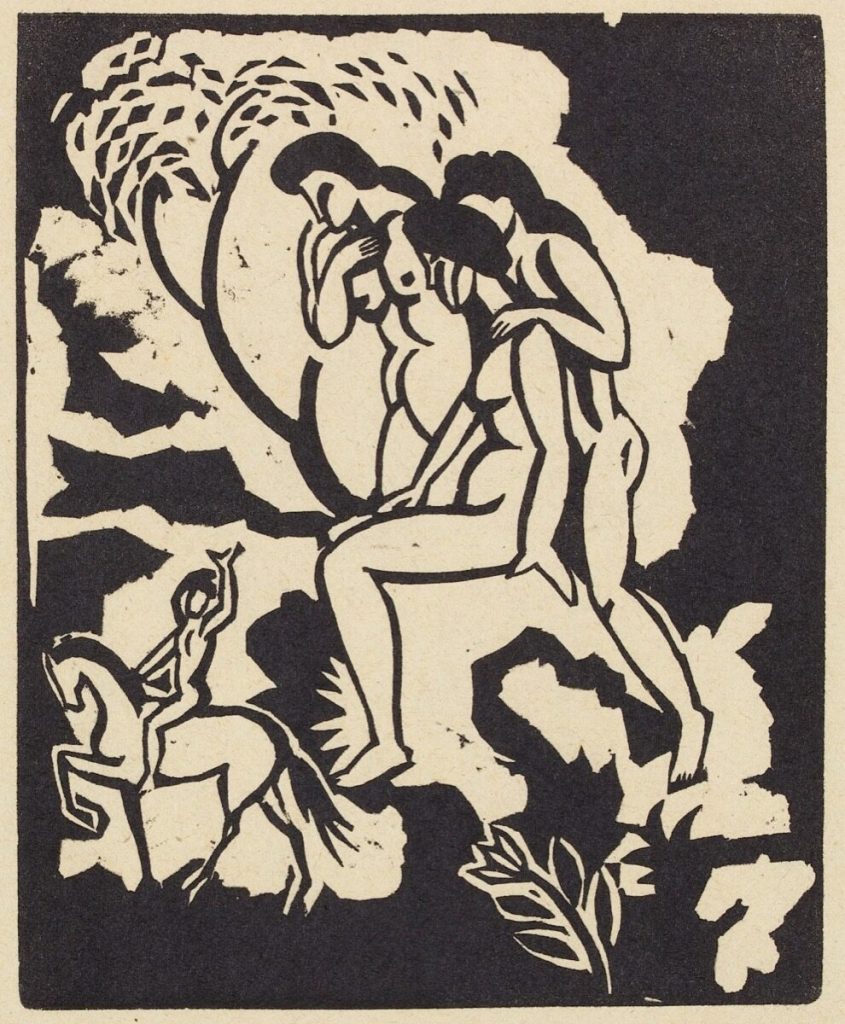
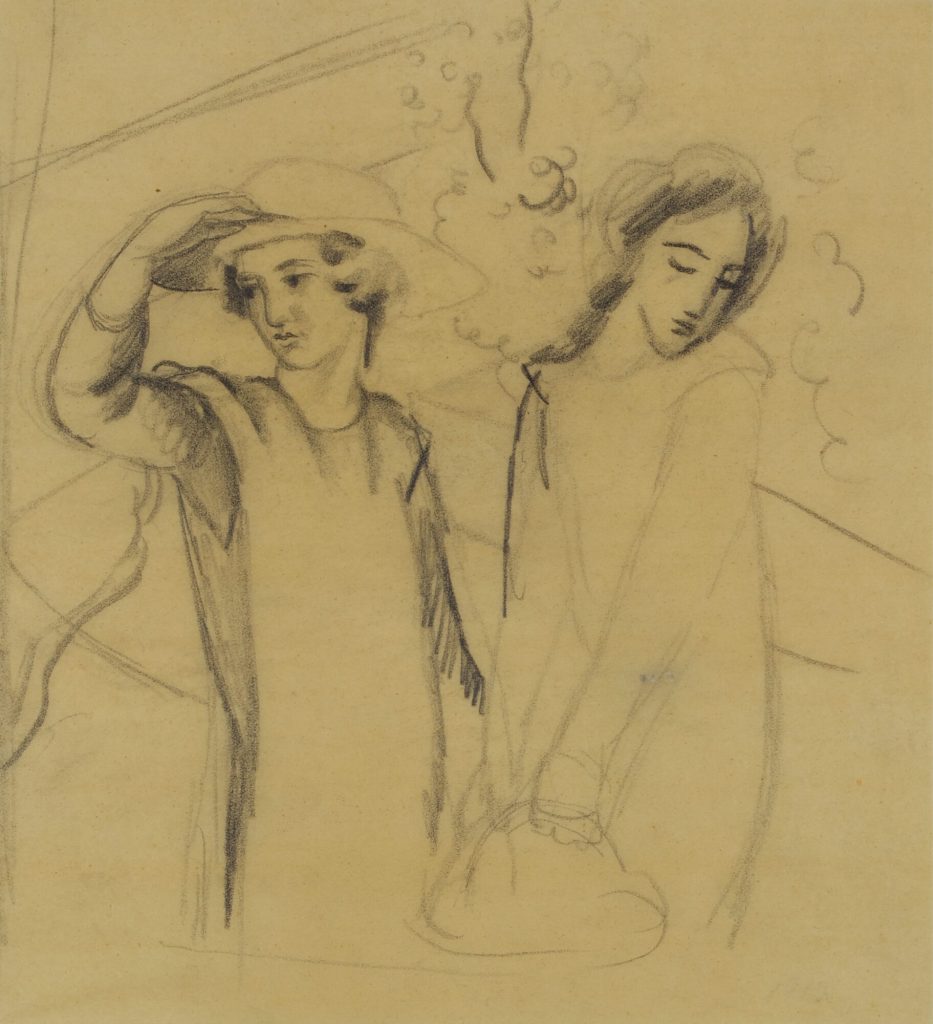
People by the Blue Lake
Kann ich es sehen?
Ja, derzeit ausgestellt
Wo ist „People by the Blue Lake“ heute? National Gallery of Art, Saal 217A · Ostgebäude, Zwischengeschoss, Washington, D.C. Ja, derzeit ausgestellt. Geprüft 29. September 2026.

Geschlossen· öffnet morgen um 10:00
Öffentlich ausgestellt.
- Geprüft
- Unverändert seit
- Quelle
- Das Museum
Angaben
- Inventarnummer
- 2020.112.10
Was es zeigt
Im Katalog
Quellen
- National Gallery of Art
- Bild: National Gallery of Art — Museum open access
Im Leben von August Macke
Das ganze Leben1911
The Blue Rider: three works in the first exhibition
Macke founds the association of Expressionist artists Der Blaue Reiter together with Wassily Kandinsky, Alfred Kubin and Franz Marc; three of his works are shown at the Blue Rider exhibition in Munich in 1911.
1912
Paris: Robert Delaunay and Orphism
In 1912 in Paris Macke meets Robert Delaunay, and the meeting is a kind of revelation for him: Delaunay’s chromatic Cubism, which Apollinaire called Orphism and which builds painting on the juxtaposition of contrasting colours, influences Macke’s art from then on. His “Shop Windows” can be considered a personal interpretation of Delaunay’s “Windows”, combined with the simultaneity of images found in Italian Futurism.
1914
Tunisia with Klee and Moilliet: landmark watercolours
In April 1914 Macke makes a two-week trip to Tunisia with Paul Klee and Klee’s school friend, the painter Louis Moilliet, and brings back a large number of landmark watercolours. The exotic atmosphere of Tunisia becomes fundamental to the luminist approach of his final period; the sketches and photographs will serve as material for “Tunisian Landscape”, “Landscape with Cows and a Camel” and other works, but Macke will not manage to use them fully.
8 August 1914
Mobilisation: to the front as a reservist
Almost immediately after the outbreak of the First World War, on 8 August 1914, Macke, a reservist, is called up for the front. Far, as Elisabeth wrote years later, from the “hurrah-patriotism” that seized many, he nevertheless considers it his duty to go; in his letters from the front he describes the horror and cruelty of the war.
26 September 1914
Killed in battle at twenty-seven
On the morning of 26 September 1914 Macke is killed in battle in Champagne at the age of 27; his remains are not found, and his name appears among those of other dead on a gravestone at the military cemetery at Souain (other accounts say he is buried in the German military cemetery at Souain-Perthes-lès-Hurlus). In one of his last letters he remarks that only the steadfastness of the defenders of the Western Front will spare Germany the devastation by war that the front-line regions of France have suffered.
26. September 1914
Died

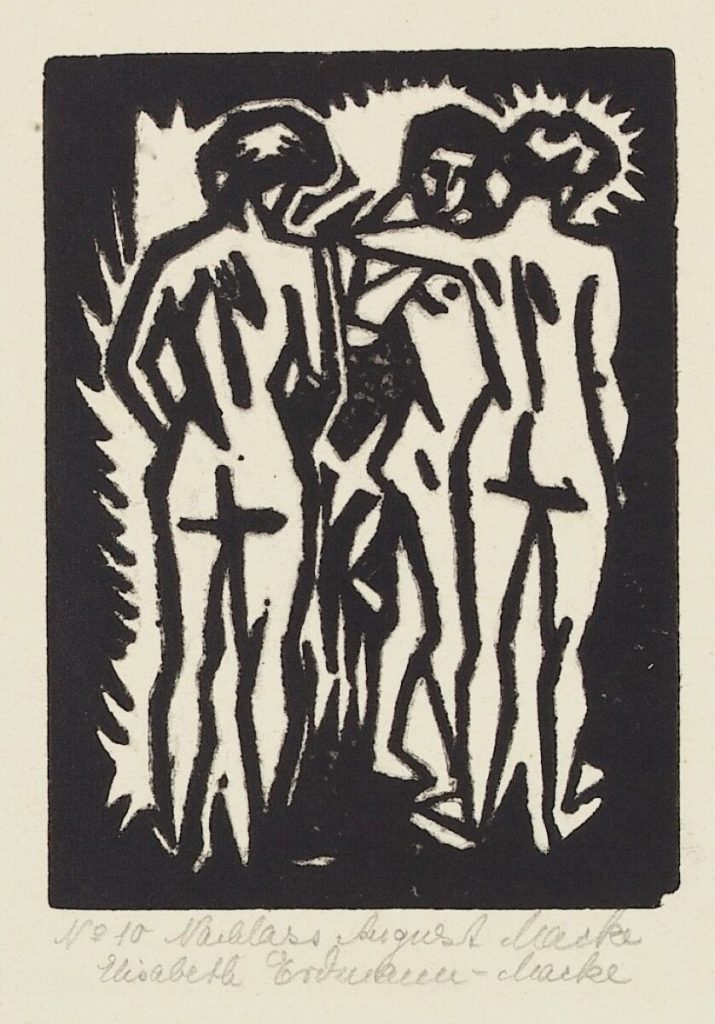
![Composition (3 Nudes) [Komposition (3 Akte)] (plate, preceding p. 79) from the periodical Das Kunstblatt, vol. 2, no. 4 (Apr 1918), August Macke, 1918 (executed 1912)](https://www.moma.org/media/W1siZiIsIjEyMjAwNCJdLFsicCIsImNvbnZlcnQiLCItcmVzaXplIDEwMjR4MTAyNFx1MDAzZSJdXQ.jpg?sha=6b27195223cf9aa3)



![Dancing Couple in the Snow [reverse], Ernst Ludwig Kirchner, 1928-1929](https://api.nga.gov/iiif/02d6ebca-0992-4be5-9e1e-06749ec65449/full/!2400,2400/0/default.jpg)

![Dance Hall Bellevue [obverse], Ernst Ludwig Kirchner, 1909/1910](https://api.nga.gov/iiif/634157b6-d0fd-4a63-b93b-0dc1eb6c03d3/full/!2400,2400/0/default.jpg)


![Sheet of Studies [recto], Leonardo da Vinci, probably 1470/1480](https://api.nga.gov/iiif/49c325bf-6243-46eb-8215-f8830fd15641/full/!2400,2400/0/default.jpg)