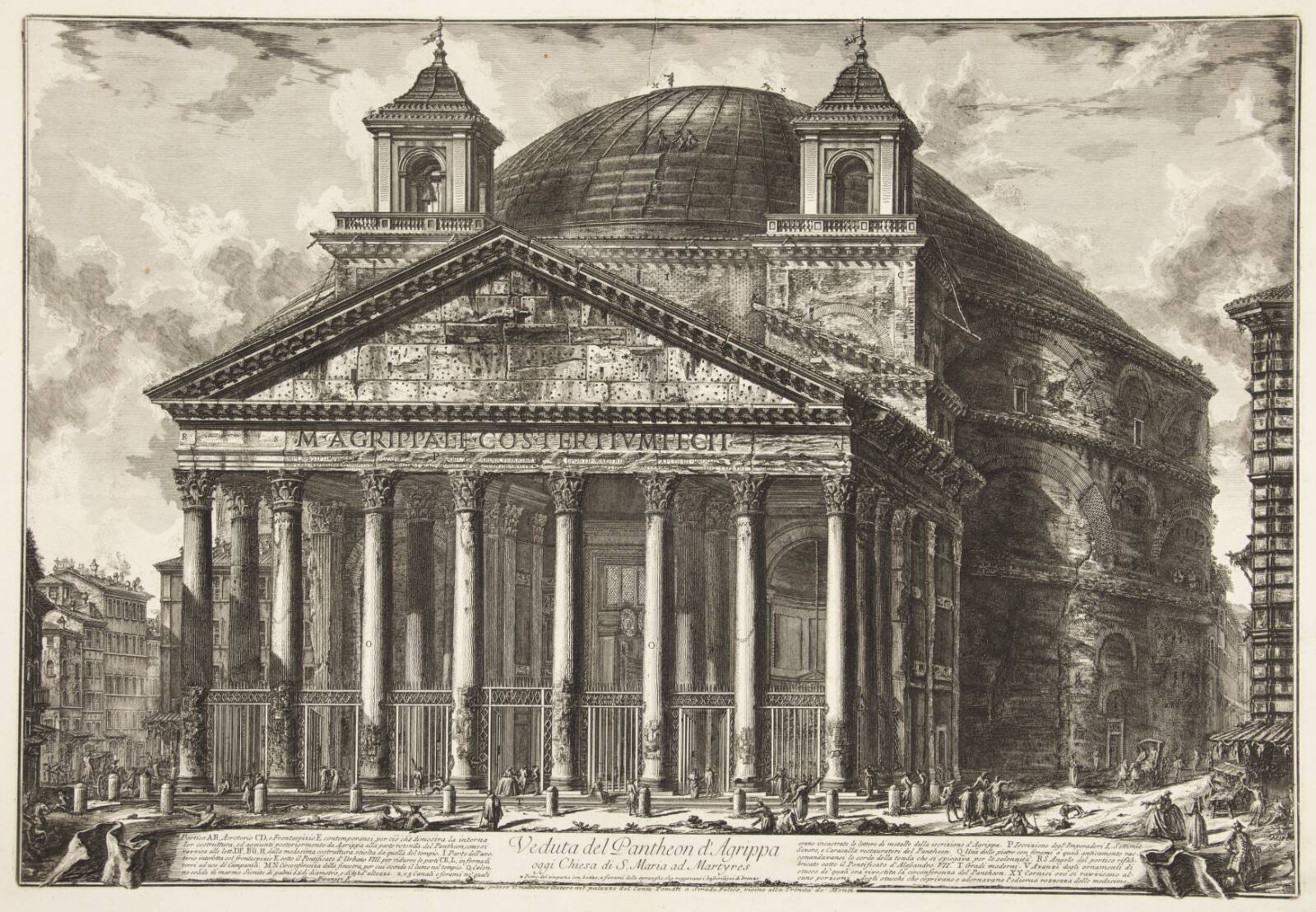
 Giovanni Battista PiranesiItalien, 1720–1778
Pantheon
Kann ich es sehen?
Ja, derzeit ausgestellt
Wo ist „Pantheon“ heute? Statens Museum for Kunst, Saal 201E, Kopenhagen. Ja, derzeit ausgestellt. Geprüft 29. September 2026.

Kopenhagen, Dänemark
Geschlossen· öffnet morgen um 10:00
Öffentlich ausgestellt.
- Geprüft
- Unverändert seit
- Quelle
- Das Museum
Angaben
- Inventarnummer
- KKSgb9860/60
Im Katalog
Ausstellungen
Ausgestellt · Saal 201E
Statens Museum for Kunst · 28. Sept. 2026 — jetzt · Geprüft
War ausgestellt
Statens Museum for Kunst · 19. Aug. 2026 — 28. Sept. 2026 · Geprüft
Quellen
- Statens Museum for Kunst
- Bild: Statens Museum for Kunst — public domain
Im Leben von Giovanni Battista Piranesi
Das ganze Lebenc. 1760
The Caffè degli Inglesi in the Egyptian style
Around 1760 Piranesi began designing the Caffè degli Inglesi on the Piazza di Spagna, conceiving its interior in the “Egyptian style” according to his pan-Roman theory; only etchings of it survive. In this café with his wall paintings and in the Antico Caffè Greco, Piranesi, whose print workshop and museum of antiquities stood close by, cultivated wealthy travellers, particularly English ones.
1761
Second edition of the “Prisons”
For the second edition of 1761 all the etchings were reworked and numbered I–XVI, plates II and V were newly added, and some were given, probably deliberately, impossible geometries. Ten years after the first edition Piranesi made practically new works on the same plates: he deepened the shadows and added details and figures, either jailers or prisoners bound to instruments of torture.
1761
The treatise “On the Magnificence and Architecture of the Romans”
In 1761 Piranesi set out his ideas in a treatise that provoked a Europe-wide scholarly debate: a champion of the pan-Roman theory, he held the architecture of the ancient Romans to be a direct continuation of Egyptian rather than Greek building, and the highest achievement of the classical world.
1761 · Laufbahn
the Accademia di San Luca; a press of his own
In 1761 Piranesi became a member of the Accademia di San Luca and opened a printing house of his own.
1761
Son born: Francesco Piranesi
1762
Publishes “The Campus Martius of Ancient Rome”
In 1762 the series of etchings “Campo Marzio dell'antica Roma” was printed; like the other series of those years, it already shows the hallmarks of his style: a striving for monumentality, for majestic buildings and spaces hard for the eye to grasp.

![View of the Remains of the Praetorian Fort [the Poecile] in Hadrian’s Villa at Tivoli, Giovanni Battista Piranesi, 1770](https://nrs.harvard.edu/urn-3:HUAM:INV165626_dynmc/full/!2400,2400/0/default.jpg)