Vasily KandinskyFrankreich, 1866–1944
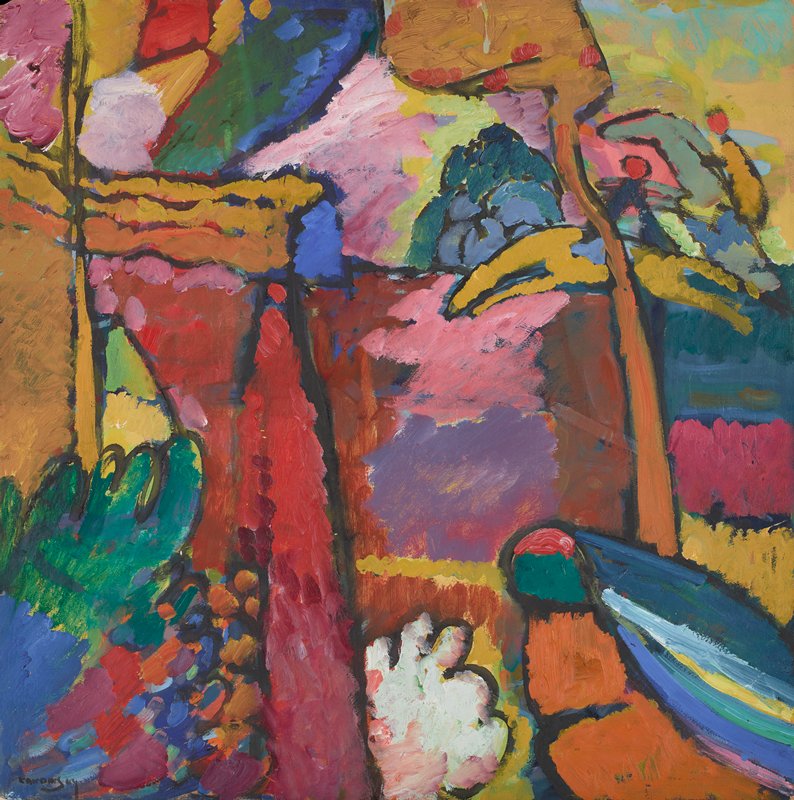
Painting with Troika
Kann ich es sehen?
Ja, derzeit ausgestellt
Wo ist „Painting with Troika“ heute? Art Institute of Chicago, Saal 392, Chicago. Ja, derzeit ausgestellt. Geprüft 29. September 2026.

Chicago, Vereinigte Staaten
Geschlossen· öffnet um 11:00
Öffentlich ausgestellt.
- Geprüft
- Unverändert seit
- Quelle
- Das Museum
Über das Gemälde
Vasily Kandinsky, along with Franz Marc, Gabriele Münter, and Alexei Jawlensky, was a founding member of Blaue Reiter (Blue Rider), a loose alliance of artists based in Munich. Often working in a common palette using expressive brushwork, they shared a belief in the symbolic and spiritual importance of forms and colors, including their effect on emotions and memories. Blaue Reiter also promoted a spontaneous, intuitive approach to painting, looking to non-Western, European medieval, and folk art for inspiration. Here the troika, a traditional carriage drawn by three horses, and the hand-painted frame, which Kandinsky made especially for this work, speak to the powerful influence these sources had on the artist.
Art Institute of ChicagoCC BY 4.0
Angaben
- Inventarnummer
- 1931.509
Was es zeigt
Im Katalog
Quellen
- Art Institute of Chicago
- Bild: Art Institute of Chicago — CC0
Im Leben von Vasily Kandinsky
Das ganze Leben1908–1909
“Thought-Forms” and the Theosophical Society
In 1908 Kandinsky bought a copy of “Thought-Forms” by Annie Besant and Charles Webster Leadbeater, and in 1909 he joined the Theosophical Society.
1908–1909
Murnau and Münter's “Russian House”
Gabriele Münter bought a summer house in Murnau, where the couple happily entertained colleagues; it is still known as the “Russenhaus”. Later Münter used its basement to hide many works by Kandinsky and others from the Nazis.
1909
President of the Neue Künstlervereinigung München
Kandinsky helped found the Neue Künstlervereinigung München and became its president. The group dissolved in late 1911: it could not reconcile the radical approach of Kandinsky and others with conventional ideas of art.
1910–1911
The treatise “Concerning the Spiritual in Art”
The treatise defended and promoted abstract art and affirmed that all forms of art are equally capable of reaching spirituality; colour in a painting can be autonomous, apart from the depiction of an object. Kandinsky distinguished three kinds of painting: impressions, improvisations and compositions.
1911
The birth of the Blue Rider
After the earlier association dissolved Kandinsky formed the Blue Rider with August Macke, Franz Marc, Albert Bloch and Gabriele Münter. The group issued an almanac and held two exhibitions; the war ended further plans.
1911
His first solo exhibition
His first solo exhibition took place in the same years, when the Blue Rider was being born.
_MET_DP236124.jpg?width=1280)