Mukul Dey
Painting
Darf man es sehen?
Empfängt derzeit nicht

Victoria and Albert Museum
London, Vereinigtes Königreich
Es gehört zur Sammlung, ist derzeit aber nicht ausgestellt.
- Geprüft
- Unverändert seit
- Quelle
- Sammlungsdaten des Museums selbst
About the painting
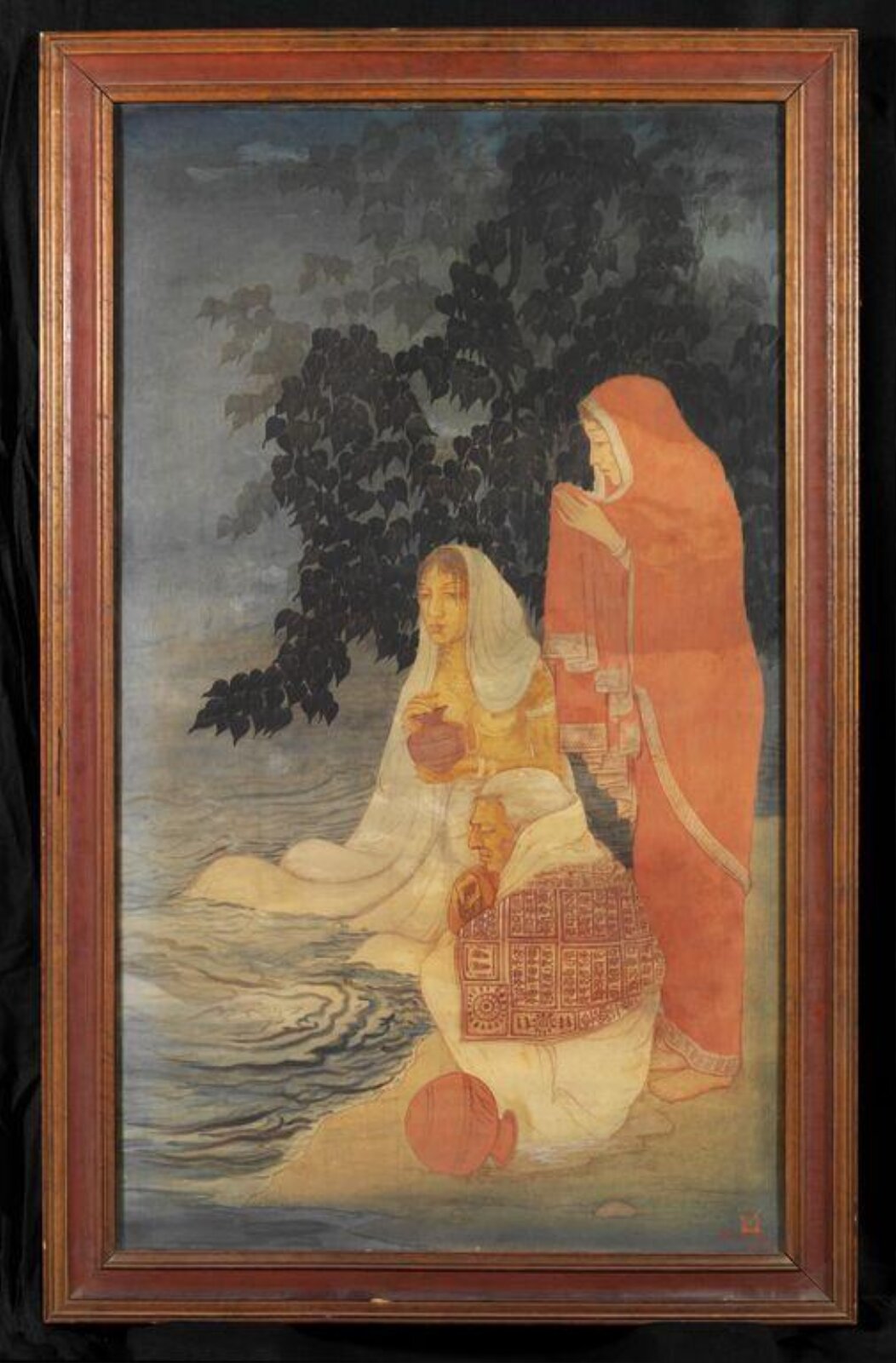
The scene depicts three women performing propitiatory and purificatory rites by the river bank. An old woman wrapped in 'namabali' or prayer-shawl (with Bengali inscriptions on it), two younger women, one in a white sari and one in an orange sari are seen at their prayers and ablutions by the Ganges in fading light. A shadowy 'pipal' tree on the river bank hints at the lunar eclipse. The modelling of the torso of the semi-nude figure shows the influence of Ajanta, while the rippling waves and clusters of 'pipal' leaves shown in relief against a formless background recall Far Eastern models.
Read on
Mukul Dey (1895) studied under Abanindranath Tagore, the pioneer and leading exponent of the Bengal School of art, as well as in Japan, the United States and England. Like several other 'neo-Bengal' artists he spent time making copies of the Ajanta cave-paintings, and later wrote 'My Pilgrimages to Ajanta and Bagh' (London, 1925).
Victoria and Albert Museum
Angaben
- Inventarnummer
- IS.32-1962
Im Katalog
Quellen
- Victoria and Albert Museum: the museum's own open data · abgerufen vor 10 Tagen
- Bild: Victoria and Albert Museum — © Victoria and Albert Museum, London