 James Jacques Joseph TissotFrankreich, 1836–1902
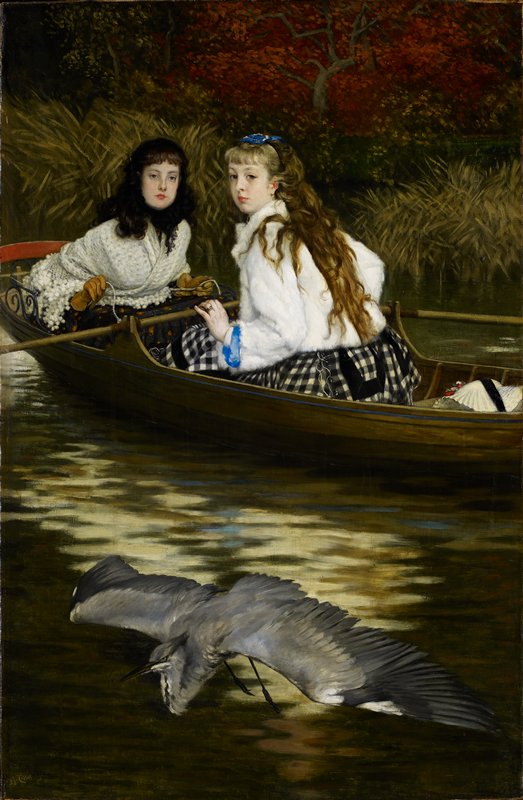
On the Thames, a Heron
Darf man es sehen?
Ja, es empfängt Besucher

Minneapolis, Vereinigte Staaten
Öffentlich ausgestellt.
- Geprüft
- Unverändert seit
- Quelle
- Das Museum
Über das Gemälde
When James Tissot fled to England in 1871 as a political refugee following the Franco-Prussian war, he discovered that English suspicion of French painting technique and a preference for sentimental narrative would require him to adapt his work for the British market. In On the Thames, A Heron, one of his first English works, Tissot created a successful amalgam of these two aesthetics by serving up to British tastes his French technique wrapped in the sweet Victorian charm of beautiful young women boating on the Thames. Also presented here is the artist's full comprehension of the aesthetics of Japanese design in his use of a high vantage point and the juxtaposition of two separate pictorial elements in compressed space. Further the instantaneous realism and framing of the composition also suggests the influence of photography.
Minneapolis Institute of Art
Angaben
- Inventarnummer
- 75.7
Im Katalog
Quellen
- Minneapolis Institute of Art
- Bild: Minneapolis Institute of Art — © Minneapolis Institute of Art
Derweil im Leben von James Jacques Joseph Tissot
Das ganze Leben1870–1871
War and the Commune
In the Franco-Prussian War Tissot took part in the improvised defence of Paris, first in two companies of the National Guard and later with the Paris Commune, which he is believed to have joined only to protect his belongings rather than out of shared ideology.
1871
Moves to London
In 1871, either because of his association with the Commune (he was suspected of sympathising with the Communards) or for better opportunities, Tissot left Paris for London, where Vanity Fair and his exhibits at the Royal Academy had already given him connections. There Seymour Haden helped him learn etching.
1871–1882 · Wirkungsort
London
1872
A house in St John's Wood and a large income
Quickly famous as a painter of elegantly dressed women in scenes of fashionable life, by 1872 Tissot had bought a house in St John's Wood, an area much favoured by London artists, and that year he earned 94,515 francs, an income normally enjoyed only by the upper classes. In 1873 he joined the Arts Club, and Edmond de Goncourt mocked his studio, where iced champagne awaited visitors at all times.
1874
Declines the first Impressionist exhibition
In 1874 Degas asked Tissot to join the first exhibition of the artists who became known as the Impressionists. Tissot declined but remained a close acquaintance of the group.
c. 1874
In Venice with Manet
Around 1874 Tissot travelled to Venice with Édouard Manet, and Berthe Morisot visited him in London. He regularly saw Whistler, who influenced his Thames scenes and introduced him to Japanese art: Japanese objects and costumes became a regular presence in Tissot's pictures.