William Henry Fox TalbotEngland, 1800–1877
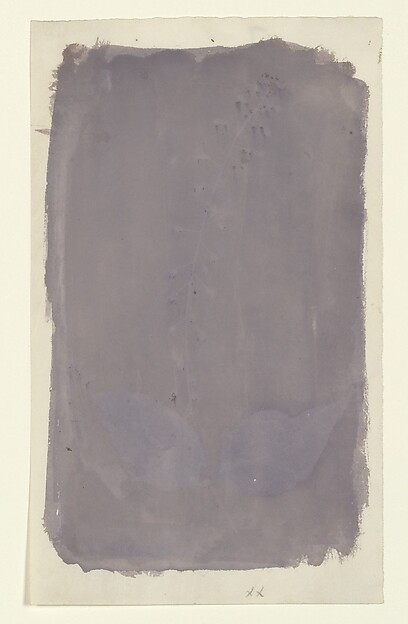
Oak Tree
Kann ich es sehen?
Derzeit nicht ausgestellt
Wo ist „Oak Tree“ heute? Sammlung: National Gallery of Art, Washington, D.C. Derzeit nicht ausgestellt. Geprüft 23. November 2026.

Washington, D.C., Vereinigte Staaten
Es gehört zur Sammlung, ist derzeit aber nicht ausgestellt.
- Geprüft
- Unverändert seit
- Quelle
- Das Museum
Angaben
- Inventarnummer
- 1995.36.117
Was es zeigt
Im Katalog
Quellen
- National Gallery of Art
- Bild: National Gallery of Art — Museum open access
Im Leben von William Henry Fox Talbot
Das ganze Leben25 January 1839
First showing of photographs at the Royal Institution
Shortly after Louis Daguerre’s daguerreotype was announced in early January, Talbot asserted his priority and, at a Friday Evening Discourse at the Royal Institution, exhibited several paper photographs he had made in 1835. Within a fortnight he described the nature of his process to the Royal Society, while Daguerre revealed no useful details of his own until mid-August.
1840
Invents the calotype
Talbot found a way to print any number of positives on salted paper from a paper negative; new chemicals cut the exposure to a minute in bright sunlight. He called the method the “calotype” (from kalos, beautiful), informally the “talbotype”: unlike the daguerreotype with its single positive, it effectively created modern photography.
1840–1841
Post: High Sheriff of Wiltshire
February 1841
Patents the calotype
Talbot obtained an English patent for the calotype process and sold licences at £20 each, later lowering the fee for amateurs to £4 while professionals paid up to £300 a year; scientists saw it as a hindrance to scientific freedom. He justified his rigour by the roughly £5,000 he had spent on photography; for science the method was free, and Talbot himself published the first known photomicrograph of a mineral crystal.
1844–1846
“The Pencil of Nature”, the first photobook, appears
Longman, Brown, Green & Longmans issued the book in separate parts: 24 prints, each pasted in by hand and accompanied by a short text. Talbot is regarded as the author of the first photographic book; scholars see in it the design of a new canon built on biblical rhetoric.
1851
Archer’s collodion process displaces the calotype
In the year of Daguerre’s death Frederick Scott Archer publicised the wet collodion process with a glass negative, which soon replaced the calotype in commercial use. Reading his patent broadly, Talbot declared that collodion users, too, needed his licence.