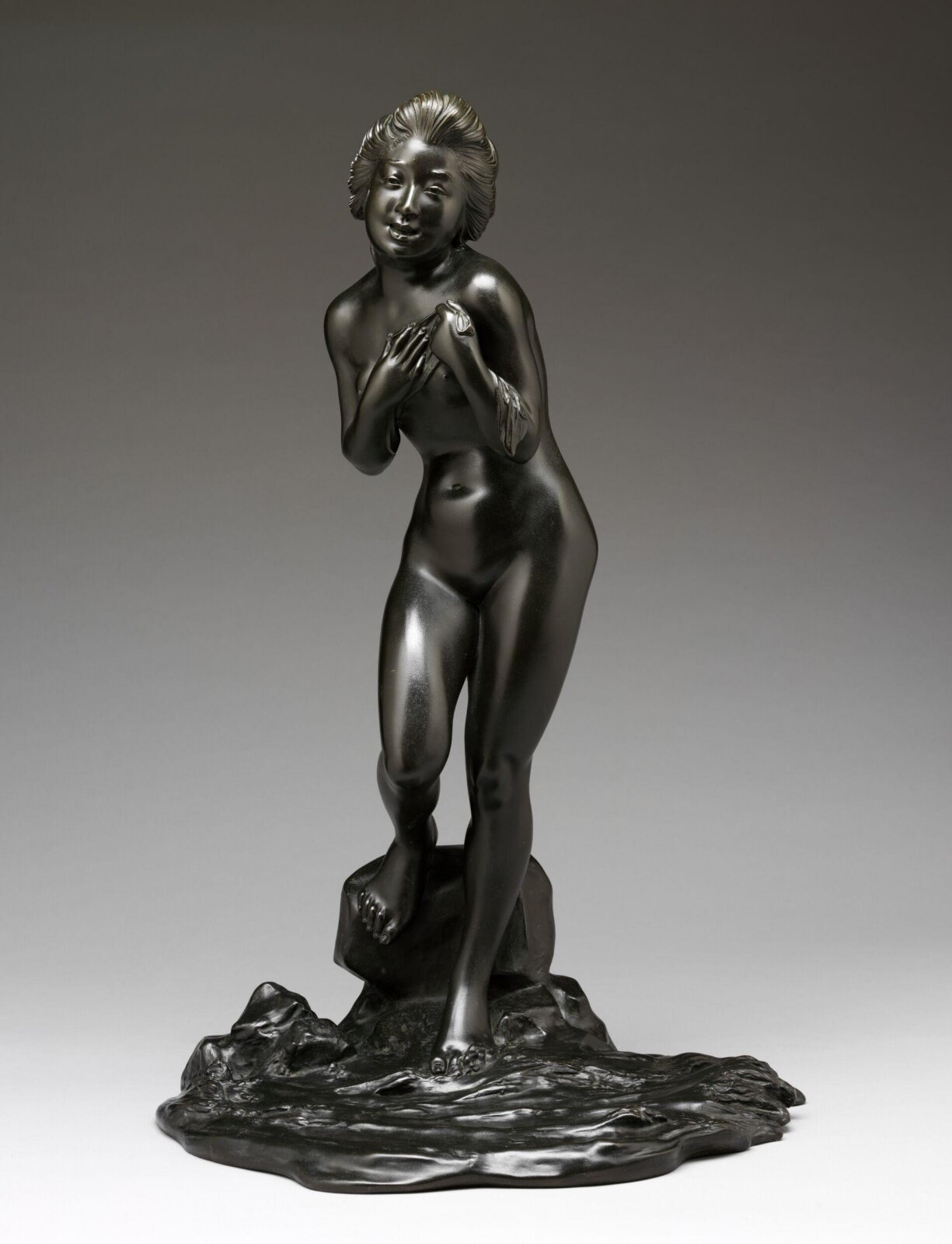
Nude Woman on Rocks
Kann ich es sehen?
Derzeit nicht ausgestellt
Wo ist „Nude Woman on Rocks“ heute? Sammlung: Victoria and Albert Museum, London. Derzeit nicht ausgestellt. Geprüft 25. September 2026.

London, Vereinigtes Königreich
Es gehört zur Sammlung, ist derzeit aber nicht ausgestellt.
- Geprüft
- Unverändert seit
- Quelle
- Das Museum
Über die Skulptur
This figure is an excellent example of the type of work produced by the Tokyo Fine Arts School which was founded in 1887 and produced works in both traditional Japanese and European neo-Classical styles. The Metal Casting Department was established in 1892 within the arts and crafts department at the Tokyo Fine Arts School. Japanese bronze casting techniques were enhanced by the introduction of western technology brought in by the Italian bronze sculptor Vincenzo Ragusa who was employed by the Tokyo Art School from 1876-1882.
Mehr lesen
In 1907 the government instituted and sponsored the ‘Bunten’ painting and sculpture competition and the work of western-style sculptors began to be officially recognised. A group of artists began to develop away from the more academic style of European sculpture towards the romantic realism of Rodin. Many Japanese artists travelled to Europe to study first hand at the ateliers of Western artists and Fujikawa Yuzō (1883-1935) studied under Rodin for a period.
Naturalistic human figures in bronze were rare in Japan prior to the 19th century although portrait figures in wood (and occasionally bronze) were produced from around the 9th century. However, the idea of a sculpture of the naked female form as art object would have been totally alien to the Japanese prior to the Meiji period (1868-1912). The sculpture has the chiselled signature of ‘Hiroaki’ and a cast monogram of an intersected ‘N’ and ‘I’ which may be the foundry mark. Neither have yet been positively identified and it is even conceivable that a Japanese artist could have made the piece in Europe. A scrap of Japanese newspaper with a date of 1915 was found inside the base of the sculpture so we do know that the piece has spent at least some time in Japan.
Victoria and Albert Museum
Angaben
- Inventarnummer
- FE.1853-1993
Im Katalog
Quellen
- Victoria and Albert Museum
- Bild: Victoria and Albert Museum — © Victoria and Albert Museum, London







