Moskovische vrouw
Kann ich es sehen?
Unbekannt
Wo ist „Moskovische vrouw“ heute? Sammlung: Rijksmuseum Amsterdam, Amsterdam. Unbekannt.

Amsterdam, Niederlande
Der Besitzer ist bekannt; ob das Werk derzeit ausgestellt ist, nicht.
- Quelle
- Das Museum
Über das Werk
In den Worten des Museums — auf Niederländisch
Staande vrouw in Moskovische kledij. Zij draagt een lange japon of mantel en sluier over het hoofd. Linksachter een staande en twee zittende figuren.
Rijksmuseum Amsterdam
Angaben
- Inventarnummer
- RP-P-1993-355
Was es zeigt
Im Katalog
Quellen
- Rijksmuseum Amsterdam
- Bild: Rijksmuseum Amsterdam — public domain
Im Leben von Jean-Baptiste Le Prince
Das ganze Leben1758
Arrival in Russia
In 1758, at the invitation of Count I. I. Shuvalov, he arrived in Russia with a group of artists to work at the newly founded Academy of Arts; he lived and worked in St. Petersburg and Moscow, where two of his brothers and a sister were already living.
1758–1762
Travels in Finland, Lithuania, and Siberia
During his five years in Russia he traveled through Finland, Lithuania, and Siberia (according to some scholars, only as far as Kazan); on the empress's instructions he made sketches of "Russian types."
1763
Return to Paris with Russian Drawings
He returned to Paris in December 1763 with an extensive collection of drawings, which he used as the basis for paintings and prints on Russian themes.
1765
The "Russian Series" at the Salon of 1765
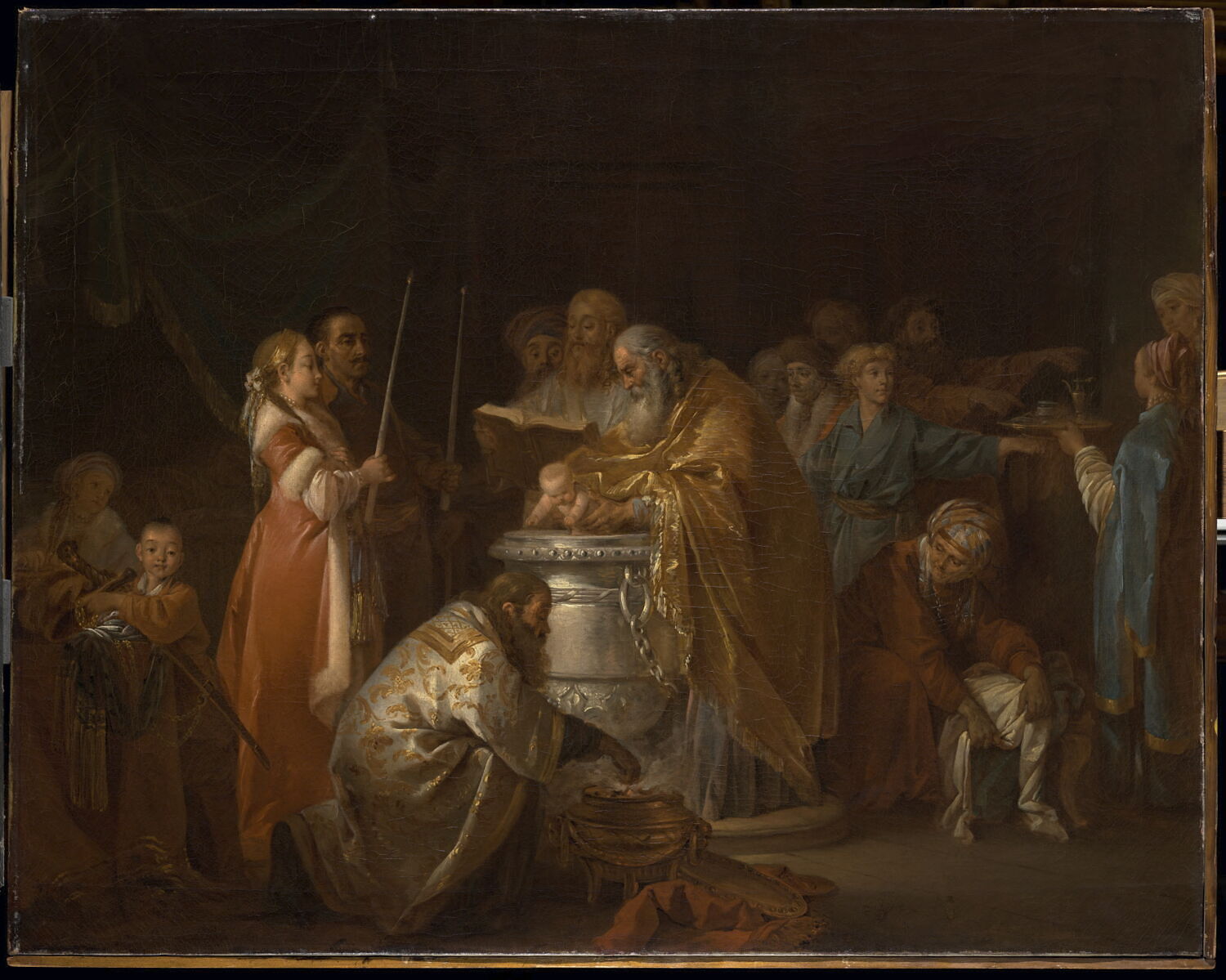
He presented fifteen paintings of scenes from Russian village life at the Salon of 1765, including The Russian Baptism, which earned Diderot's enthusiastic praise, and The Cradle, which he repeated many times.
1768
Pioneer of Aquatint
In 1768 he was the first artist to introduce aquatint into his etchings; he may indeed have been the inventor of this tonal technique, later made famous by Goya. In the history of printmaking he is also known as the inventor of the lavis technique.
30. September 1781
Died