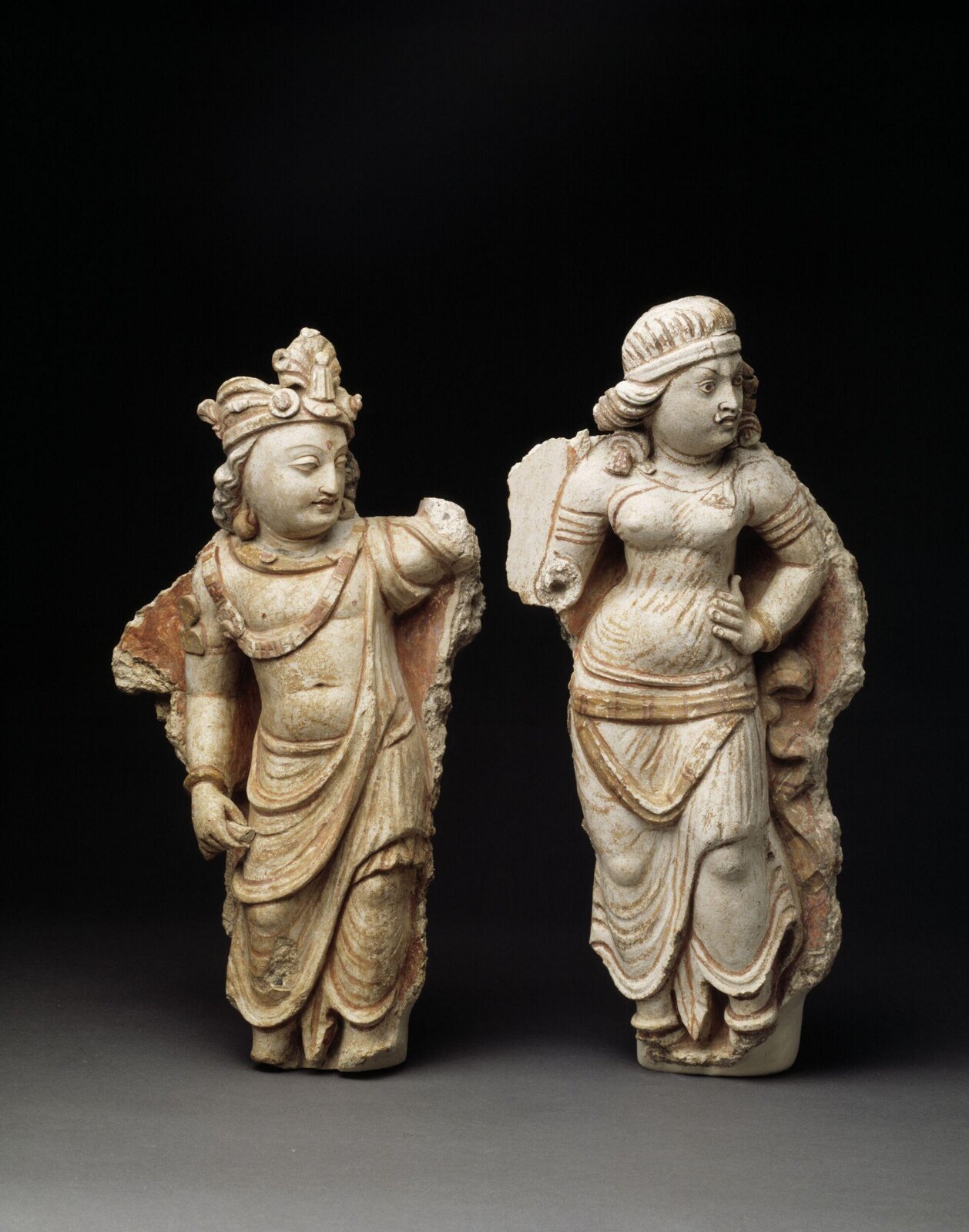
Male attendant
Darf man es sehen?
Ja, es empfängt Besucher

Victoria and Albert Museum
London, Vereinigtes Königreich
SaalThe Himalayas and South-East Asia, Room 47a
Öffentlich ausgestellt. Wer dafür bürgt, steht unten.
- Geprüft
- vor 9 Tagen
- Unverändert seit
- 25. Sept. 2026
- Quelle
- Sammlungsdaten des Museums selbst
About the sculpture
These two figures once formed part of the high-relief decoration of a Buddhist monument in the Gandharan region of Pakistan. The rapid expansion of Buddhist monasteries demanded quicker and less expensive methods of decoration. Stucco, a plaster largely composed of lime and sand, satisfied this need and was widely used in the later Gandharan period. Section moulds were also frequently employed.
Read on
Both these figures display extensive evidence of being richly painted, with traces of yellow, red, and brown iron-oxides still clearly visible. The male figure is dressed in princely attire, with his robes draped in a Hellenistic manner, and with an elaborate diadem or crown worn over long flowing hair. He gestures to his left, perhaps in the direction of central subject of the composition, presumably a figure of the Buddha. The female is similarly clad in a diaphanous robe, though here only her lower body is covered; she is bare breasted and wears arm and wrist ornaments. Her waist-skirt is secured with sash tried in a flamboyant bow to her left; her long hair is secured with an undecorated headband. Curiously, she appears to have two small fangs protruding from her upper jaw, suggesting that she represents some demonic creature, converted by the Buddha's teachings.
These figures probably formed part of a relief decorating a Buddhist monument, reportedly from the Khyber Pass region.
Victoria and Albert Museum
Angaben
- Inventarnummer
- IS.319:1, 2-1951
What it shows
Im Katalog
Quellen
- Victoria and Albert Museum: the museum's own open data · abgerufen vor 9 Tagen
- Bild: Victoria and Albert Museum — © Victoria and Albert Museum, London







