 Gustave CourbetFrankreich, 1819–1877
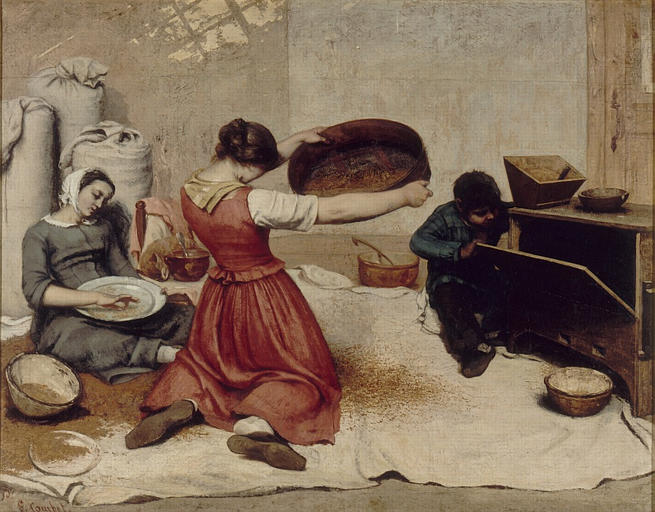
Die Kornsieberinnen
Les Cribleuses de blé
Kann ich es sehen?
Unbekannt
Wo ist „Die Kornsieberinnen“ heute? Sammlung: Musée des Beaux-Arts de Nantes, Nantes. Unbekannt.
Nantes, Frankreich
Der Besitzer ist bekannt; ob das Werk derzeit ausgestellt ist, nicht.
- Unverändert seit
- Quelle
- Das Museum
Angaben
- Inventarnummer
- 874
Im Katalog
Quellen
- Musée des Beaux-Arts de Nantes
- Bild: Musée des Beaux-Arts de Nantes — Gérard Blot; Ministère de la Culture (France), base Joconde
Im Leben von Gustave Courbet
Das ganze Leben1855
Stages the “Pavilion of Realism”
Refusing to accept the jury's decision, Courbet asked museums and private owners to lend his paintings, had a separate building erected and showed about forty canvases there, without state permission, under the Second Empire. The public was baffled and laughed at the “crude art”, and the critics mocked him; the paintings were appreciated by Delacroix and Baudelaire.
1855
The “Realist Manifesto” in the exhibition catalogue
The catalogue of the Pavilion of Realism opened with a manifesto in which Courbet claimed the right to artistic freedom and the right to show his works to the public on his own. He defined his aim as conveying the customs, ideas and appearance of his time, to be not only a painter but a man as well: to “create living art”.
1855
The Exposition Universelle jury turns down three paintings
Courbet submitted fourteen paintings to the Salon of 1855, part of the Exposition Universelle; three were rejected “for lack of space”, among them the monumental “A Burial at Ornans” and “The Artist's Studio”.
1855
Empress Eugénie before “The Bathers”
According to Proudhon's recollection, Empress Eugénie, visiting the Pavilion of Realism, stopped before Courbet's “Bathers”, with its robustly peasant-like nude body shown without the usual idealization, and exclaimed, “Is this a Percheron too?” She had just been looking at Rosa Bonheur's “Horse Fair”.