 Nicolas PoussinFrankreich, 1594–1665
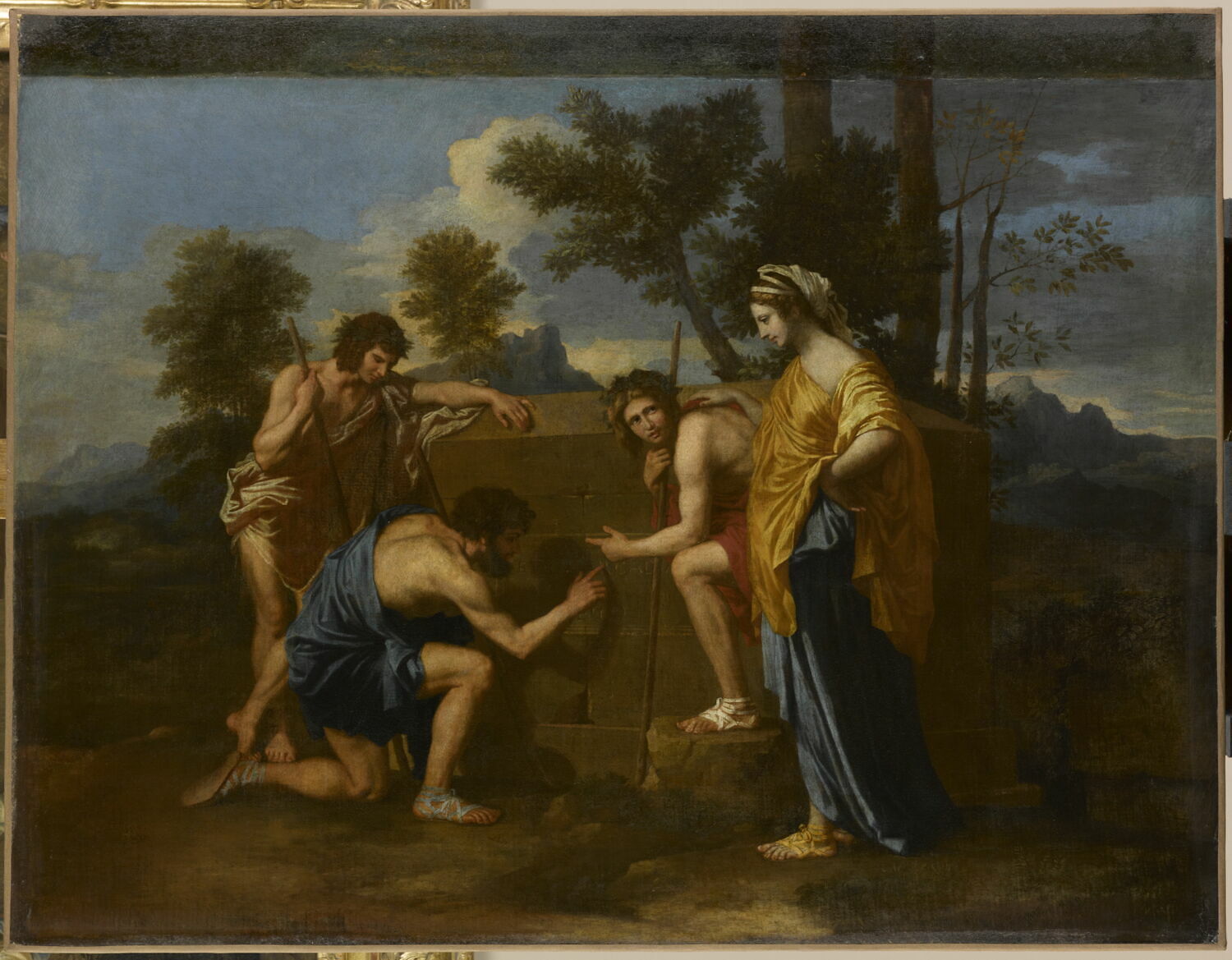
Les Bergers d'Arcadie
Darf man es sehen?
Ja, es empfängt Besucher

Öffentlich ausgestellt.
- Geprüft
- Unverändert seit
- Quelle
- Das Museum
Über das Gemälde
Et in Arcadia ego ist eine lateinische Phrase. Ihre Bedeutung ist umstritten. Die sprachlich näherliegende Übersetzung „Auch ich (bin) in Arkadien“ wurde im Verlauf der Rezeptionsgeschichte mehr und mehr verdrängt durch die Fassung „Auch ich (war) in Arkadien“.
Mehr lesen
Die Phrase findet sich zum ersten Mal in dem gleichnamigen Gemälde des italienischen Barockmalers Giovanni Francesco Barbieri, gen. Guercino. Dort steht sie auf einem Mauerstück geschrieben, auf dem ein Totenkopf liegt. Die Komposition ist gleichsam ein Stillleben mit den Hirten als Betrachter im Bild. Durch die zugrunde liegende ikonographische Tradition ist der Totenkopf als symbolische Repräsentation des Todes definiert. Die Worte sind somit ein Ausspruch des Todes („mich gibt es auch in Arkadien“) und von der Art des Memento Mori („Bedenke, dass du sterben musst“): sie mahnen die beiden Hirtenjungen inmitten dieses Idylls an den Tod, der eben auch Arkadien nicht verschont.
In zwei Gemälden mit dem Namen Die Hirten von Arkadien hat der französische Barockmaler Nicolas Poussin das Thema aufgegriffen, aber durch Eingriffe in die Komposition wesentlich weiter entwickelt. Die auffälligste Veränderung Poussins ist, dass das Mauerstück durch einen Sarkophag ersetzt ist. Die Deutung beider Gemälde, besonders des zweiten, ist umstritten. Manche Interpreten nehmen an, dass bei Poussin nunmehr nicht der Tod, sondern der Tote als Sprecher der Phrase zu denken sei und damit ein Bezugswechsel des et (auf ego statt auf Arcadia) einhergehe.
Angaben
- Inventarnummer
- INV 7300
Im Katalog
Quellen
- Louvre
- Bild: Louvre — © 2011 GrandPalaisRmn (musée du Louvre) / Stéphane Maréchalle
Derweil im Leben von Nicolas Poussin
Das ganze Leben1624–1640
Domenichino’s academy, anatomy, measuring ancient statues
He resumed his study of anatomy with the surgeon Larchet, drew models at Domenichino’s academy, worked in the open air and measured ancient statues — on the back of the drawing “The Victory of Joshua” survive his measurements of the Apollo Belvedere; unlike many, he did not “restore” the lost fragments of antiques. In his Roman years he began to learn modelling, made wax models, arranged them in the order he wanted on a board, and copied Titian’s “Bacchanal” — in oil and as a bas-relief together with one of the Duquesnoy brothers.
1630s
Cassiano dal Pozzo — his chief patron
Poussin’s flowering coincided with his complete abandonment of church commissions: he gathered a circle of patrons around him but strove for independence, accepting commissions from connoisseurs without binding himself to any of them permanently. The most important was Cassiano dal Pozzo; in the surviving correspondence the relationship comes close to servitude, although the painter did not live in his house.
1630s
Brother-in-law Gaspard Dughet — his first pupil
After the wedding Poussin went on living in the house on the Via Paolina; with him lived Anne-Marie’s brother Gaspard Dughet, the future well-known landscape painter, and from 1636 his younger brother Jean. Poussin became Gaspard’s first teacher, and Gaspard later took his surname; the marriage seems to have been a happy one, but childless.
1639
Begins his correspondence with Paul Fréart de Chantelou
From 1639 until the painter’s death runs his correspondence with the court counsellor and royal maître d’hôtel Paul Fréart de Chantelou — a monument of long friendship and the chief source on Poussin’s daily occupations; the letters are in French and make no literary claims.
1640
December 1640: Poussin returns to Paris
François Sublet de Noyers, Superintendent of the King’s Buildings, whose invitations Poussin had declined, sent his cousins Roland and Paul Fréart to Rome, offering the title of First Painter to the King and a substantial residence at the Tuileries. Poussin yielded, and in December 1640 he was back in Paris.