Henri RousseauFrankreich, 1844–1910
L'enfant à la poupée
Darf man es sehen?
Unbekannt
Paris, Frankreich
Der Besitzer ist bekannt; ob das Werk derzeit ausgestellt ist, nicht.
- Unverändert seit
- Quelle
- Das Museum
Angaben
- Inventarnummer
- RF 1963-29
Was es zeigt
Im Katalog
Quellen
- Musée de l’Orangerie
- Bild: Musée de l’Orangerie — © C. Jean ; Réunion des musées nationaux - utilisation soumise à autorisation; Ministère de la Culture (France), base Joconde
Derweil im Leben von Henri Rousseau
Das ganze Leben1893–1910
A studio in Montparnasse
In 1893 Rousseau moved to a studio in Montparnasse, where he lived and worked until his death in 1910.
1903
Widowed again
The second marriage did not last: already in 1903 Rousseau was widowed again.
1905
“The Hungry Lion” beside the Fauves
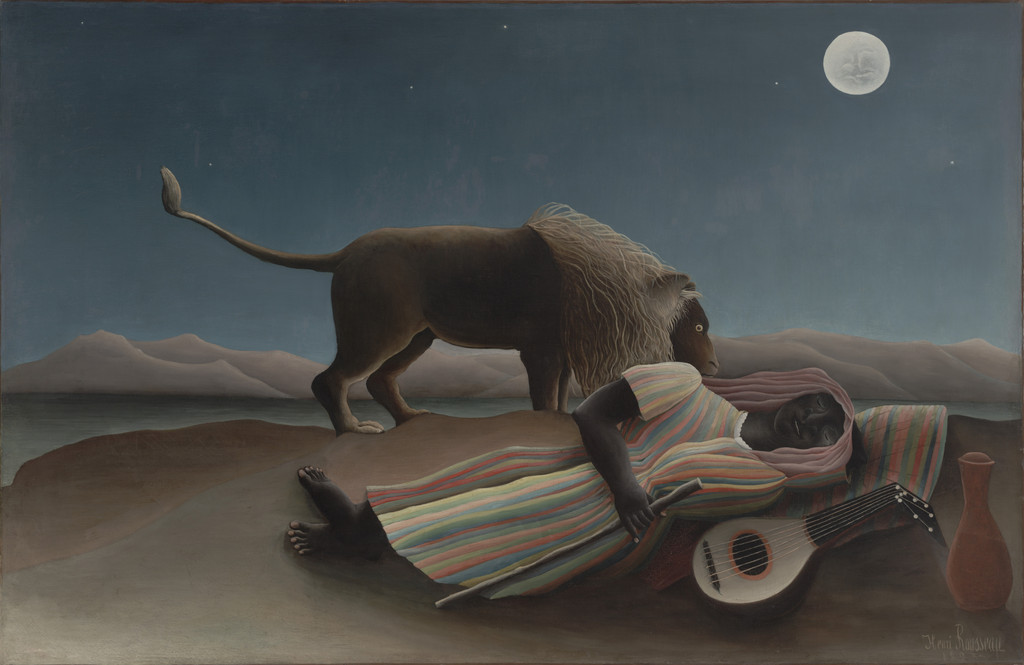
In 1905 “The Hungry Lion” was shown at the Salon d’Automne beside paintings by the Fauves Matisse, Vlaminck and Derain; this is when the attitude of the mass of critics to Rousseau’s work turned.
after 1905
Vollard buys his works
After “The Hungry Lion” was shown, Ambroise Vollard, France’s leading dealer in modern art, bought several of Rousseau’s works.
after 1905
Exotic scenes without travel: the Botanical Garden
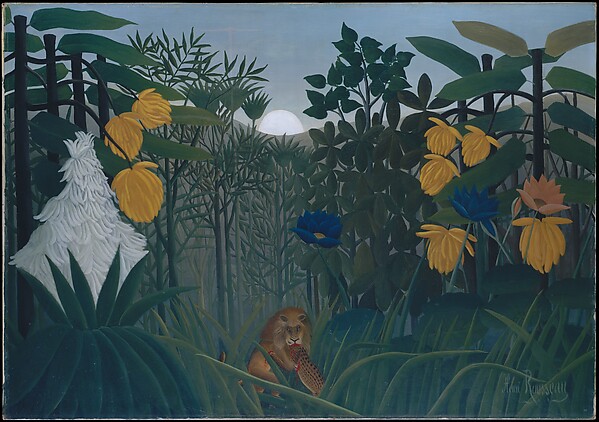
Rousseau never left France, yet his exotic canvases became especially prominent after 1905: to render foliage accurately he studied plants in the Paris Botanical Garden, and he often copied figures from magazine illustrations and postcards.
1907
A commission from Countess Delaunay: “The Snake Charmer”
In 1907 Berthe, Countess Delaunay, mother of the painter Robert Delaunay, commissioned “The Snake Charmer” from Rousseau.