 TitianItalien, 1490–1576
Ländliches Konzert
Le Concert champêtre
Darf man es sehen?
Empfängt derzeit nicht

Louvre
Paris, Frankreich
Es gehört zur Sammlung, ist derzeit aber nicht ausgestellt.
- Geprüft
- Unverändert seit
- Quelle
- Das Museum
Über das Gemälde
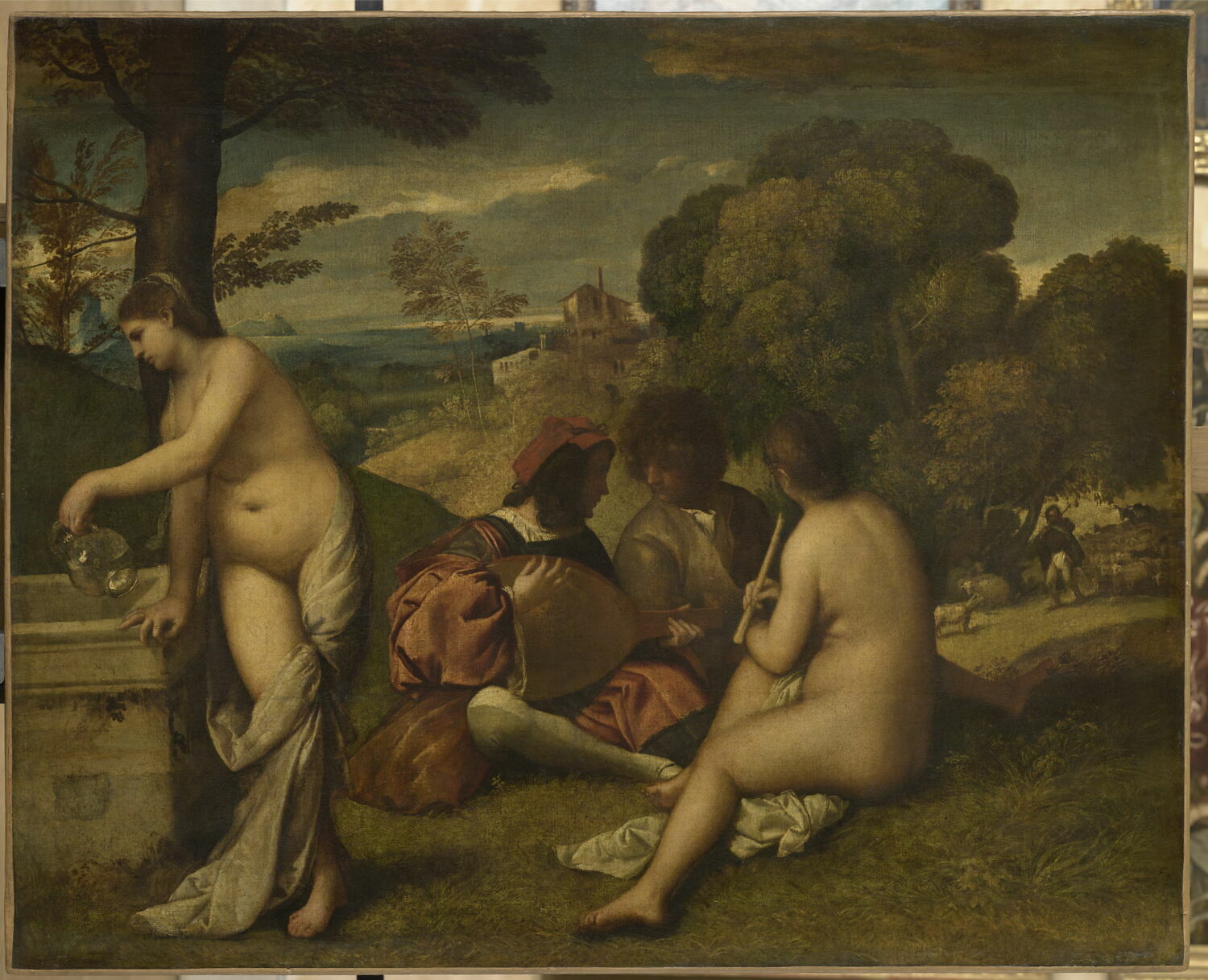
The Pastoral Concert or Le Concert Champêtre is an oil painting of c. 1509 attributed to the Italian Renaissance master Titian. It was previously attributed to his fellow Venetian and contemporary Giorgione. It is located in the Musée du Louvre in Paris.
This painting was created between approximately 1509 and 1510; the exact date of its creation is unknown. This period also represents a turbulent period of history in Venice, specifically the League of Cambrai's War in 1509. Art historian Jonathan Unglaub suggests that this painting was painted in response to the war, providing an "idyllic refuge from the ravages of history."
Weiterlesen
The term "Concert Champêtre" was first used in 1754 by Nicolas Bernard Lépicié, to describe this painting. But when it entered the Louvre in 1792 it was given the title of a Fête champêtre, a genre arguably based on this painting. It is believed to display the Renaissance admiration of classical poetry, an essential value of humanism. This painting is also considered the origin of a genre of Pastoral paintings, because of its connection to pastoral poetry, as seen by the young men gathering in the Italian countryside's lush, picturesque greenery. The pastoral concert or Fête Champêtre genre is described as a gathering in a picturesque landscape. Usually, young men are gathered together in a creative pursuit, seated on the landscape's grass. The paintings themselves are almost always allegories or depictions of mythological characters. This is the 16th-century genre; in the French-led 18th-century type, women are very prominent.
This painting is an example of the Venetian school of Italian Renaissance art. Paintings from Venice are characterized as having rich color schemes that create a "warm glow" and emphasize naturalism above all else. Venetian paintings also have a specialty in mythological and allegorical themes. The unique use of color is known as colorito, and it was most often found in Venetian painting.
The patronage of this painting remains unknown. Isabella d'Este is a possible candidate for patron due to a so-called bagno scene she commissioned for her brother Alfonso I d'Este, Duke of Ferrara. Still, the word bagno is considered to describe a painting by Palma Vecchio, another Venetian painter active during the same period.
Angaben
- Inventarnummer
- INV 71
Im Katalog
Quellen
- Louvre
- Bild: Louvre — © 2016 GrandPalaisRmn (musée du Louvre) / Michel Urtado
Derweil im Leben von Titian
Das ganze Lebenc. 1500
Leaves for Venice as a boy: apprentice to Zuccato
According to Ludovico Dolce, the boy was sent at the age of nine, with his brother Francesco, to live with an uncle in Venice and apprentice to Sebastiano Zuccato; leaving Zuccato, he briefly transferred to the studio of Gentile Bellini. Vasari tells it differently, with Titian studying first under Giovanni Bellini, and there is no documentation of his work before 1510.
1510
Giorgione dies; Titian finishes his paintings
In 1510 the plague raging in Venice took the life of Giorgione. Titian finished the pictures his friend had left incomplete, for example the “Sleeping Venus” and the “Pastoral Concert”, and, as is generally accepted, emerged from his shadow only after this death.
31 May 1513
A petition to the Council of Ten: a battle canvas and a sansaria
On 31 May 1513 Titian petitioned the Council of Ten for a commission to paint a great battle scene for the Doge's Palace (completed only in 1538) and for the next available sansaria, a broker's patent at the Fondaco dei Tedeschi worth 120 ducats a year. The request was granted but reversed in March 1514, and he did not obtain the patent upon Bellini's death in late 1516; the appointment was withheld until 1523.
1516–1517
First Painter of the Republic of Venice
After the death of Giovanni Bellini, the “patriarch of Venetian painting”, in November 1516 Titian was given the title of First Painter of the Republic (he had petitioned for the post as early as 1513). The title carried a decent salary but obliged him to paint portraits of newly elected doges for a symbolic fee; Titian kept it until his death.
1525
Marries Cecilia, the mother of his sons
Cecilia, a barber's daughter from Pieve di Cadore, had been Titian's housekeeper and for some five years his mistress, and had already borne him two sons, Pomponio and Orazio. In 1525, when she fell seriously ill, Titian married her to legitimise the children; Cecilia recovered, and the marriage was a happy one.
1527
Aretino, Sansovino and the “triumvirate”
In March 1527 the satirist Pietro Aretino arrived in Venice: he became friends with Titian and with Jacopo Sansovino, and the three were popularly known as “the triumvirate”, becoming the centre of the city's artistic establishment. Aretino enlisted both in pursuing the patronage of Federico II Gonzaga, and by the autumn of 1527 the Marquis of Mantua had received from Titian a portrait of Aretino (lost); important commissions and an introduction to Emperor Charles V followed.