 Pietro PeruginoItalien, 1448–1523
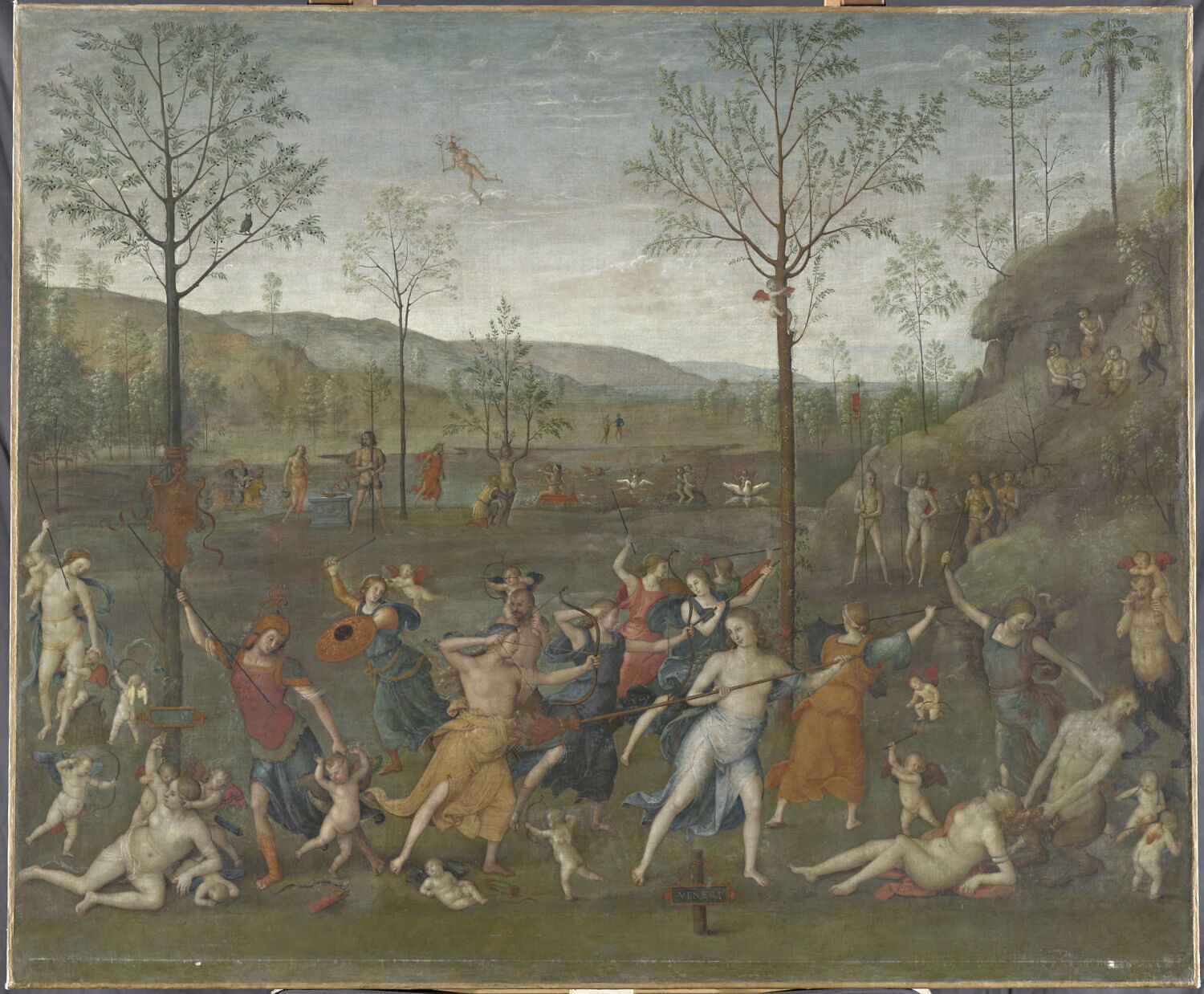
Le Combat de l'Amour et de la Chasteté
Kann ich es sehen?
Ja, derzeit ausgestellt
Wo ist „Le Combat de l'Amour et de la Chasteté“ heute? Louvre, Salle 710, Aile Denon, Niveau 1, Paris. Ja, derzeit ausgestellt. Geprüft 26. September 2026.

Geschlossen· öffnet um 9:00
Öffentlich ausgestellt.
- Geprüft
- Unverändert seit
- Quelle
- Das Museum
Über das Gemälde
Der Kampf zwischen Liebe und Keuschheit (fr. Le Combat de l’Amour et de la Chasteté) ist ein Gemälde in Tempera auf Leinwand von Pietro Perugino (* um 1450; † 1523), fertiggestellt 1505 und im Bestand der Gemäldegalerie des Louvre in Paris.
Das Gemälde ist eines der wenigen erhaltenen Werke des Meisters mit einem Thema aus der Mythologie. Es ist auch deswegen bemerkenswert, weil Kontaktaufnahme zum Künstler durch die Auftraggeberin, Vertragsabschluss, wiederholte Anmahnung der Lieferung sowie die Reaktion der Auftraggeberin nach Erhalt des Bildes außergewöhnlich detailliert dokumentiert sind.
Angaben
- Inventarnummer
- INV 722
Im Katalog
Quellen
- Louvre
- Bild: Louvre — © 2025 GrandPalaisRmn (musée du Louvre) / Didierjean/Chan-Liat
Im Leben von Pietro Perugino
Das ganze Leben1486–1499
Two studios: in Florence and in Perugia
Between 1486 and 1499 Perugino works mainly between Florence and Perugia, maintaining a studio in each city. In the 1480s and 1490s he is one of the most celebrated artists of Italy.
1504
On the commission to site Michelangelo's “David”
Perugino sits on the commission of artists charged with choosing the site for Michelangelo's David.
1506
Leaving Florence for good
After a series of failures and the loss of his pupils, Perugino leaves Florence for good in 1506 and goes to Perugia, and from there, a year or two later, to Rome.
1507–1508
Julius II summons him to Rome: the Stanza dell'Incendio
Pope Julius II summons Perugino to paint the Stanza dell'Incendio del Borgo in the Vatican, but soon prefers a younger competitor, Raphael, who had been trained by Perugino. Perugino manages to paint the ceiling with figures of God the Father in different glories in five medallions.
1523
Death from the plague; the grave unknown
Perugino dies of the plague at Fontignano; like other plague victims he is hastily buried in an unconsecrated field, the precise spot now unknown. He dies with considerable property, leaving three sons.
1523
Died