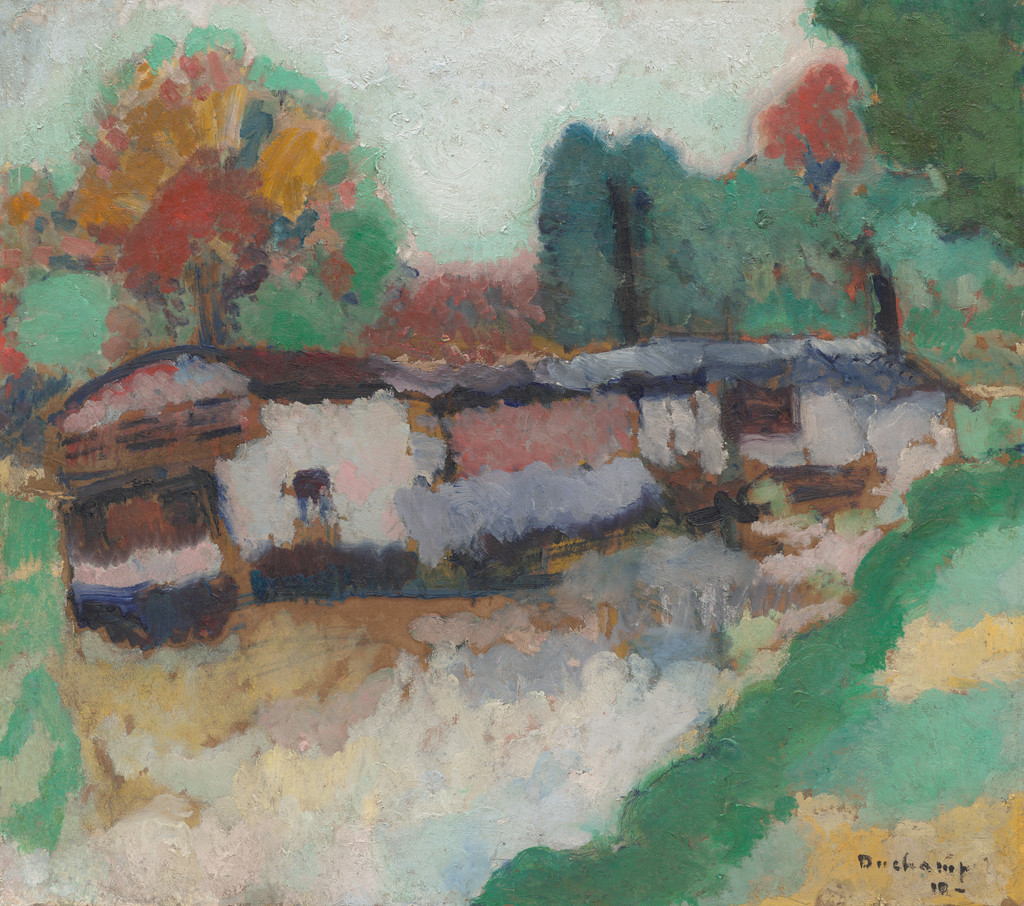
 Marcel DuchampFrankreich, 1887–1968
Laundry Barge
Darf man es sehen?
Empfängt derzeit nicht

Museum of Modern Art
New York City, Vereinigte Staaten
Es gehört zur Sammlung, ist derzeit aber nicht ausgestellt.
- Geprüft
- vor 12 Tagen
- Quelle
- Sammlungsdaten des Museums selbst
Angaben
- Inventarnummer
- 673.1990
Quellen
- Museum of Modern Art: the museum's own open data · abgerufen vor 12 Tagen
- Bild: Museum of Modern Art — © the artist or rights holder
Derweil im Leben von Marcel Duchamp
Das ganze LebenSeptember 1911
Meeting Francis Picabia
They met at the Salon d’Automne in Paris, where both were exhibiting; Duchamp showed a larger version of his “Young Man and Girl in Spring”. “Our friendship began right there,” he said.
1912
Takes the “Nude” back from the Salon des Indépendants
Through Duchamp’s brothers, Albert Gleizes asked him to withdraw the painting or at least rename it (as Duchamp later told it); he quietly refused, but went straight to the show and took the canvas home by taxi. “It was really a turning point in my life,” he recalled, adding that after this he would not be very much interested in groups.
1912
A stage version of Raymond Roussel
He saw a stage adaptation of Raymond Roussel’s novel Impressions of Africa, with plots that turned in on themselves, word play, surrealistic sets and humanoid machines. He credited it with radically changing his approach to art and inspiring the Large Glass.
1912
Two months in Munich
He painted the last of his Cubist-like paintings, started the image of The Bride Stripped Bare by Her Bachelors, Even and began scribbling plans for the Large Glass, which would take more than ten years to complete. He walked to Munich’s Alte Pinakothek every day, where he was struck by the works of Lucas Cranach the Elder, while the friend he visited kept showing him the sights and the nightlife.
autumn 1912
“La Maison Cubiste” and the Section d’Or exhibition
Despite the affair of the Nude, he took part in André Mare’s La Maison Cubiste at the 1912 Salon d’Automne, signed the invitation to the Section d’Or exhibition and exhibited in it in the fall of the same year.
November 1912 · Ausbildung
École des chartes