 Georges SeuratFrankreich, 1859–1891
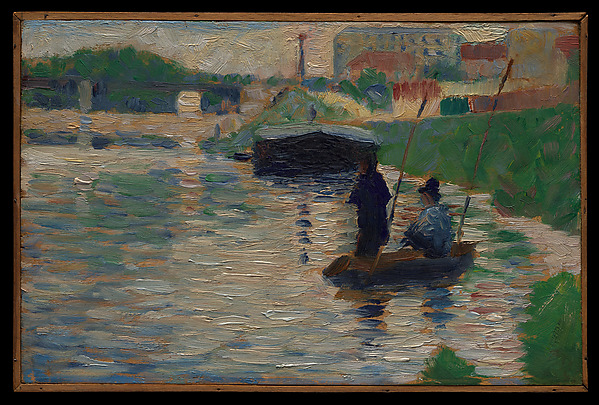
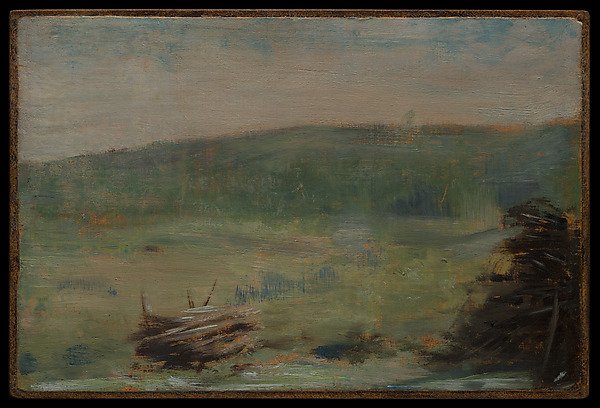
Landscape at Saint-Ouen
Kann ich es sehen?
Ja, derzeit ausgestellt
Wo ist „Landscape at Saint-Ouen“ heute? Metropolitan Museum of Art, Saal 825, New York City. Ja, derzeit ausgestellt. Geprüft 29. September 2026.

New York City, Vereinigte Staaten
Jetzt geöffnet· bis 21:00
Öffentlich ausgestellt.
- Geprüft
- Unverändert seit
- Quelle
- Das Museum
Angaben
- Inventarnummer
- 1980.342
Was es zeigt
Im Katalog
Quellen
- Metropolitan Museum of Art
- Bild: Metropolitan Museum of Art — Open Access (CC0)
Im Leben von Georges Seurat
Das ganze Leben1878
From Lequien's school to the École des Beaux-Arts
Having begun at the École Municipale de Sculpture et Dessin run by the sculptor Justin Lequien near his family's home, in 1878 Seurat moves on to the École des Beaux-Arts, where he is taught by Henri Lehmann: he draws from casts of antique sculpture and copies drawings by old masters. His studies yield a well-considered and fertile theory of contrasts, to which all his later work is subjected.
November 1879 – 1880
A year of infantry service at Brest
In November 1879 Seurat leaves the École des Beaux-Arts for a year of military service: he undergoes infantry training with the 19th Line Regiment, stationed at Brest. In 1880 he returns to Paris.
1880–1882
A studio with Aman-Jean and two years of monochrome drawing
Back in Paris, Seurat shares a studio with his friend Aman-Jean while renting a small apartment at 16 rue de Chabrol; for the next two years he works at mastering the art of monochrome drawing and studies Eugène Delacroix carefully, making notes on his use of colour.
1880s
Charles Henry's lectures at the Sorbonne
In the 1880s Seurat hears lectures by the mathematician Charles Henry at the Sorbonne on the emotional properties and symbolic meaning of lines and colour; there remains controversy over how far he adopted Henry's ideas.
1880s
The colour theorists: Chevreul, Rood, Blanc
Seurat finds the idea of separate strokes of pure colour that blend optically in the viewer's eye in “Modern Chromatics” (1879) by the American physicist Ogden Rood and in the chemist Michel Eugène Chevreul's work on the law of simultaneous contrast of colours; according to his friends, his bedside book is Charles Blanc's “Grammaire des arts du dessin” (1867).