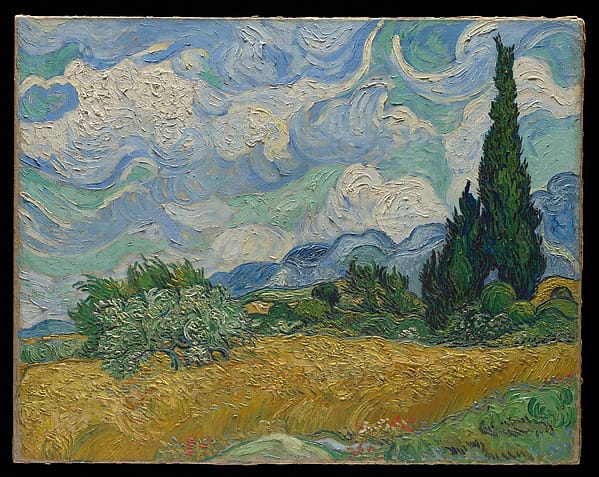
Henri Edmond CrossFrankreich, 1856–1910
La Promenade
Kann ich es sehen?
Derzeit nicht ausgestellt
Wo ist „La Promenade“ heute? Sammlung: National Gallery of Art, Washington, D.C. Derzeit nicht ausgestellt. Geprüft 29. September 2026.

Washington, D.C., Vereinigte Staaten
Es gehört zur Sammlung, ist derzeit aber nicht ausgestellt.
- Geprüft
- Unverändert seit
- Quelle
- Das Museum
Angaben
- Inventarnummer
- 1963.11.86
Was es zeigt
Im Katalog
Quellen
- National Gallery of Art
- Bild: National Gallery of Art — Museum open access
Im Leben von Henri Edmond Cross
Das ganze Leben1890s
Meets Fénéon, Gide and Verhaeren
In the 1890s he works alongside Signac and gets to know the writers and critics Félix Fénéon, André Gide and Emile Verhaeren.
c. 1895
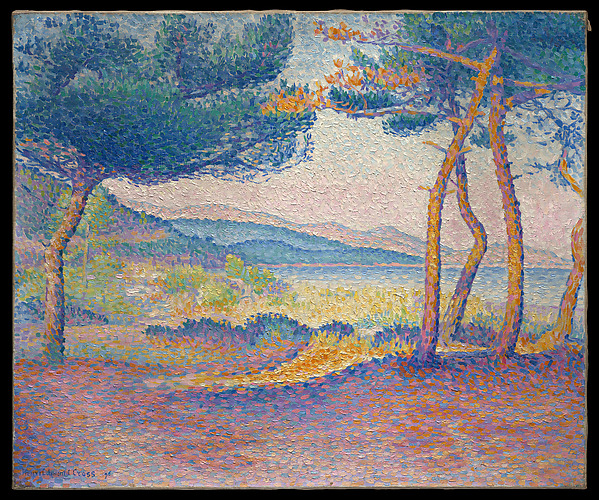
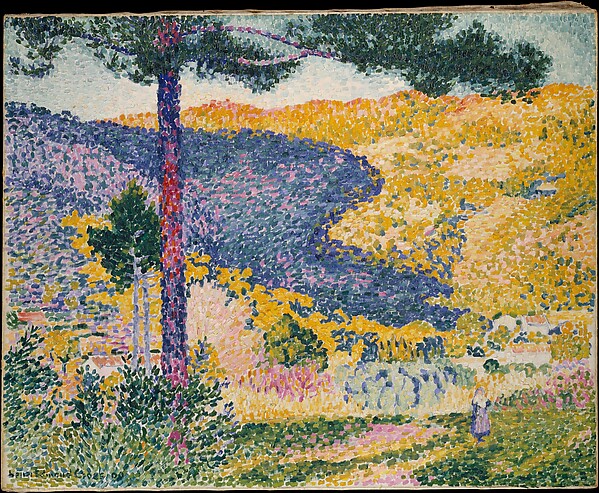
Moves from Pointillism to a mosaic-like brushstroke
From about 1895 he gradually changes his technique: instead of tiny dots, broad blocky brushstrokes with small areas of bare canvas left between them. The surfaces resemble mosaics, and such paintings are seen as precursors of Fauvism and Cubism.
1895
Shows at La Libre Esthétique at Maus’s invitation
Octave Maus, who had earlier invited him to the annual exhibitions of Les XX, invites him to the Libre Esthétique show; Cross takes part again in 1897, 1901, 1904, 1908 and 1909.
1896
Lithograph “The Wanderer” for an anarchist journal
The lithograph “L’Errant” (“The Wanderer”), his first work with a publisher, appeared anonymously in Jean Grave’s anarchist journal Les Temps Nouveaux. Like Signac and Pissarro, Cross held anarchist principles, and they shaped his choice of subjects — scenes of a utopian world.
1898
The first Neo-Impressionist exhibition in Germany
In 1898, together with Signac, Maximilien Luce and Théo van Rysselberghe, he takes part in the first Neo-Impressionist exhibition in Germany, organized by Harry Kessler at the Keller und Reiner Gallery.



![Ginevra de' Benci [obverse], Leonardo da Vinci, c. 1474/1478](https://api.nga.gov/iiif/8f29e3c9-a289-4d53-abf0-31a66e9e98fa/full/!2400,2400/0/default.jpg)
![Wreath of Laurel, Palm, and Juniper with a Scroll inscribed Virtutem Forma Decorat [reverse], Leonardo da Vinci, c. 1474/1478](https://api.nga.gov/iiif/ff62e8d0-45c4-498f-ad36-6358de827e04/full/!2400,2400/0/default.jpg)