 Bernard, EmileFrankreich, 1868–1941
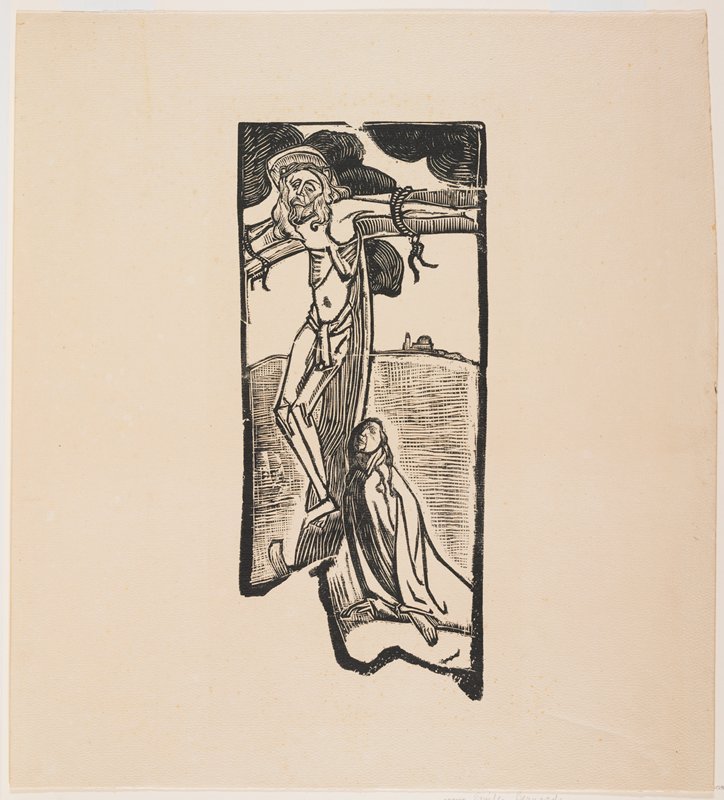
La Crucifixion
Darf man es sehen?
Empfängt derzeit nicht

Minneapolis Institute of Art
Minneapolis, Vereinigte Staaten
Es gehört zur Sammlung, ist derzeit aber nicht ausgestellt.
- Geprüft
- Unverändert seit
- Quelle
- Sammlungsdaten des Museums selbst
Über das Werk
Although produced in the spirit of a medieval woodcut, Émile Bernard's print is deceptively original. He achieved a primitive look by carving the coarse, unruly side-grain of a wood plank rather than the smoother end-grain, unheard of for a 19th-century artist. The narrow format borrows from Japanese hashira-e prints, which hung on pillars. And his angular, elongated Christ seems to prefigure German Expressionism. Using ropes on the cross was also novel; artists had switched to nails in the Middle Ages because they produced more blood.
Minneapolis Institute of Art
Angaben
- Inventarnummer
- P.71.113
Im Katalog
Quellen
- Minneapolis Institute of Art: die offenen Daten des Museums · abgerufen vor 8 Tagen
- Bild: Minneapolis Institute of Art — © Minneapolis Institute of Art
Derweil im Leben von Bernard, Emile
Das ganze Leben1887–1888
An exhibition in the restaurant on the Avenue de Clichy
Back in Paris, Bernard attends the Académie Julian and meets van Gogh, who is impressed by his work. He finds a restaurant on the Avenue de Clichy where his work is shown alongside that of van Gogh, Anquetin and Toulouse-Lautrec; van Gogh calls the group the “School of the Petit Boulevard”.
1888
On foot to Pont-Aven: friendship with Gauguin
A year later Bernard again sets out for Pont-Aven on foot and sees Gauguin; their friendship and artistic partnership quickly grow strong. Bernard wants an art of the most extreme simplicity, accessible to all and practised collectively, and Gauguin is impressed by his ability to put his ideas into words. Other accounts have him living in Pont-Aven in 1886–1888 and joining the Pont-Aven group.
1890
A religious crisis and a turn to the Middle Ages
In 1890 Bernard goes through a religious crisis and turns to the subjects and themes of medieval art. In the same year he sets out to revive symbolism, which he saw as Christian in essence — the invisible expressed through the visible.
1891
The break with Gauguin
In 1891 Bernard breaks off his friendship with Gauguin. It was always his great frustration that Gauguin never named him as an influence on pictorial symbolism; one writer says his rivalry with Gauguin led him “out of spite” towards classicism.
1891
Among the Symbolists and the Nabis
In 1891 Bernard joins the group of Symbolist painters that includes Odilon Redon and Ferdinand Hodler, and in the same year becomes a member of the Nabis.
1893–1903
Journeys through Egypt, Italy and Spain
From 1893 to 1903 Bernard travels in Egypt, Italy and Spain, painting mostly religious and Symbolist canvases, and his style grows more eclectic. One writer holds that it was in the Middle East, in a period of great crisis, that he turned to classicism.