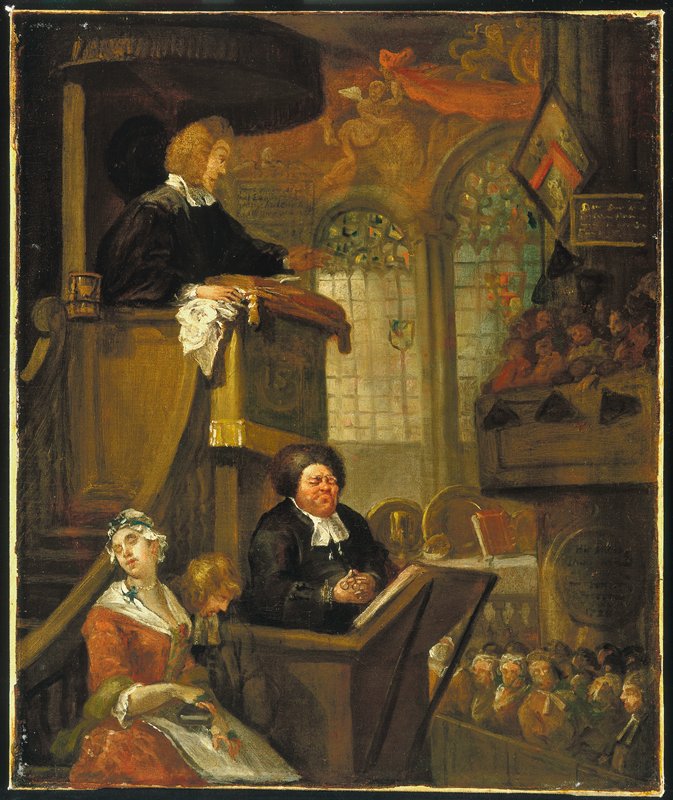
William HogarthEngland, 1697–1764
Koor van zingende mannen
Darf man es sehen?
Unbekannt: Das Museum schweigt sich aus

Rijksmuseum Amsterdam
Amsterdam, Niederlande
Der Eigentümer ist bekannt. Ob es heute ausgestellt ist, sagt das Museum nicht, und Raten haben wir nicht gelernt.
- Quelle
- Sammlungsdaten des Museums selbst
Über das Werk
In the museum's own words — the original
Tekst in het Engels op de papieren met bladmuziek. De heren repeteren 'Judith' door William Huggins met muziek door William Defesch dat werd uitgevoerd op 16 februari 1732.
Rijksmuseum Amsterdam
Angaben
- Inventarnummer
- RP-P-OB-18.716
What it shows
Im Katalog
Quellen
- Rijksmuseum Amsterdam: the museum's own open data · abgerufen vor 6 Tagen
- Bild: Rijksmuseum Amsterdam — public domain
Derweil im Leben von William Hogarth
Das ganze Lebenchildhood
A poor family and his father’s debtors’ prison
William was born in Bartholomew Close in London, the first surviving child of the poor Latin teacher Richard Hogarth and Anne Gibbons; his father’s scheme of a Latin-speaking coffee house failed and he spent five years in the Fleet debtors’ prison, while the boy had to sell folk remedies his mother prepared. He disliked school but drew tirelessly, sketching street scenes and the characters of London’s fairs, and never spoke of his father’s imprisonment.
1712–1764 · Wirkungsort
London
1713
Apprentice to the engraver Ellis Gamble
In 1713, without finishing primary school, Hogarth became an apprentice to the silver engraver Ellis Gamble in Leicester Fields, where he learned engraving and metalwork, trade cards and similar wares, and first met the Rococo style. He never completed the apprenticeship.
1718
His father’s death: Hogarth supports his mother and sisters
In 1718 his father died, and William, the eldest child, had to support his mother and two sisters by taking small commissions — commercial visiting cards, small coats of arms and other trifles. He found the work stupid and dull: he longed for high art, and above all for graphic art.
until April 1720
His own engraving workshop
By April 1720 Hogarth was an engraver in his own right: he opened a small workshop, at first engraving coats of arms and shop bills and designing plates for booksellers.
23 March 1729
A secret wedding to Jane Thornhill
Not hoping for Sir James’s consent — he saw the match as unequal, Hogarth being a rather obscure artist then — William and Jane married in secret at Paddington Church. Jane and her mother helped to reconcile him with his father-in-law: they hung the first paintings of “A Harlot’s Progress” in his house, and on learning the artist’s name Sir James admitted that a man who could produce such pictures could also keep a wife without a dowry.