 David HockneyVereinigtes Königreich, 1937–2026
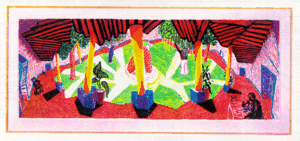
Hotel Acatlan: 2 Weeks Later
Darf man es sehen?
Nein: gestohlen, es wird gesucht
Listed in the FBI's National Stolen Art File under no. 00224.
- Geprüft
- · Gemeldet
- Unverändert seit
- Quelle
- Ein Register gestohlener Kunst
Über das Werk
Image of hotel lobby with red floor, yellow columns, and red/black ceiling.
Angaben
Im Katalog
Quellen
- Die Datei gestohlener Kunst des FBI
- Bild: FBI National Stolen Art File
Derweil im Leben von David Hockney
Das ganze Leben1980–1983
Designing for the Metropolitan Opera
In 1980 Hockney agrees to design sets and costumes for a French triple bill at the Metropolitan Opera — Satie’s “Parade”, Poulenc’s “Les Mamelles de Tirésias” and Ravel’s “L’enfant et les sortilèges” — and in 1981 for a second one, of Stravinsky’s “Le sacre du printemps”, “Le rossignol” and “Oedipus Rex”. The reimagined set of “L’enfant et les sortilèges” from the 1983 exhibition “Hockney Paints the Stage” became a permanent installation at the Spalding House branch of the Honolulu Museum of Art.
December 1985
Quantel Paintbox: drawing straight onto the screen
In December 1985 Hockney uses the Quantel Paintbox, a computer that lets the artist sketch directly onto the screen. The resulting work is featured in a BBC series, “Painting with Light”, that profiles several artists.
December 1985
The cover and pages of French Vogue
Hockney is commissioned to design the cover and pages for the December 1985 issue of the French edition of Vogue: for the cover he paints Celia Birtwell from different views, as if the eye had scanned her face diagonally, in keeping with his interest in Cubism and admiration for Picasso.
1987–1994
Operas in Los Angeles, Chicago, London and Mexico City
Hockney designs Wagner’s “Tristan und Isolde” for the Los Angeles Music Center Opera (1987), Puccini’s “Turandot” for the Lyric Opera of Chicago (1991) and Richard Strauss’s “Die Frau ohne Schatten” for the Royal Opera House in London (1992). In 1994 he designs costumes and scenery for twelve opera arias for the TV broadcast of Plácido Domingo’s Operalia in Mexico City.