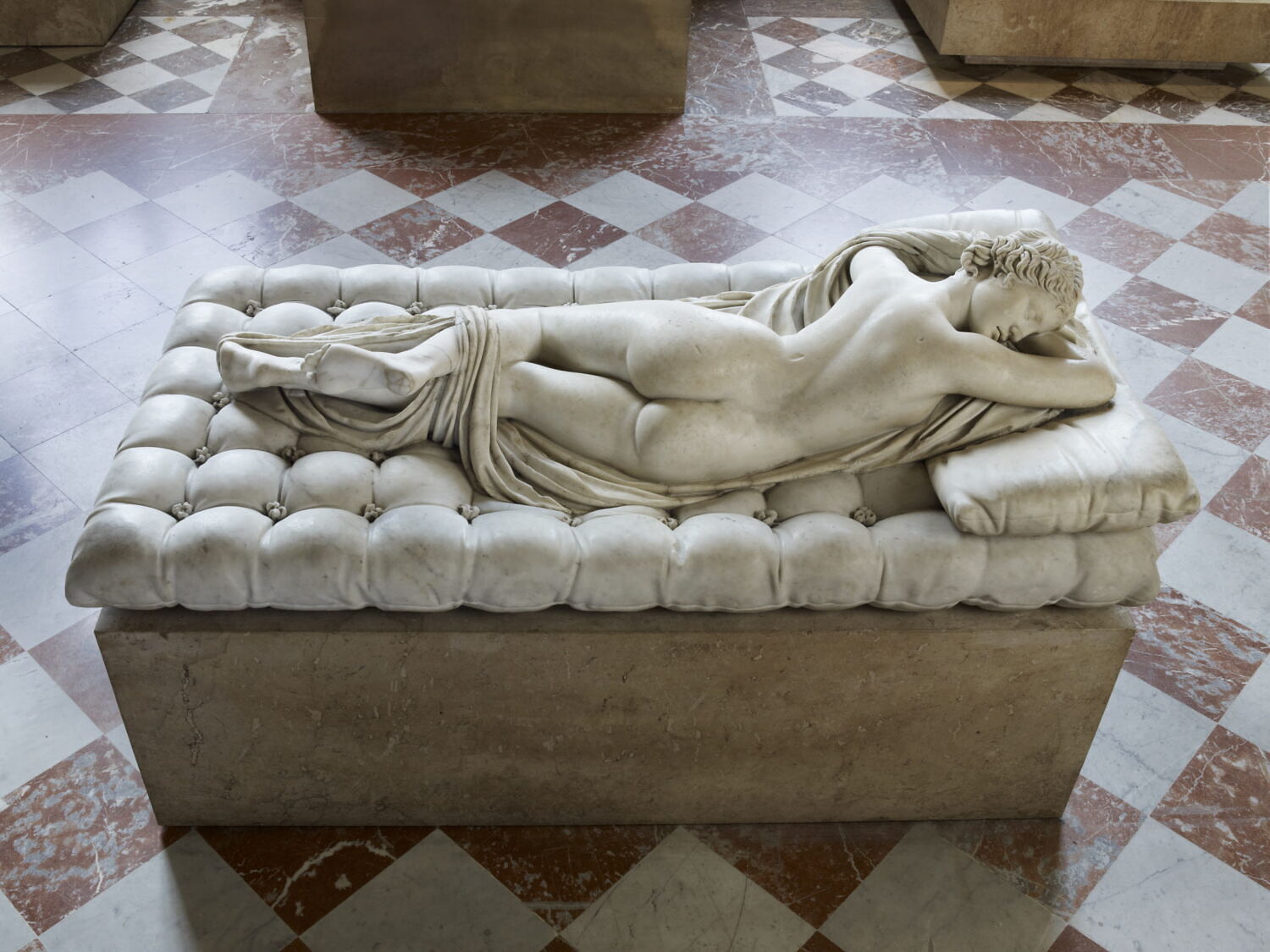
Schlafende Hermaphrodite
Hermaphrodite endormi
Kann ich es sehen?
Ja, derzeit ausgestellt
Wo ist „Schlafende Hermaphrodite“ heute? Louvre, Salle 348, Aile Sully, Niveau 0, Paris. Ja, derzeit ausgestellt. Geprüft 16. November 2026.

Geschlossen· öffnet morgen um 9:00
Öffentlich ausgestellt.
- Geprüft
- Unverändert seit
- Quelle
- Das Museum
Über die Skulptur
Der Schlafende Hermaphrodit, eine römische Skulptur eines unbekannten Bildhauers aus der ersten Hälfte des 2. Jahrhunderts n. Chr. (100–150), befindet sich im Louvre in Paris. Diese Marmorfassung eines griechischen Skulpturentypus zeigt die Figur auf dem Bauch schlafend. Auch die weich wirkende Matratze besteht aus Marmor; Gian Lorenzo Bernini schuf sie 1620. Die Skulptur ist derzeit in Saal 348, Sully-Flügel, Ebene 0, ausgestellt.
Sleeping Hermaphroditus or Sleeping Hermaphrodite (also, "The Borghese Hermaphrodite") is an ancient Roman marble sculpture depicting Hermaphroditus life size; it rests on a marble mattress completed by Italian artist Gian Lorenzo Bernini in 1620. The form is derived from ancient portrayals of Venus and other female nudes, and from feminized Hellenistic portrayals of Dionysus. This subject was widely repeated during the Hellenistic period and in ancient Rome, given the number of versions that have survived.
The sculpture was discovered at Santa Maria della Vittoria in Rome in 1618 and became part of the Borghese Collection. It was sold to France at the end of the 18th century and is currently on display at The Louvre, in Paris.
Mehr lesen
The Sleeping Hermaphrodite has been described as a good early Imperial Roman copy of a bronze original by the later of the two Hellenistic sculptors named Polycles (working c. 155 BC); the original bronze was mentioned in Pliny's Natural History.
Angaben
- Inventarnummer
- MR 220
Im Katalog
Quellen
- Louvre
- Bild: Louvre — © 2011 Musée du Louvre, Dist. GrandPalaisRmn / Thierry Ollivier