ART WIKI32.963 ausgestellt
KarteSammlungKünstlerMuseenAusstellungenJournal
Anmelden

ART WIKI

Wo das Meisterwerk hängt und wann man vorgelassen wird.

Sammlungen: Art Institute of Chicago, Cleveland Museum of Art, Eremitage, Getty Villa, Harvard Art Museums, Hirshhorn Museum and Sculpture Garden, J. Paul Getty Museum, Louvre, Metropolitan Museum of Art, Minneapolis Institute of Art, Museum of Modern Art, National Gallery of Art, National Museum of Asian Art, National Portrait Gallery, Puschkin-Museum, Rijksmuseum Amsterdam, Russisches Museum, Smithsonian American Art Museum, Statens Museum for Kunst, Tretjakow-Galerie, Victoria and Albert Museum, Whitney Museum of American Art, Staatskatalog des Museumsfonds Russlands (274 Museen), Europeana (19 Museen), Wikidata (6 Museen), Paris Musées (12 Museen) und Joconde, die Museumsdatenbank des französischen Kulturministeriums (495 Museen). Die Bilder gehören ihren Rechteinhabern.

Rubriken

  • Karte
  • Suche
  • Sammlung
  • Meisterwerke
  • Jetzt ausgestellt
  • Künstler

Mehr

  • Museen & Galerien
  • Ausstellungen
  • Journal
  • Woher die Daten stammen
  • Datenschutz & Cookies
StartseiteKarteKatalog
  1. Sammlung/
  2. Victoria and Albert Museum/
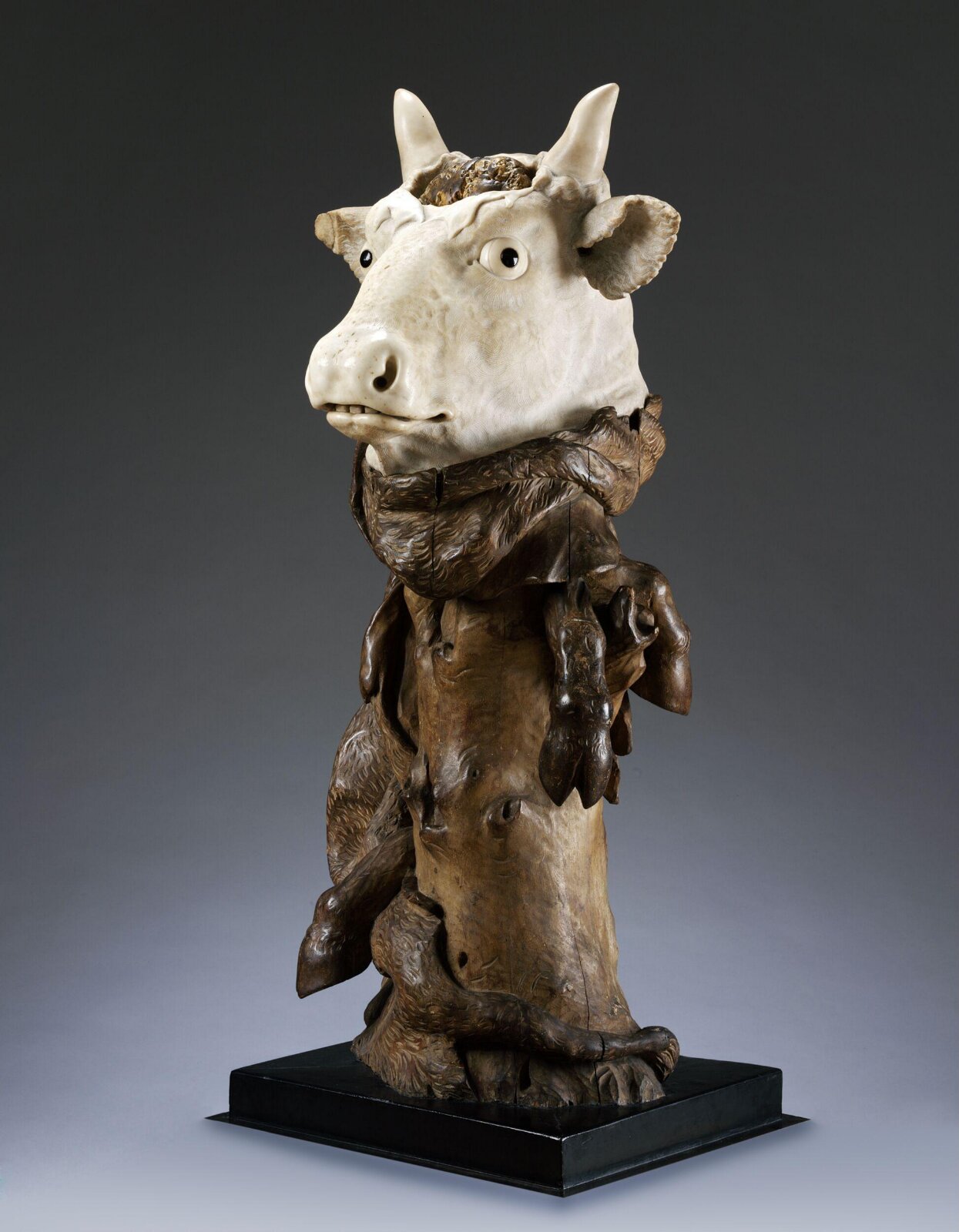
  3. Head of an ox
Head of an ox, 2nd half 17th century

Head of an ox

2nd half 17th century · Statue · 124 × 56 cm

Darf man es sehen?

Ja, es empfängt Besucher

Victoria and Albert Museum

London, Vereinigtes Königreich

SaalEurope 1600-1815, Room 6, The Lisa and Bernard Selz Gallery

Öffentlich ausgestellt. Wer dafür bürgt, steht unten.

Geprüft
vor 12 Tagen
Unverändert seit
25. Sept. 2026
Quelle
Das Museum
Auf der KarteMuseumsseite

Über die Skulptur

This head of an ox, carved in marble and resting on a wooden tree trunk, contains an unusual curiosity. In the centre of the ox's head is a cavity in which rests a 'stone' identified as an osteoma, a new piece of bone growing on another (typically a skull) which was originally thought to be the fossilised or petrified brain of an ox. This may have been based on an event in Padua in 1670, when a hardened mass of bone was discovered inside a slaughtered ox.

The discovery created a sensation, as it was believed that the brain of the animal had become petrified during its lifetime. In 1933, the Natural History Museum confirmed that the huge osteoma displayed here was organic and likely to be a piece of diseased bone from a large mammal, such as an elephant or whale.

Weiterlesen

The sculpture may once have belonged to the Querini family at the Villa Altichiero in Padua, although there is no firm documentary evidence. Its theatricality was typical of the seventeenth-century fascination with naturally occurring oddities, particularly within the context of the noble and scholarly collections, where artistic objects sat alongside the naturalia they sought to emulate. This unusual sculpture, with its varied textures and bizarre subject-matter, would have provided a dramatic talking point.

Victoria and Albert Museum

Angaben

Inventarnummer
60-1882

Was es zeigt

Ox

Im Katalog

SkulpturMarmorPadua

Quellen

  • Victoria and Albert Museum
  • Bild: Victoria and Albert Museum — © Victoria and Albert Museum, London

Nachbarn im Haus: Victoria and Albert Museum

Museumsseite
Bird of Paradise, Hashimoto Chitaka, 2026

Hashimoto Chitaka

Bird of Paradise, 2026

Torsion 2, Taruma Shoko, 2025

Taruma Shoko

Torsion 2, 2025

Fu, Someya Satoshi, 2025

Someya Satoshi

Fu, 2025

Bow Before the Curtain Falls, 2024

Bow Before the Curtain Falls, 2024

Summer, 2024

Summer, 2024

Red Flow, Ishizuka Genta, 2024

Ishizuka Genta

Red Flow, 2024

3D replica of Michelangelo's Prisoner (4117-1854), Factum Arte, 2024

Factum Arte

3D replica of Michelangelo's Prisoner (4117-1854), 2024

Sculpture, ‘Co-Existence – the Man and the Monkey’, Zhao Lin, 2024

Zhao Lin

Sculpture, ‘Co-Existence – the Man and the Monkey’, 2024






