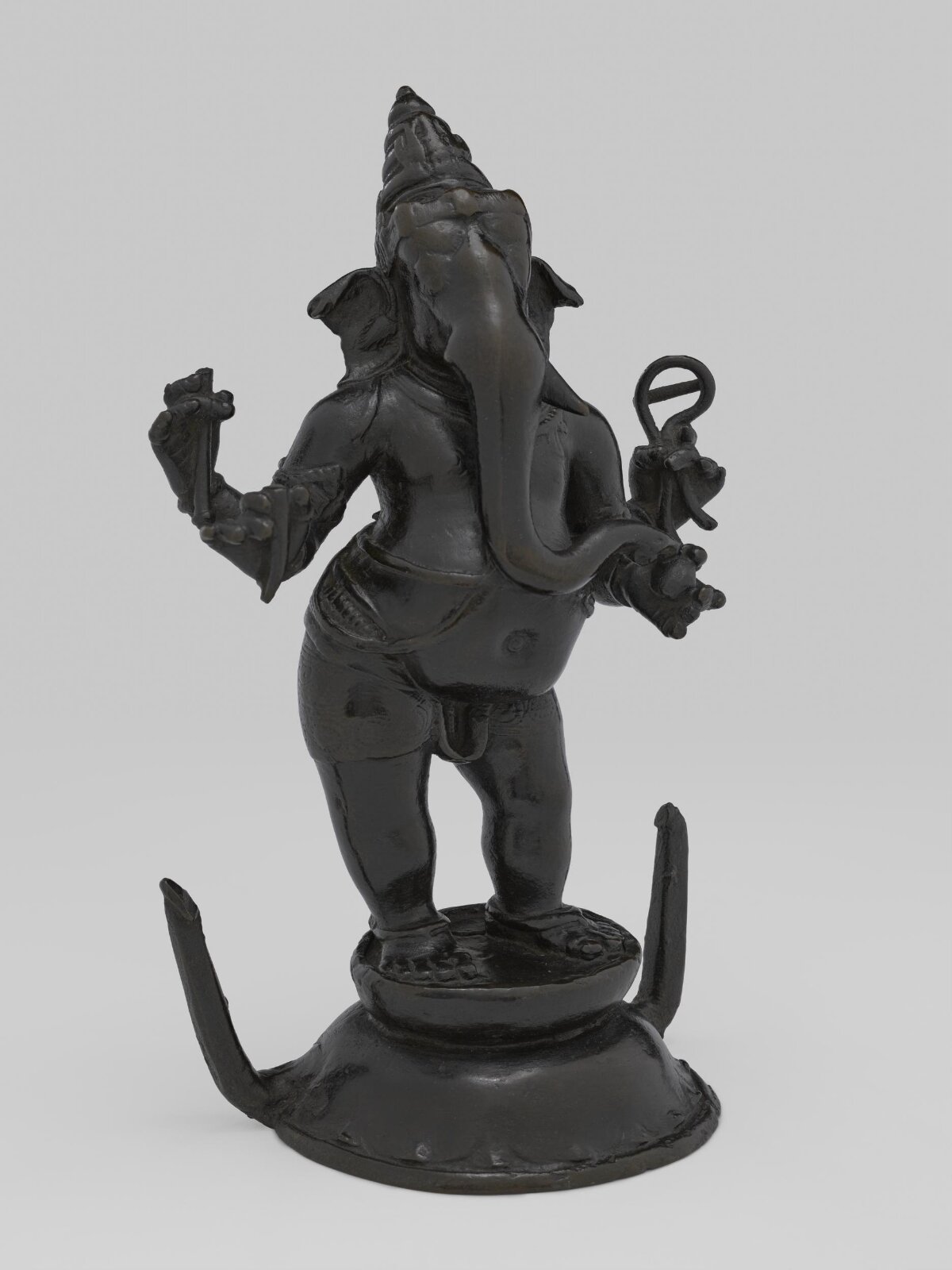
Ganesha
Kann ich es sehen?
Derzeit nicht ausgestellt
Wo ist „Ganesha“ heute? Sammlung: Victoria and Albert Museum, London. Derzeit nicht ausgestellt. Geprüft 25. September 2026.

London, Vereinigtes Königreich
Es gehört zur Sammlung, ist derzeit aber nicht ausgestellt.
- Geprüft
- Unverändert seit
- Quelle
- Das Museum
Über die Skulptur
Ganesha is the elephant-headed son of Shiva and Parvati. He is represented here in a processional form that would accompany his parents during temple parades, although he would be carried on a separate palanquin.
Mehr lesen
Here Ganesha stands in a relaxed posture with his hip flexed. In this four-armed form, he holds in his upper hands a noose (pasa) and elephant-goad (ankusa). While in his lower left hand he displays one of the delicacies that he enjoys, variously identified as wood-apple (kapittha) or sweetmeats, which he is about to take with his trunk. The fourth hand holds his broken tusk. The reason Ganesha has a broken tusk is explained in a variety of anecdotal stories, but its origins may lie in its resemblance to the plough, as this evokes his early role as a patron of agrarian activity. This role appears to have been displaced in the later medieval period by other functions, notably to serve as the patron and protector of those embarking on new ventures.
This sculpture is a good example of the masterful casting techniques of the Chola period (850-1267 A.D.). It demonstrates the metalworkers’ use of subtle form, simple ornament and restrained surface decoration, along with minimal chased detail.
Ganesha stands on a circular lotus-pedestal that has upright projections which could support an arched surround.
Victoria and Albert Museum
Angaben
- Inventarnummer
- IS.2-1951
Was es zeigt
Im Katalog
Quellen
- Victoria and Albert Museum
- Bild: Victoria and Albert Museum — © Victoria and Albert Museum, London