Arkhip KuindzhiUkraine, 1842–1910
Dnieper in the morning
Kann ich es sehen?
Unbekannt
Wo ist „Dnieper in the morning“ heute? Sammlung: Tretjakow-Galerie, Moskau. Unbekannt.

Moskau, Russland
Der Besitzer ist bekannt; ob das Werk derzeit ausgestellt ist, nicht.
- Quelle
- Das Museum
Über das Gemälde
In den Worten des Museums — auf Russisch
Один из секретов успеха пейзажей Архипа Куинджи заключался в том, что он обращался к знакомым с детства, дорогим его сердцу природным мотивам. Всю жизнь художник черпал вдохновение в воспоминаниях о родной деревне Карасу (Карасёвке) в предместье Мариуполя. Это селение с белоснежными мазанками на высоком берегу реки – прообраз знаменитых пейзажей «Украинская ночь» (1876, Государственная Третьяковская галерея) и «Лунная ночь на Днепре» (1880, Государственный Русский музей). Полотно «Днепр утром» стало продолжением живописного повествования о красоте и очаровании малороссийской природы.
Mehr lesen
На картине изображен высокий берег Днепра, окутанный розоватой утренней дымкой. Передний план пейзажа занимает роскошное пестрое поле, усеянное дикими травами и цветами, над которыми царственно возвышается чертополох. Обобщая изображение и в то же время фокусируя внимание на отдельных деталях, художник создал иллюзию колышущихся на ветру трав. Куинджи виртуозно передал величественное пространство степной шири. Сквозь пелену тумана проступают очертания извилистого берега полноводной реки, голубоватые дали и едва различимая линия горизонта, сливающаяся с небом. Не сразу становятся заметны пароход и блестящие купола церквей на дальнем плане. Небо затянуто розовато-серыми облаками, сквозь которые проходит мягкий, рассеянный солнечный свет. Высветленная цветовая гамма наполняет картину умиротворяющей тишиной и покоем. По словам историка искусства и критика Адриана Прахова, при взгляде на степные пейзажи Куинджи «звучат в ушах величавые напевы малороссийской песни. Такие лирические гимны природе могут выходить только из глубоко-поэтической, глубоко-чувствующей души!»
Впервые полотно «Днепр утром» было представлено широкой публике в 1882 году на очередной персональной выставке Куинджи в Петербурге. Позднее художник неоднократно возвращался к композиции пейзажа, которая легла в основу картин «Днепр» (1901, Псковский музей-заповедник) и «Ночное» (1905–1908, Государственный Русский музей).
Tretjakow-Galerie
Angaben
- Inventarnummer
- 884
Im Katalog
Quellen
- Tretjakow-Galerie
- Bild: Tretjakow-Galerie — Museum open access
Im Leben von Arkhip Kuindzhi
Das ganze Lebenlate 1879
The break with the Peredvizhniki
By the end of 1879 Kuindzhi broke with the Peredvizhniki for good: an anonymous newspaper article sharply criticised both his work and the Society, and its author turned out to be Klodt. Kuindzhi demanded Klodt’s expulsion but, realising that Klodt, an Academy professor, would not be expelled, announced his own withdrawal despite attempts to persuade him to stay; many scholars consider the story only a pretext for a break that had long been brewing.
October – November 1880
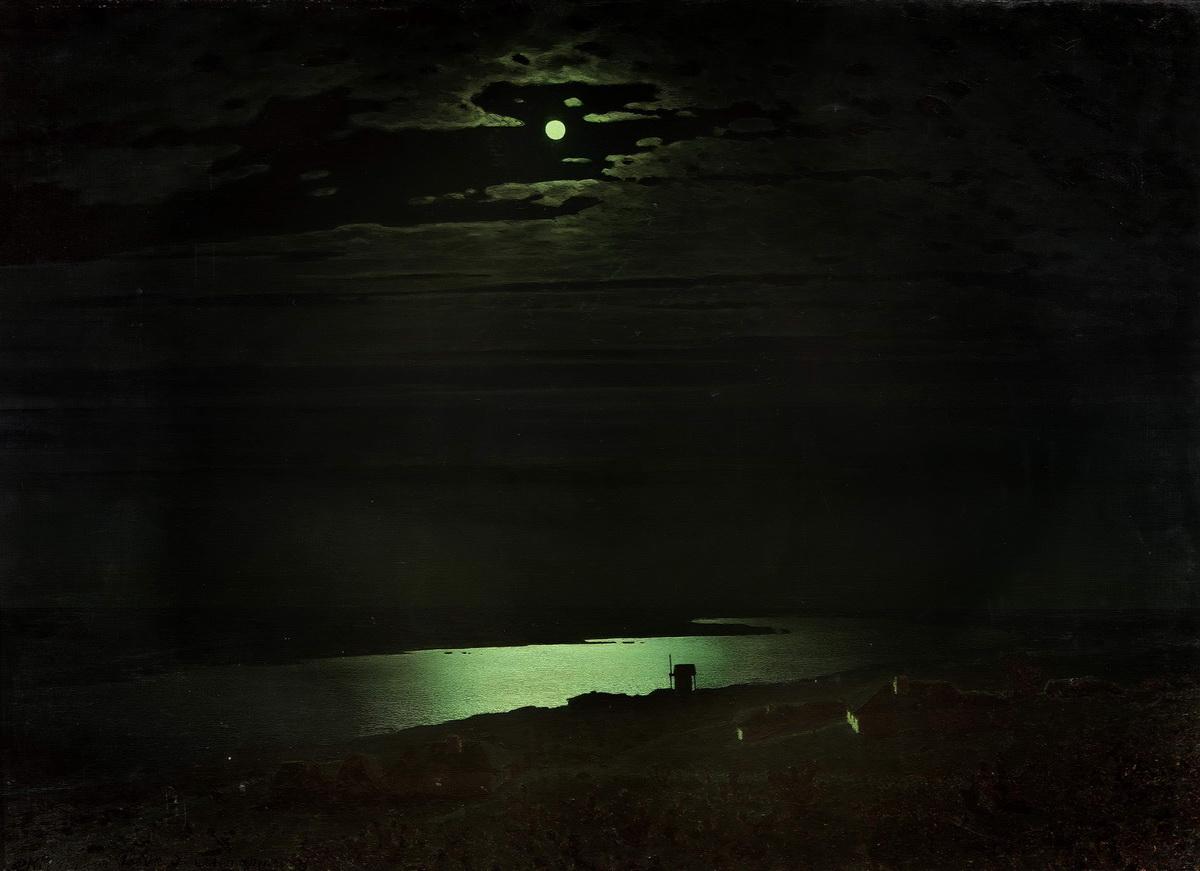
A one-painting exhibition: “Moonlit Night on the Dnieper”
In autumn 1880 Kuindzhi staged an exhibition of a single painting at the Society for the Encouragement of Artists: he draped the hall’s windows and lit the canvas with a beam of electric light. “Moonlit Night on the Dnieper” was an unprecedented success. The painting was bought by Grand Duke Konstantin Konstantinovich, who took it with him on a round-the-world voyage, and under the action of the sea air its bitumen paints darkened.
1881
A one-painting exhibition: “The Birch Grove”
In 1881 Kuindzhi staged an exhibition of another single painting, “The Birch Grove” (1879), which was just as successful.
1882
The last exhibition before the silence
In June 1882, in the Solodovnikov Passage on Kuznetsky Most, Kuindzhi staged an exhibition of two paintings, “The Birch Grove” and “Moonlit Night on the Dnieper”. After it he “fell silent” for twenty years, shutting himself up in his studio and showing his work to no one.
1882–1901
Twenty years of seclusion
The reasons for the seclusion are unknown; he was probably tired of the fuss and of accusations of cheap effects. The public thought he had exhausted himself, but he worked tirelessly, searching for pigments and grounds resistant to the air, and created about five hundred sketches and finished works and about three hundred graphic works.
1883
The dispute with Sudkovsky over “Dead Calm”
In 1883 Rufin Sudkovsky’s painting “Dead Calm” appeared, using the same device, a stony bottom showing through the water, as “Lake Ladoga”. Kuindzhi accused Sudkovsky of plagiarism and quarrelled with his former friend; Kramskoi and Repin called “Dead Calm” “a direct borrowing”, and in the end victory remained with Kuindzhi.