 Edouard VuillardFrankreich, 1868–1940
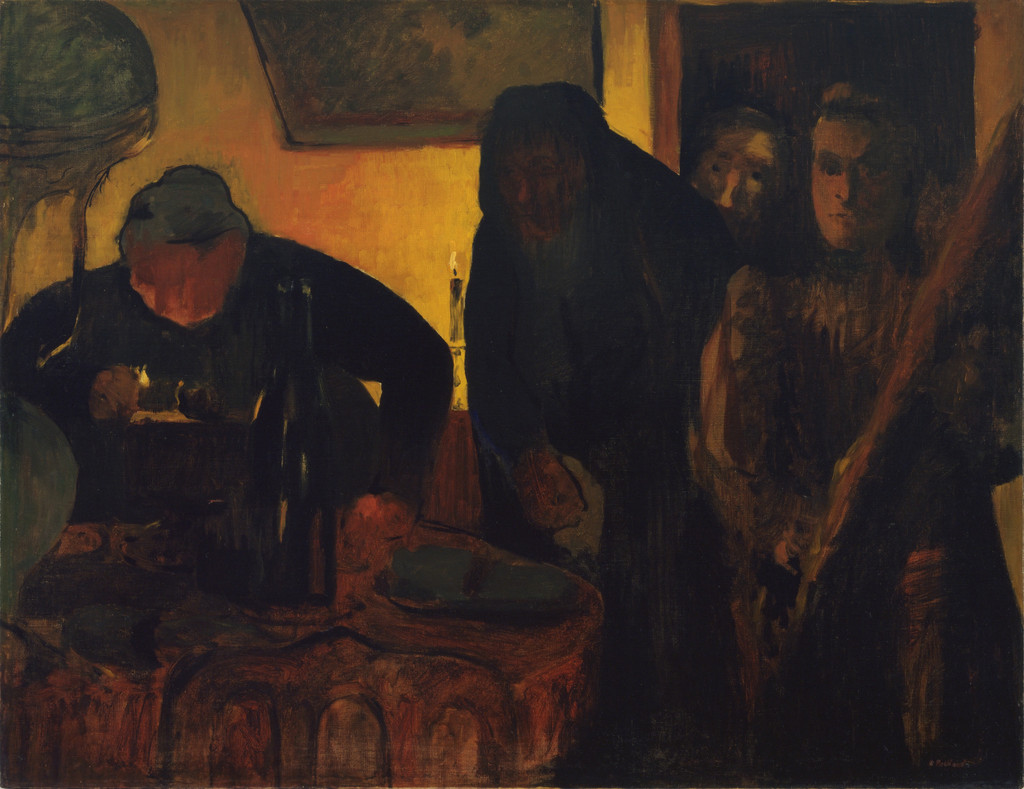
Dinnertime
Darf man es sehen?
Empfängt derzeit nicht

New York City, Vereinigte Staaten
Es gehört zur Sammlung, ist derzeit aber nicht ausgestellt.
- Geprüft
- Quelle
- Das Museum
Angaben
- Inventarnummer
- 101.1961
Im Katalog
Quellen
- Museum of Modern Art
- Bild: Museum of Modern Art — © the artist or rights holder
Derweil im Leben von Edouard Vuillard
Das ganze Leben1886–1927 · Wirkungsort
Paris
1887
Admitted to the École des Beaux-Arts
After failing the entrance competitions in February and July 1886 and again in February 1887, the persistent Vuillard is accepted in July 1887 into Robert-Fleury’s course and in 1888 moves to Jean-Léon Gérôme’s. Other accounts date the start of his studies there to 1886.
1890
Joins the Nabis
He begins attending the meetings of the “prophets” in late 1889 and in 1890, through Maurice Denis, becomes a member of the group, which met in Paul Ranson’s studio and in the cafés of the Passage Brady; because of his military service he is given the coded nickname “Nabi Zouave”. Other accounts date his membership from 1891.
early 1890s
The Natanson brothers and La Revue Blanche
Through his theatre work he meets Alexandre and Thadée Natanson, founders of the cultural review La Revue Blanche, where his graphics appear alongside work by Bonnard, Toulouse-Lautrec and Vallotton; the brothers become his important patrons. Other accounts say they had known each other since the Lycée Condorcet.
early 1890s
A shared studio and the first stage sets
He shares a studio at 28 Rue Pigalle with Bonnard, the director Lugné-Poe and a theatre critic, and designs sets for plays by Maeterlinck and other Symbolist writers. In the early 1890s he works chiefly for Lugné-Poe’s Théâtre de l’Œuvre, designing backdrops and programmes.
1891
First exhibition with the Nabis at Saint-Germain-en-Laye
At the château of Saint-Germain-en-Laye he shows two paintings, among them “The Woman in a Striped Dress”; the reviews are largely good, although the critic of Le Chat Noir (19 September 1891) finds the works still indecisive.