ART WIKI32.963 ausgestellt
KarteSammlungKünstlerMuseenAusstellungenJournal
Anmelden

ART WIKI

Wo das Meisterwerk hängt und wann man vorgelassen wird.

Sammlungen: Art Institute of Chicago, Cleveland Museum of Art, Eremitage, Getty Villa, Harvard Art Museums, Hirshhorn Museum and Sculpture Garden, J. Paul Getty Museum, Louvre, Metropolitan Museum of Art, Minneapolis Institute of Art, Museum of Modern Art, National Gallery of Art, National Museum of Asian Art, National Portrait Gallery, Puschkin-Museum, Rijksmuseum Amsterdam, Russisches Museum, Smithsonian American Art Museum, Statens Museum for Kunst, Tretjakow-Galerie, Victoria and Albert Museum, Whitney Museum of American Art, Staatskatalog des Museumsfonds Russlands (274 Museen), Europeana (19 Museen), Wikidata (6 Museen), Paris Musées (12 Museen) und Joconde, die Museumsdatenbank des französischen Kulturministeriums (495 Museen). Die Bilder gehören ihren Rechteinhabern.

Rubriken

  • Karte
  • Suche
  • Sammlung
  • Meisterwerke
  • Jetzt ausgestellt
  • Künstler

Mehr

  • Museen & Galerien
  • Ausstellungen
  • Journal
  • Woher die Daten stammen
  • Datenschutz & Cookies
StartseiteKarteKatalog
  1. Sammlung/
  2. National Gallery of Art/
  3. Day and Night
Day and Night, M.C. Escher, 1938
Maurits Cornelis Escher, PorträtMaurits Cornelis EscherNiederlande, 1898–1972

Day and Night

1938 · Print

Darf man es sehen?

Empfängt derzeit nicht

National Gallery of Art

Washington, D.C., Vereinigte Staaten

Es gehört zur Sammlung, ist derzeit aber nicht ausgestellt.

Geprüft
vor 3 Tagen
Unverändert seit
19. Aug. 2026
Quelle
Das Museum
Auf der KarteMuseumsseite

Angaben

1938 · mit 40 Jahren
18981972
Inventarnummer
1974.28.8

Was es zeigt

BirdWasserFlussWindmillStadtDorfGebäudeField

Im Katalog

DruckgrafikHolzschnittModerne20. JahrhundertDutch

Quellen

  • National Gallery of Art
  • Bild: National Gallery of Art — © the artist or rights holder

Derweil im Leben von Maurits Cornelis Escher

Das ganze Leben
  1. 4 July 1935 – August 1937

    Leaving Fascist Italy: Château-d’Œx

    On 4 July 1935 the Eschers left Italy: the political climate under Mussolini had become unacceptable to the artist, their nine-year-old son’s health had worsened and at school George was being made to wear the uniform of the Balilla organisation; they had to sell the house in Rome, and the family moved to Château-d’Œx in Switzerland. Life there was more expensive and they had to work hard: Jetta took up the piano again, Escher joined a chess club and tried landscapes, but was disappointed — they lacked the warmth of the Italian ones; in the summer of 1935 he went to The Hague to see his parents and drew one of his best-known portraits of his father.

  2. 1936

    A voyage with the Adria line and a second Alhambra

    In early 1936 Escher proposed to the Adria shipping company free passage in return for drawings of their ships and ports — to his surprise the company agreed — and from May, with Jetta, he sailed along the Italian coast and then to Spain, where he revisited the Alhambra and spent days at a time drawing its mosaic patterns in detail: tessellation then fascinated him to the point of obsession. The voyage, which ended with their return to Château-d’Œx by 1 September, was his last long study journey; he called it the richest source of inspiration he had ever tapped.

  3. 1937

    1937: from nature to geometry

    1937 was a year of transition: Escher exchanged landscape for works embodying geometric constructions and thereafter made his works in the studio rather than in the field — his art changed from observational to the product of geometric analysis and visual imagination. His first picture of an impossible reality, “Still Life and Street”, dates from late 1936 or 1937, and “Metamorphosis I” (1937) began a series of designs that told a story through pictures.

  4. from 1937

    Papers by Pólya and Haag, and the 17 symmetry groups

    Escher began to study mathematics from papers by George Pólya and the crystallographer Friedrich Haag on plane symmetry groups, sent to him by his brother Berend. He carefully studied the 17 canonical wallpaper groups, created periodic tilings in 43 drawings of different types of symmetry and, from 1937, made woodcuts based on those groups, using his own notation.

  5. August 1937

    Moving to Uccle near Brussels

    In August 1937 the family, which had never got used to the atmosphere of rural Switzerland, moved to Uccle, a suburb of Brussels. In 1938 the Eschers had a third son, Jan.

  6. 14 June 1939 – 27 May 1940

    The deaths of his father and mother

    On 14 June 1939 Escher’s father, George Arnold, died in The Hague at the age of 96; on 27 May 1940 his mother, Sara Gleichman, died too. Brussels was by then occupied by Nazi Germany and Escher could not attend his mother’s funeral; for the rest of the year he settled her financial affairs and carried out a commission from Leiden’s town hall to decorate the building.

Mehr von Maurits Cornelis Escher

Alle Werke
Green Sea, M.C. Escher

Green Sea

Nicht ausgestellt · National Gallery of Art

Study for Regular Division of the Plane, M.C. Escher, n.d

Study for Regular Division of the Plane

n.d · Nicht ausgestellt · National Gallery of Art

Portrait, M.C. Escher

Portrait

Nicht ausgestellt · National Gallery of Art

(Color test for unidentified print), M.C. Escher

(Color test for unidentified print)

Nicht ausgestellt · National Gallery of Art

Pond, M.C. Escher

Pond

Nicht ausgestellt · National Gallery of Art

Railroad, M.C. Escher

Railroad

Nicht ausgestellt · National Gallery of Art

City with Rocks (verso), M.C. Escher

City with Rocks (verso)

Nicht ausgestellt · National Gallery of Art

Study for Regular Division of the Plane, M.C. Escher, n.d.

Study for Regular Division of the Plane

n.d. · Nicht ausgestellt · National Gallery of Art

Nachbarn im Haus: National Gallery of Art

Museumsseite
Ginevra de' Benci [obverse], Leonardo da Vinci, c. 1474/1478

Leonardo da Vinci

Bildnis der Ginevra de’ Benci, c. 1474/1478

Wreath of Laurel, Palm, and Juniper with a Scroll inscribed Virtutem Forma Decorat [reverse], Leonardo da Vinci, c. 1474/1478

Leonardo da Vinci

Wreath of Laurel, Palm, and Juniper with a Scroll inscribed Virtutem Forma Decorat [reverse], c. 1474/1478

Green Wheat Fields, Auvers, Vincent van Gogh, 1890

Vincent van Gogh

Green Wheat Fields, Auvers, 1890

Girl in White, Vincent van Gogh, 1890

Vincent van Gogh

Junges Mädchen, vor einem Weizenfeld stehend, 1890

Roses, Vincent van Gogh, 1890

Vincent van Gogh

Roses, 1890

Self-Portrait, Vincent van Gogh, 1889

Vincent van Gogh

Self-Portrait, 1889

Farmhouse in Provence, Vincent van Gogh, 1888

Vincent van Gogh

Bauernhof in der Provence, 1888

La Mousmé, Vincent van Gogh, 1888

Vincent van Gogh

La Mousmé, 1888

Zum selben Thema · Bird

Alle Werke zum Thema
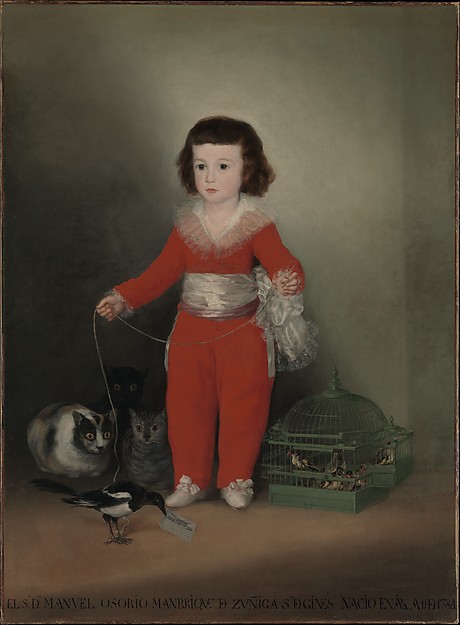
Manuel Osorio Manrique de Zuñiga (1784–1792), Goya, 1787–88

Francisco de Goya

Porträt des Don Manuel, 1787–88

Metropolitan Museum of Art

Blinded Minotaur Led by a Girl III (Minotaur aveugle guide par une fillette III), Pablo Picasso, 1934

Pablo Picasso

Blinded Minotaur Led by a Girl III (Minotaur aveugle guide par une fillette III), 1934

Nicht ausgestellt · National Gallery of Art

Dove (La colombe), Pablo Picasso, 1949

Pablo Picasso

Dove (La colombe), 1949

Nicht ausgestellt · National Gallery of Art

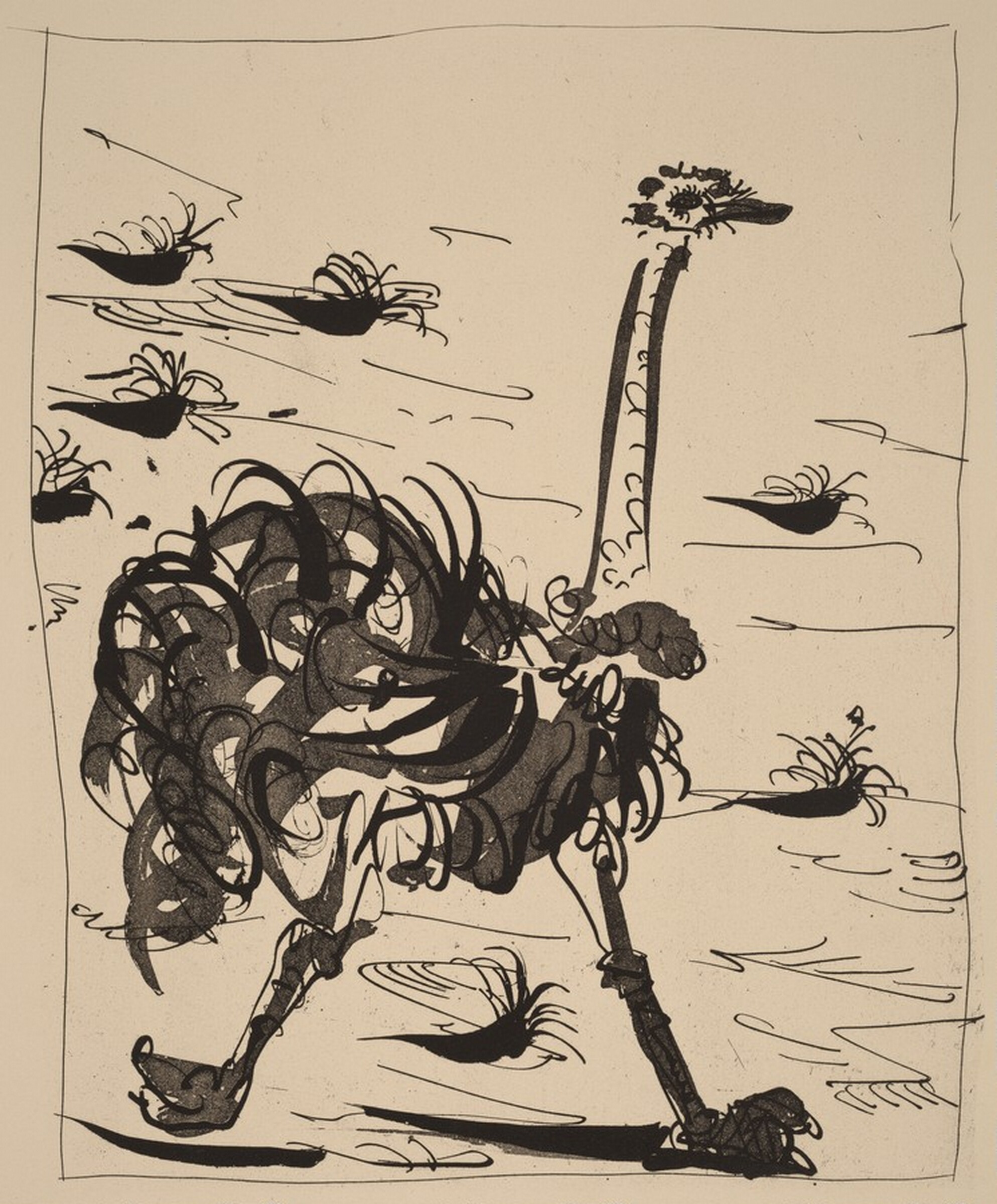
L'Autruche (The Ostrich), Pablo Picasso, 1941/1942

Pablo Picasso

L'Autruche (The Ostrich), 1941/1942

Nicht ausgestellt · National Gallery of Art

Blind Minotaur Led by Marie-Thérèse with a Dove in a Starry Night (Minotaure aveugle guidé par Marie-Thérèse au pigeon dans une nuit étoilée), Pablo Picasso, 1934

Pablo Picasso

Blind Minotaur Led by Marie-Thérèse with a Dove in a Starry Night (Minotaure aveugle guidé par Marie-Thérèse au pigeon dans une nuit étoilée), 1934

Nicht ausgestellt · National Gallery of Art

Blind Minotaur Led by Marie-Thérèse with a Dove in a Starry Night (Minotaure aveugle guidé par Marie-Thérèse au pigeon dans une nuit étoilée), Pablo Picasso, 1934

Pablo Picasso

Blind Minotaur Led by Marie-Thérèse with a Dove in a Starry Night (Minotaure aveugle guidé par Marie-Thérèse au pigeon dans une nuit étoilée), 1934

Nicht ausgestellt · National Gallery of Art

Blind Minotaur Led by Marie-Thérèse with a Dove in a Starry Night (Minotaure aveugle guidé par Marie-Thérèse au pigeon dans une nuit étoilée), Pablo Picasso, 1934

Pablo Picasso

Blind Minotaur Led by Marie-Thérèse with a Dove in a Starry Night (Minotaure aveugle guidé par Marie-Thérèse au pigeon dans une nuit étoilée), 1934

Nicht ausgestellt · National Gallery of Art

Pigeon with Gray Background (Pigeon au fond gris), Pablo Picasso, 1947

Pablo Picasso

Pigeon with Gray Background (Pigeon au fond gris), 1947

Nicht ausgestellt · National Gallery of Art