ART WIKI33.040 ausgestellt
KarteSammlungKünstlerMuseenAusstellungenJournal
Anmelden

ART WIKI

Wo das Meisterwerk hängt und wann man vorgelassen wird.

Sammlungen: Art Institute of Chicago, Cleveland Museum of Art, Eremitage, Getty Villa, Harvard Art Museums, Hirshhorn Museum and Sculpture Garden, J. Paul Getty Museum, Louvre, Metropolitan Museum of Art, Minneapolis Institute of Art, Museum of Modern Art, National Gallery of Art, National Museum of Asian Art, National Portrait Gallery, Puschkin-Museum, Rijksmuseum Amsterdam, Russisches Museum, Smithsonian American Art Museum, Statens Museum for Kunst, Tretjakow-Galerie, Victoria and Albert Museum, Whitney Museum of American Art, Staatskatalog des Museumsfonds Russlands (274 Museen), Europeana (19 Museen), Wikidata (6 Museen), Paris Musées (12 Museen) und Joconde, die Museumsdatenbank des französischen Kulturministeriums (495 Museen). Die Bilder gehören ihren Rechteinhabern.

Rubriken

  • Karte
  • Suche
  • Sammlung
  • Meisterwerke
  • Jetzt ausgestellt
  • Künstler

Mehr

  • Museen & Galerien
  • Ausstellungen
  • Journal
  • Woher die Daten stammen
  • Datenschutz & Cookies
StartseiteKarteKatalog
  1. Sammlung/
  2. Harvard Art Museums/
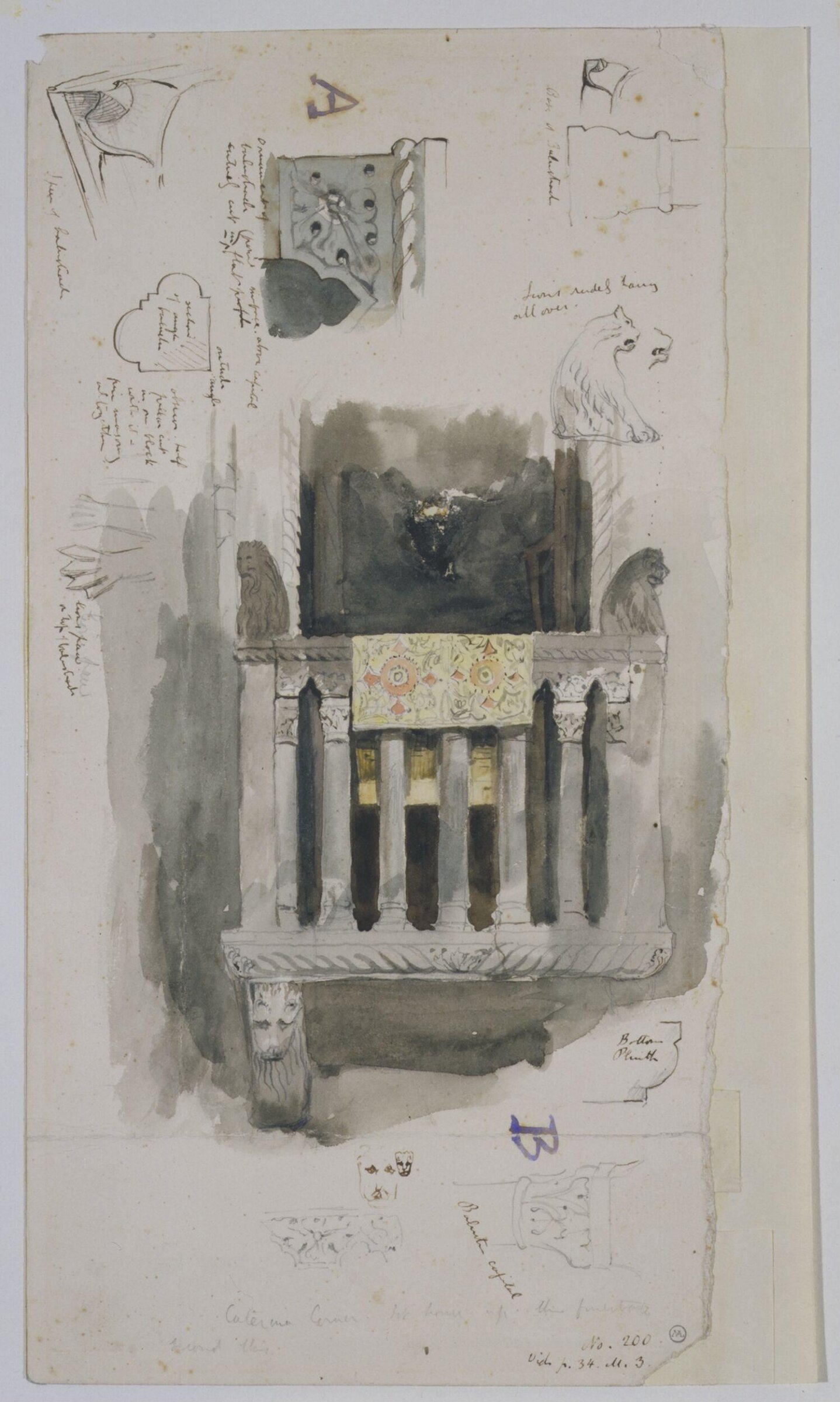
  3. Dawn After the Wreck
Dawn After the Wreck, John Ruskin, 19th century
John Ruskin, PorträtJohn RuskinEngland, 1819–1900

Dawn After the Wreck

19th century · Print

Darf man es sehen?

Empfängt derzeit nicht

Harvard Art Museums

Cambridge, Vereinigte Staaten

Es gehört zur Sammlung, ist derzeit aber nicht ausgestellt.

Geprüft
vor 9 Tagen
Unverändert seit
27. Sept. 2026
Quelle
Das Museum
Auf der KarteMuseumsseite

Angaben

Inventarnummer
M2123

Im Katalog

DruckgrafikRadierungKlassizismusRomantik19. JahrhundertVereinigtes Königreich

Quellen

  • Harvard Art Museums
  • Bild: Harvard Art Museums — © President and Fellows of Harvard College

Derweil im Leben von John Ruskin

Das ganze Leben
  1. 8. Februar 1819

    Born

  2. 1843

    In defence of Turner: the first volume of “Modern Painters”

    The first volume of “Modern Painters” — an answer to Turner's critics — is published by Smith, Elder & Co. under the name “A Graduate of Oxford”; Ruskin controversially argues that modern landscape painters, above all Turner, surpass “Old Masters” such as Gaspard Dughet, Claude and Salvator Rosa in “truth to nature”, moral as well as material. Reviews are mixed, but Charlotte Brontë and Elizabeth Gaskell are impressed, and the book cements Ruskin's relationship with Turner.

  3. April – July 1854

    Effie leaves Ruskin and the marriage is annulled

    Suffering from illness and from fierce quarrels with her husband and his overly protective parents, Effie goes to her own parents in Scotland; she and Millais have fallen in love, and her leaving causes a public scandal. In April 1854 she files a suit of nullity on grounds of non-consummation, which is granted in July; Ruskin does not even mention it in his diary.

  4. 1858

    Turin: Veronese against a dull sermon

    In Turin Ruskin sits through a particularly dull sermon at a Waldensian church and sees Paolo Veronese's “Presentation of the Queen of Sheba” at the Galleria Sabauda; later, in April 1877, he will name this as the start of his “unconversion” from Evangelical Christianity. His faith, long shaken by Biblical and geological scholarship, collapses, and, believing that much of his writing had rested on lies and half-truths, Ruskin goes through a deep personal crisis before returning to Christianity after a long struggle.

  5. August – November 1860

    “Unto This Last” in the Cornhill Magazine

    In four essays published in the Cornhill Magazine Ruskin rejects the division of labour as dehumanising and calls political economy a false “science” that ignores the social affections that bind communities together, but the editor, Thackeray, is forced to abandon the series by the outcry of conservative readers and a nervous publisher. The national press is hostile and his father disapproves, while Carlyle is delighted and declares that they are henceforth “a minority of two”.

  6. 20. Januar 1900

    Died

Mehr von John Ruskin

Alle Werke
Architectural details from the Sagredo Palace, Venice, John Ruskin, 19th century

Architectural details from the Sagredo Palace, Venice

19th century · Victoria and Albert Museum

View of Amalfi, John Ruskin, 1844

View of Amalfi

1844 · Harvard Art Museums

Fragment of the Alps, John Ruskin, c. 1854-1856

Fragment of the Alps

c. 1854-1856 · Harvard Art Museums

Gezicht op S. Anastasia te Verona, over de Adige, John Ruskin, 1829 - 1900

Gezicht op S. Anastasia te Verona, over de Adige

1829 - 1900 · Rijksmuseum Amsterdam

Bergkam aan het Meer van Genève, John Ruskin, 1829 - 1900

Bergkam aan het Meer van Genève

1829 - 1900 · Rijksmuseum Amsterdam

The Garden of San Miniato near Florence, John Ruskin, 1845

The Garden of San Miniato near Florence

1845 · Nicht ausgestellt · National Gallery of Art

Tower of the Cathedral at Sens, John Ruskin, c. 1845

Tower of the Cathedral at Sens

c. 1845 · Nicht ausgestellt · National Gallery of Art

Ornamental Study with Acanthus Motif for "The Stones of Venice", John Ruskin, 1849

Ornamental Study with Acanthus Motif for "The Stones of Venice"

1849 · Nicht ausgestellt · National Gallery of Art

Nachbarn im Haus: Harvard Art Museums

Museumsseite
Glück auf in Deutschland (N:4), Pınar Öğrenci, 2024

Pınar Öğrenci

Glück auf in Deutschland (N:4), 2024

Glück auf in Deutschland (N:10), Pınar Öğrenci, 2024

Pınar Öğrenci

Glück auf in Deutschland (N:10), 2024

Glück auf in Deutschland (N:7b), Pınar Öğrenci, 2024

Pınar Öğrenci

Glück auf in Deutschland (N:7b), 2024

Glück auf in Deutschland (N:6), Pınar Öğrenci, 2024

Pınar Öğrenci

Glück auf in Deutschland (N:6), 2024

Glück auf in Deutschland (N:11), Pınar Öğrenci, 2024

Pınar Öğrenci

Glück auf in Deutschland (N:11), 2024

Dwarpalika (Temple Guardian), Sneha Shrestha, 2023

Sneha Shrestha

Dwarpalika (Temple Guardian), 2023

The Eternal Pond of the Universe, Bingyi 冰逸, 2022-2024

Bingyi 冰逸

The Eternal Pond of the Universe, 2022-2024

Triangle Constellation, Carlos Amorales, 2015

Carlos Amorales

Triangle Constellation, 2015