
 Winslow HomerVereinigte Staaten, 1836–1910
Danger
Darf man es sehen?
Empfängt derzeit nicht

National Gallery of Art
Washington, D.C., Vereinigte Staaten
Es gehört zur Sammlung, ist derzeit aber nicht ausgestellt.
- Geprüft
- Unverändert seit
- Quelle
- Das Museum
Angaben
- Inventarnummer
- 1984.58.2
Im Katalog
Quellen
- National Gallery of Art
- Bild: National Gallery of Art — Museum open access
Derweil im Leben von Winslow Homer
Das ganze Lebenspring 1881 – November 1882
England: the village of Cullercoats
In 1881 Homer set off on his second and last trip abroad, to England, and from the spring of 1881 to November 1882 lived in the village of Cullercoats on the North Sea, depicting the courage of fishermen and above all of women: gutting fish, mending nets, waiting for the men at the water's edge. The period profoundly changed his later work: his palette grew sober and his pictures larger. Of the local women he wrote: “The women are the working bees.”
November 1882
Return: “a very different Homer”
In November 1882 Homer returned to the United States and showed his English watercolours in New York. Critics noticed the change at once: “He is a very different Homer from the one we knew”, his pictures were “works of High Art”, and his women were no longer “dolls who flaunt their millinery” but sturdy, fearless wives and mothers.
summer 1883
Moves to Prouts Neck
In the summer of 1883 Homer moved from New York to Prouts Neck, a peninsula ten miles south of Portland, Maine, and lived there for the rest of his life, using solitude to work. He settled on the family estate, in a remodelled carriage house seventy-five feet from the ocean.
1884
Death of his mother
In 1884 Homer's mother died: his first teacher and the strongest influence on him. After her death he became a “parent” to his ageing but domineering father, and his sister-in-law Martha (“Mattie”) became his closest female intimate.
winter 1884 – 1885
Florida, Cuba and the Bahamas
In the winter of 1884–1885 Homer travelled to Florida, Cuba and the Bahamas, painting a series of watercolours commissioned by Century Magazine: the storm-tossed green sea of Prouts Neck gave way to the sparkling blue skies of the Caribbean, and for Edith Blake, wife of the governor of the Bahamas, he painted “Children Under a Palm Tree”. “A Garden in Nassau” (1885) is one of the best of these watercolours, but they proved too advanced for traditional buyers.
1888–1903
Trips to Key West
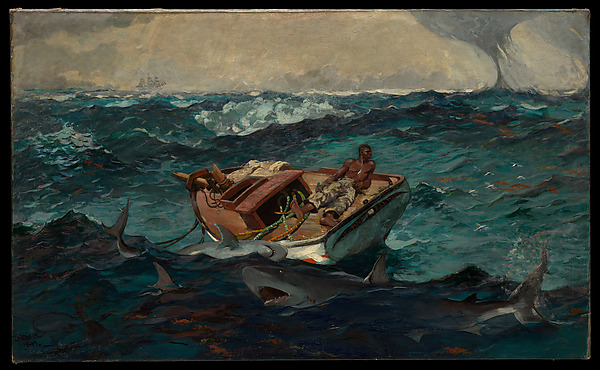
Between 1888 and 1903 Homer frequently visited Key West, Florida; some of his best-known works, “A Norther, Key West”, “The Gulf Stream”, “Taking on Wet Provisions” and “Palms in the Storm”, are said to have been produced there.


![Ginevra de' Benci [obverse], Leonardo da Vinci, c. 1474/1478](https://api.nga.gov/iiif/8f29e3c9-a289-4d53-abf0-31a66e9e98fa/full/!2400,2400/0/default.jpg)
![Wreath of Laurel, Palm, and Juniper with a Scroll inscribed Virtutem Forma Decorat [reverse], Leonardo da Vinci, c. 1474/1478](https://api.nga.gov/iiif/ff62e8d0-45c4-498f-ad36-6358de827e04/full/!2400,2400/0/default.jpg)


