 Claude MonetFrankreich, 1840–1926
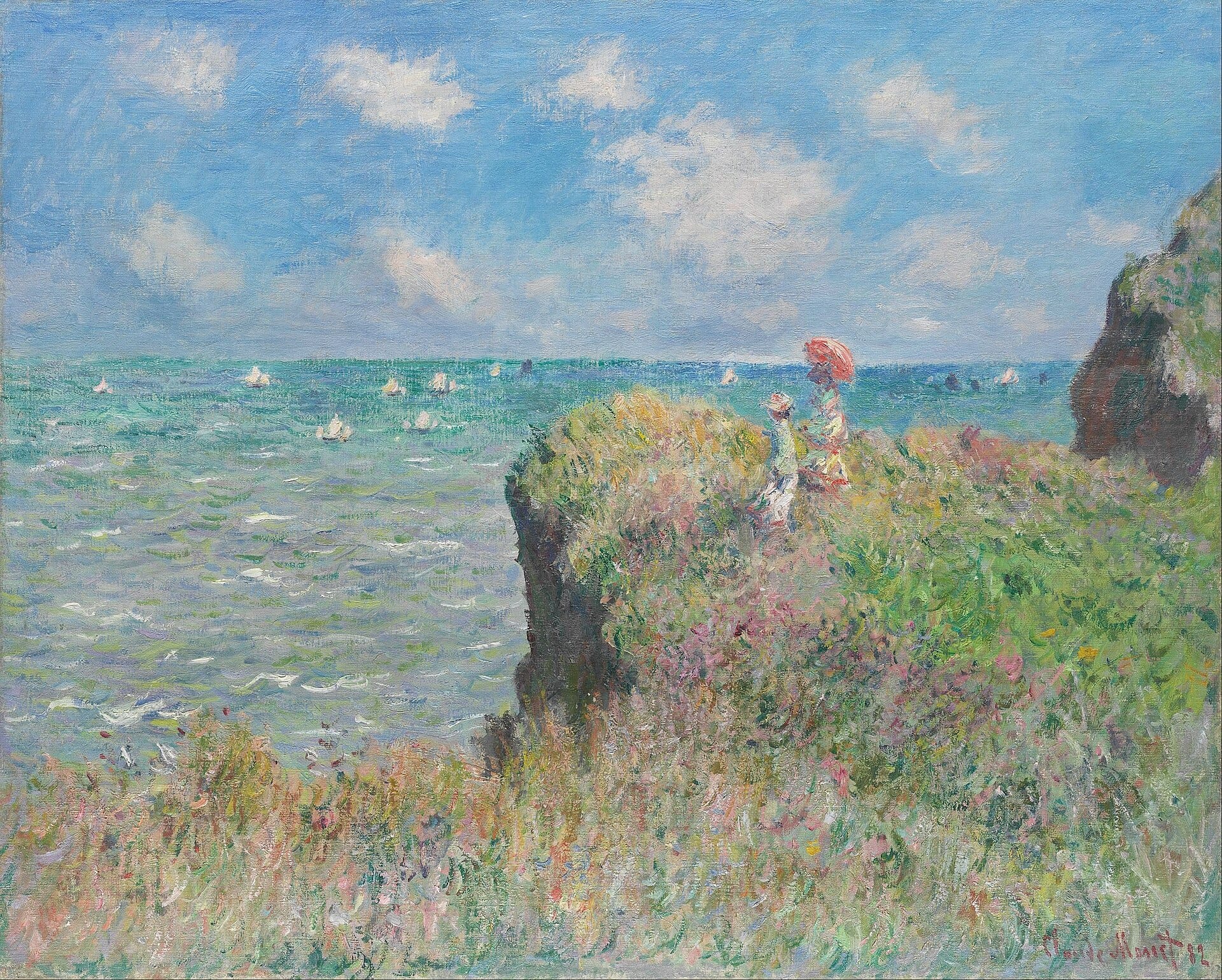
Cliff Walk at Pourville
Kann ich es sehen?
Ja, derzeit ausgestellt
Wo ist „Cliff Walk at Pourville“ heute? Art Institute of Chicago, Saal 240, Chicago. Ja, derzeit ausgestellt. Geprüft 29. September 2026.

Chicago, Vereinigte Staaten
Jetzt geöffnet· bis 17:00
Öffentlich ausgestellt.
- Geprüft
- Unverändert seit
- Quelle
- Das Museum
Über das Gemälde
The Cliff Walk at Pourville is an 1882 painting by the French Impressionist painter Claude Monet, displayed in the Art Institute of Chicago. It is one in a series of landscape paintings by Monet during his time in Normandy. It depicts two girls atop a cliff overlooking the sea in fishing village Pourville, in a scene of summer sunshine and brisk breeze which juxtaposes leisure and labor by contrasting the bourgeois figures with fishing boats on the horizon.
In den Worten des Museums
In February 1882, Claude Monet went to Normandy to paint, one of many such expeditions that he made in the 1880s. This was also a retreat from personal and professional pressures. His wife, Camille, had died three years earlier, and Monet had entered into a domestic arrangement with Alice Hoschedé (whom he would marry in 1892, after her husband's death). France was in the midst of a lengthy economic recession that affected Monet's sales. In addition, the artist was unenthusiastic about the upcoming seventh Impressionist exhibition—divisions within the group had become pronounced by this time—and he delegated the responsibility for his contribution to his dealer, Paul Durand-Ruel.
Mehr lesen
Disappointed in the area around the harbor city of Dieppe, which he found too urban, Monet settled in Pourville and remained in this fishing village until mid-April. He became increasingly enamored of his surroundings, writing to Hoschedé and her children: "How beautiful the countryside is becoming, and what joy it would be for me to show you all its delightful nooks and crannies!" He was able to do so in June, when they joined him in Pourville.The two young women strolling in Cliff Walk at Pourville are probably Marthe and Blanche, the eldest Hoschedé daughters.
In this work, Monet addressed the problem of inserting figures into a landscape without disrupting the unity of its painterly surface. He integrated these elements with one another through texture and color. The grass—composed of short, brisk, curved brushstrokes—appears to quiver in the breeze, and subtly modified versions of the same strokes and hues suggest the women's wind-whipped dresses and shawls and the undulation of the sea. X-radiographs show that Monet reduced the rocky outcropping at the far right to balance the proportions of sea and sky.
Art Institute of ChicagoCC BY 4.0
Angaben
Was es zeigt
Im Katalog
Quellen
- Art Institute of Chicago
- Bild: Wikimedia Commons — Public domain (PD-Art)
Im Leben von Claude Monet
Das ganze Leben1880–1881
Durand-Ruel resumes purchases
Durand-Ruel offered to handle the buying and selling of Monet's works on a permanent basis, after which the artist's fortunes rapidly improved.
Dezember 1881 – April 1883 · Wohnort
Villa Saint-Louis
1883
First major retrospective
In the year of his move to Giverny, Monet's first large retrospective exhibition took place.
1883
Riviera trip with Renoir
Monet and Renoir took a short painting trip by train along the Italian Riviera as far as Genoa; on the way back they stopped at L'Estaque to see Cézanne. On this trip Monet discovered Bordighera.
1883–1926 · Wirkungsort
Giverny
18 January – 5 April 1884
Three months in Bordighera
Instead of the planned three weeks, Monet spent almost three months in the Ligurian town of Bordighera and painted 38 pictures. He called the town a magical, fairy-tale land; on the way back he stopped in Menton.







%20-%201922.4465%20-%20Art%20Institute%20of%20Chicago.jpg?width=1280)