
 Henri RousseauFrankreich, 1844–1910
Boy on the Rocks
Darf man es sehen?
Empfängt derzeit nicht

National Gallery of Art
Washington, D.C., Vereinigte Staaten
Es gehört zur Sammlung, ist derzeit aber nicht ausgestellt.
- Geprüft
- Unverändert seit
- Quelle
- Sammlungsdaten des Museums selbst
Über das Gemälde
Boy On The Rocks (French: Garçon sur les rochers) is a painting by French artist Henri Rousseau. It is an oil on canvas and was created sometime between 1895 and 1897. The painting was purchased by art collector Chester Dale in 1927 and was subsequently bequeathed to the National Gallery of Art in Washington, D.C. in 1963.
Rousseau's work has been described as having a "mysterious poetry" and a "dreamlike force".
According to Nicolas Pioch's comments on the painting:
"Only a child can so bestride the world with such ease, and only a childlike artist with a simple, naïve vision can understand this elevation and make us see it as dauntingly true."
The painting was used on the cover of the May 19, 1999, issue of the Journal of the American Medical Association.
Angaben
- Inventarnummer
- 1963.10.63
Was es zeigt
Im Katalog
Quellen
- National Gallery of Art: die offenen Daten des Museums · abgerufen vor 8 Tagen
- Bild: National Gallery of Art — Museum open access
Derweil im Leben von Henri Rousseau
Das ganze Leben1886–1893
Twenty paintings in seven years: ridicule and friends
Over the next seven years Rousseau, dividing his time between work, family and painting, showed about twenty pictures at the Salon des Indépendants; the public barely noticed them and critics kept mocking them, but his friends, the Impressionist painters, supported him, valuing his spontaneity and sincerity.
1893
Retires from the civil service to paint
In 1893, at the age of 49, Rousseau retired from the civil service on a modest pension to devote himself entirely to painting.
after 1893
Meets Alfred Jarry
Soon after leaving his post Rousseau met the talented young poet Alfred Jarry, who was struck by the oddity of his work and introduced him to the circle of intellectuals around the avant-garde journal Mercure de France, in whose pages a favourable review of his art appeared.
1893–1910
A studio in Montparnasse
In 1893 Rousseau moved to a studio in Montparnasse, where he lived and worked until his death in 1910.
1894
“War” at the Salon des Indépendants
“War,” shown at the 1894 Salon des Indépendants, began Rousseau’s wider fame: the picture earned praise in Mercure de France, and its powerful allegorical message convinced many connoisseurs that he was no ordinary landscape painter.
after 1897
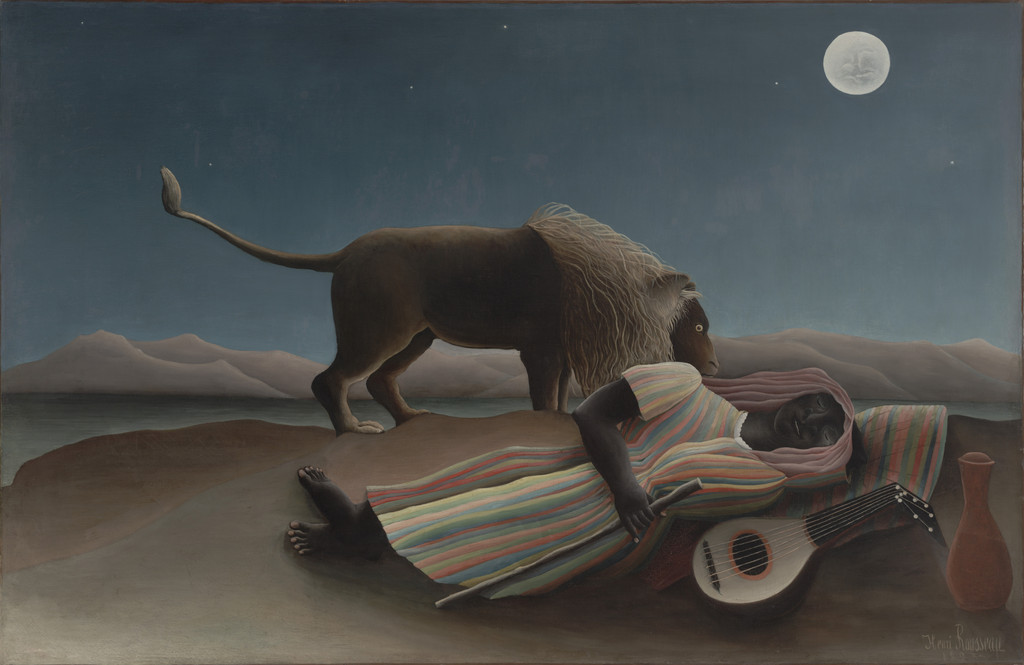
The mayor of Laval declines “The Sleeping Gypsy”
Believing himself an heir to the academic tradition, Rousseau offered “The Sleeping Gypsy” to the mayor of his native Laval, who declined with a sneer.



![Ginevra de' Benci [obverse], Leonardo da Vinci, c. 1474/1478](https://api.nga.gov/iiif/8f29e3c9-a289-4d53-abf0-31a66e9e98fa/full/!2400,2400/0/default.jpg)
![Wreath of Laurel, Palm, and Juniper with a Scroll inscribed Virtutem Forma Decorat [reverse], Leonardo da Vinci, c. 1474/1478](https://api.nga.gov/iiif/ff62e8d0-45c4-498f-ad36-6358de827e04/full/!2400,2400/0/default.jpg)


