ART WIKI33.040 ausgestellt
KarteSammlungKünstlerMuseenAusstellungenJournal
Anmelden

ART WIKI

Wo das Meisterwerk hängt und wann man vorgelassen wird.

Sammlungen: Art Institute of Chicago, Cleveland Museum of Art, Eremitage, Getty Villa, Harvard Art Museums, Hirshhorn Museum and Sculpture Garden, J. Paul Getty Museum, Louvre, Metropolitan Museum of Art, Minneapolis Institute of Art, Museum of Modern Art, National Gallery of Art, National Museum of Asian Art, National Portrait Gallery, Puschkin-Museum, Rijksmuseum Amsterdam, Russisches Museum, Smithsonian American Art Museum, Statens Museum for Kunst, Tretjakow-Galerie, Victoria and Albert Museum, Whitney Museum of American Art, Staatskatalog des Museumsfonds Russlands (274 Museen), Europeana (19 Museen), Wikidata (6 Museen), Paris Musées (12 Museen) und Joconde, die Museumsdatenbank des französischen Kulturministeriums (495 Museen). Die Bilder gehören ihren Rechteinhabern.

Rubriken

  • Karte
  • Suche
  • Sammlung
  • Meisterwerke
  • Jetzt ausgestellt
  • Künstler

Mehr

  • Museen & Galerien
  • Ausstellungen
  • Journal
  • Woher die Daten stammen
  • Datenschutz & Cookies
StartseiteKarteKatalog
  1. Sammlung/
  2. Kupferstichkabinett Dresden/
  3. Bacchantenkopf
Bacchantenkopf, Jacob Jordaens, 1608–1678
Jacques Jordaens, PorträtJacques JordaensFlandern, 1593–1678

Bacchantenkopf

1608–1678 · Drawing

Darf man es sehen?

Unbekannt

Kupferstichkabinett Dresden

Dresden, Deutschland

Der Besitzer ist bekannt; ob das Werk derzeit ausgestellt ist, nicht.

Unverändert seit
27. Sept. 2026
Quelle
Das Museum
Auf der KarteMuseumsseite

Angaben

1608–1678
15931678

Im Katalog

Zeichnungen & AquarelleBarock17. Jahrhundert

Quellen

  • Kupferstichkabinett Dresden
  • Bild: Kupferstichkabinett Dresden — In Copyright

Derweil im Leben von Jacques Jordaens

Das ganze Leben
  1. 1615

    Admitted to the guild as a master “water painter”

    After eight years of training Jordaens was admitted to the Antwerp Guild of Saint Luke as a master waterscilder (“water painter”), one who painted in water-based paints the canvases that served as substitutes for tapestries or as tapestry cartoons; other accounts give 1616. Unlike Rubens and van Dyck, he never went to Italy and, apart from short trips within the Low Countries, lived in Antwerp all his life.

  2. 15 May 1616

    Marries his master's daughter Catharina van Noort

    Jordaens married Adam van Noort's eldest daughter Catharina (other accounts call her Anna Catharina). At first the couple lived with or near his father-in-law; they had three children: Elisabeth, Jacob, who became a painter, and Anna Catharina.

  3. 1639–1640

    Charles I's commission: “The Story of Cupid and Psyche”

    Through the English king's agent in Brussels, Balthazar Gerbier, and the diplomat Cesare Alessandro Scaglia, Jordaens received a commission for 22 paintings for the Queen's House at Greenwich without knowing the patron or the destination; when Rubens, Gerbier's preferred choice, died on 30 May 1640, the whole commission passed to Jordaens. But Scaglia died in May 1641, only eight paintings reached the English court, and a dispute with his heirs over payment for seven of them dragged on into the next generation.

  4. 1640–1641

    After Rubens's death, Antwerp's leading painter

    With the deaths of Rubens in 1640 and van Dyck in 1641, Jordaens became the leading painter of Antwerp, and commissions came increasingly from abroad; Rubens's heirs asked him to finish “Perseus and Andromeda” for Philip IV. He never became a court painter: he worked mainly for wealthy townspeople and the clergy.

  5. 1645

    Converts to Calvinism

    Raised a Catholic, Jordaens converted to Calvinism (other accounts say only that this was towards the end of his life), yet the Catholic Church went on commissioning altarpieces from him. He belonged to the Protestant community De Brabantse Olijfberg and towards the end of his life opened his house for private services.

  6. 18. Oktober 1678

    Died

Mehr von Jacques Jordaens

Alle Werke
Portrait of Catherine Behaghel, Jacques Jordaens, 1635

Portrait of Catherine Behaghel

1635 · Rijksmuseum Amsterdam

Portrait of Magdalena de Cuyper, Jacques Jordaens, c. 1635 - c. 1636

Portrait of Magdalena de Cuyper

c. 1635 - c. 1636 · Rijksmuseum Amsterdam

Portrait of Rogier Le Witer, Jacques Jordaens, 1635

Portrait of Rogier Le Witer

1635 · Rijksmuseum Amsterdam

Self-Portrait with Parents, Brothers and Sisters, Jacques Jordaens, 1615

Self-Portrait with Parents, Brothers and Sisters

1615 · Eremitage

Sts Paul and Barnabas in Lystra, Jacques Jordaens, c. 1616

Sts Paul and Barnabas in Lystra

c. 1616 · Eremitage

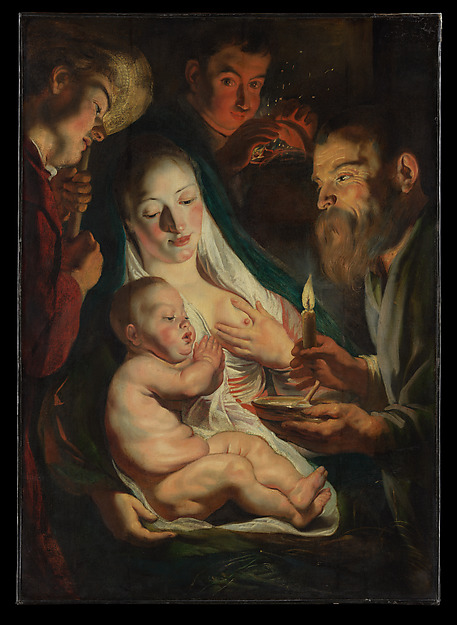
The Holy Family with Shepherds, Jacob Jordaens, 1616

The Holy Family with Shepherds

1616 · Metropolitan Museum of Art

Madonna and Child in the Garland of Flowers, Jacques Jordaens, c. 1618

Madonna and Child in the Garland of Flowers

c. 1618 · Eremitage

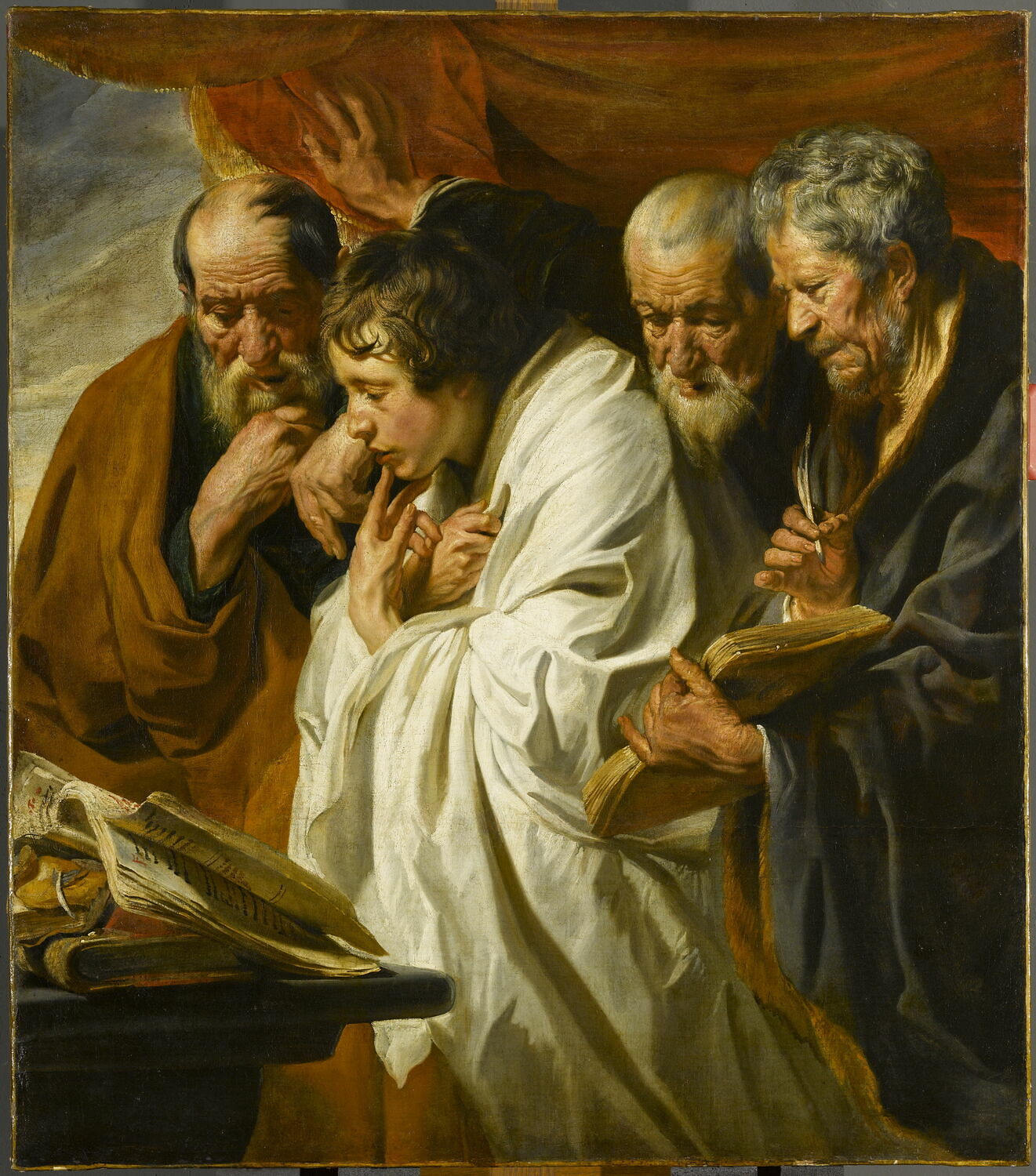
Les Quatre évangélistes, Jordaens, Jacob, 1e tiers du XVIIe siècle (1625 - 1630)

Les Quatre évangélistes

1e tiers du XVIIe siècle (1625 - 1630) · Louvre

Aus der Sammlung: Kupferstichkabinett Dresden

Museumsseite
Der Erzengel Michael, Raphael

Raphael

Der Erzengel Michael

Kopf einer jungen Frau mit Turban und Perlenkette, Raphael

Raphael

Kopf einer jungen Frau mit Turban und Perlenkette

Plakat: I. Kunstausstellung der Wiener Secession, Gustav Klimt, 1898

Gustav Klimt

Plakat: I. Kunstausstellung der Wiener Secession, 1898

Jan Antonides van der Linden, Professor der Medizin in Leiden, Rembrandt, 1665

Rembrandt van Rijn

Jan Antonides van der Linden, Professor der Medizin in Leiden, 1665

Jan Antonides van der Linden, Professor der Medizin in Leiden, Rembrandt, 1665

Rembrandt van Rijn

Jan Antonides van der Linden, Professor der Medizin in Leiden, 1665

Diana und Aktaion, Rembrandt, 1663–1665

Rembrandt van Rijn

Diana und Aktaion, 1663–1665

Petrus am Totenbett der Tabea, Rembrandt, 1662–1665

Rembrandt van Rijn

Petrus am Totenbett der Tabea, 1662–1665

Die Frau mit dem Pfeil (Venus und Cupido?), Rembrandt, 1661

Rembrandt van Rijn

Die Frau mit dem Pfeil (Venus und Cupido?), 1661