
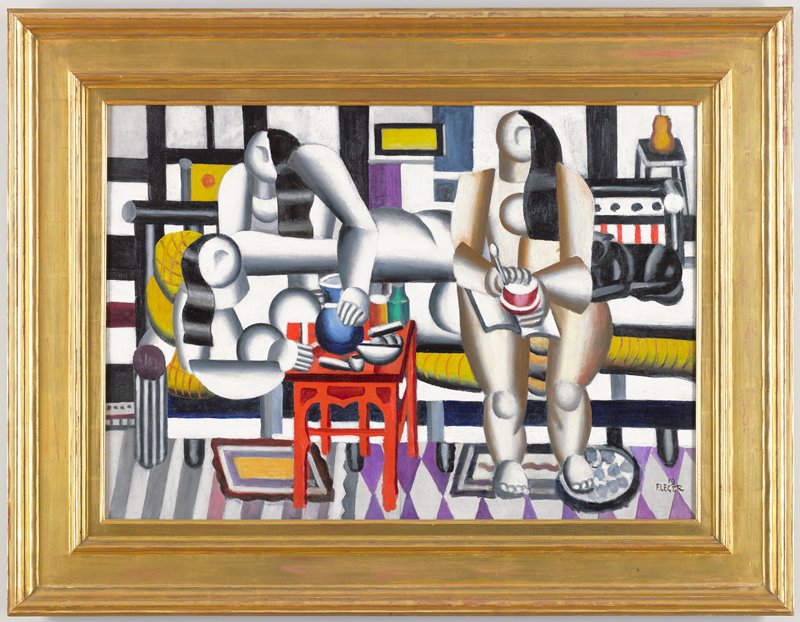
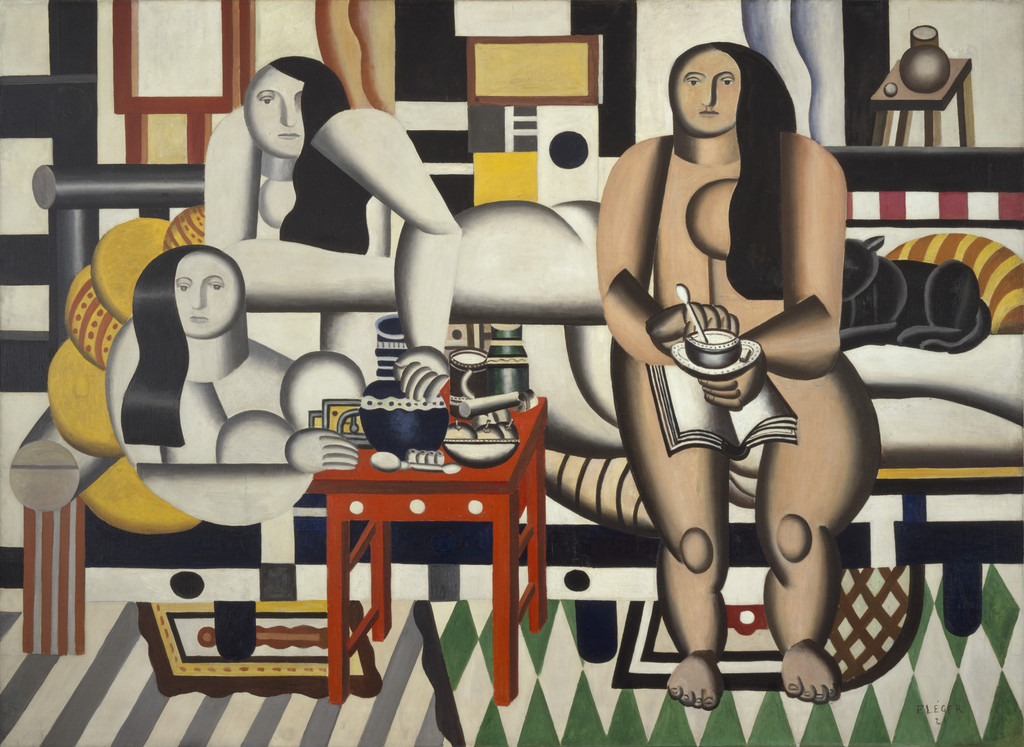
 Fernand LégerFrankreich, 1881–1955
Abstraction
Darf man es sehen?
Empfängt derzeit nicht

National Gallery of Art
Washington, D.C., Vereinigte Staaten
Es gehört zur Sammlung, ist derzeit aber nicht ausgestellt.
- Geprüft
- vor 17 Stunden
- Unverändert seit
- 19. Aug. 2026
- Quelle
- Sammlungsdaten des Museums selbst
Angaben
- Inventarnummer
- 2011.60.12
What it shows
Im Katalog
Quellen
- National Gallery of Art: the museum's own open data · abgerufen vor 4 Tagen
- Bild: National Gallery of Art — © the artist or rights holder
Derweil im Leben von Fernand Léger
Das ganze Leben1940–1945
The war years in exile in the United States
In 1940–1945 Léger lives in exile in the United States. He teaches at Yale University, where Focillon, Milhaud and Maurois also teach, gives “Composition with Two Parrots” to the Museum of Modern Art in New York, and in the summer gives a course of lectures at Mills College (Oakland, California), where he organizes an exhibition of his paintings.
1940–1945
Broadway neon and bands of colour
During his American sojourn Léger begins making paintings in which freely arranged bands of colour are juxtaposed with figures and objects outlined in black. He credited the neon advertisements of Broadway as the source of this innovation: you talk to someone and he suddenly turns blue, then the colour fades, another one comes and turns him red or yellow.
1940–1945
A circle of refugees: Pierre Matisse and Father Couturier
In his years of exile Léger meets other refugee artists at Pierre Matisse's and forms a friendship with Father R. P. Couturier.
1945
Joining the French Communist Party
In 1945, on his return to France, Léger joins the Communist Party. According to the art historian Charlotta Kotik, his determination to depict the common man, and to create for him, came from socialist theories widespread among the avant-garde, but his social conscience was not that of a fierce Marxist but of a passionate humanist.
December 1945
Return to France
In December 1945 Léger returns to France after five years in the United States. His work becomes less abstract, and he produces many monumental figure compositions of popular life — acrobats, builders, divers, country outings.




![Scenes from the Passion of Christ: The Descent into Limbo [right panel], Andrea Vanni, 1380s](https://api.nga.gov/iiif/4205a539-eadd-4486-89a7-3cff9c1ba428/full/!2400,2400/0/default.jpg)


