ART WIKI32.963 ausgestellt
KarteSammlungKünstlerMuseenAusstellungenJournal
Anmelden

ART WIKI

Wo das Meisterwerk hängt und wann man vorgelassen wird.

Sammlungen: Art Institute of Chicago, Cleveland Museum of Art, Eremitage, Getty Villa, Harvard Art Museums, Hirshhorn Museum and Sculpture Garden, J. Paul Getty Museum, Louvre, Metropolitan Museum of Art, Minneapolis Institute of Art, Museum of Modern Art, National Gallery of Art, National Museum of Asian Art, National Portrait Gallery, Puschkin-Museum, Rijksmuseum Amsterdam, Russisches Museum, Smithsonian American Art Museum, Statens Museum for Kunst, Tretjakow-Galerie, Victoria and Albert Museum, Whitney Museum of American Art, Staatskatalog des Museumsfonds Russlands (274 Museen), Europeana (19 Museen), Wikidata (6 Museen), Paris Musées (12 Museen) und Joconde, die Museumsdatenbank des französischen Kulturministeriums (495 Museen). Die Bilder gehören ihren Rechteinhabern.

Rubriken

  • Karte
  • Suche
  • Sammlung
  • Meisterwerke
  • Jetzt ausgestellt
  • Künstler

Mehr

  • Museen & Galerien
  • Ausstellungen
  • Journal
  • Woher die Daten stammen
  • Datenschutz & Cookies
StartseiteKarteKatalog
  1. Sammlung/
  2. Puschkin-Museum/
  3. Wie? Bist du eifersüchtig?
Wie? Bist du eifersüchtig?, Paul Gauguin, 1892
Paul Gauguin, PorträtPaul GauguinFrankreich, 1848–1903

Wie? Bist du eifersüchtig?

Aha Oe Feii?

1892 · Painting · 66.2 × 89.3 cm

Darf man es sehen?

Unbekannt

Puschkin-Museum

Moskau, Russland

Der Besitzer ist bekannt; ob das Werk derzeit ausgestellt ist, nicht.

Quelle
Das Museum
Auf der KarteMuseumsseite

Über das Gemälde

Aha Oe Feii? or Are You Jealous? (French: Eh quoi ! Tu es jalouse ?) is an oil-on-canvas painting by Paul Gauguin from 1892, based on a real-life episode during his stay on Tahiti which he later described in the diary Noa Noa: "On the shore two sisters are lying after bathing, in the graceful poses of resting animals; they speak of yesterday's love and tomorrow's conquests. The recollection causes them to quarrel, "What? Are you jealous?" Gauguin titled the painting in Tahitian language, Aha Oe Feii?, in the lower left corner of the canvas.

Weiterlesen

The painting evokes a sense of Pacific paradise in which sexual relations are playful and harmless. According to Professor Peter Toohey, "this jealousy is not the product of a threat to an exclusive sexual relationship or jilted love affair – it is the result of one of the sisters having enjoyed more sex than the other the night before". In a letter to his friend from 1892, Gauguin wrote about the painting: "I think this is the best of what I've made so far".

The painting is housed in the Pushkin Museum, Moscow, Russia.

Wikipedia · CC BY-SA

Angaben

1892 · mit 44 Jahren
18481903
Inventarnummer
Ж-3269

Im Katalog

GemäldeÖlFranzösische MalereiImpressionismus19. JahrhundertFrankreich

Quellen

  • Puschkin-Museum
  • Bild: Puschkin-Museum — © Pushkin State Museum of Fine Arts

Derweil im Leben von Paul Gauguin

Das ganze Leben
  1. 1870s–1891 · Wirkungsort

    Paris

  2. 1886–1891 · Wirkungsort

    Pont-Aven

  3. February 1891

    Successful Auction at the Hôtel Drouot

    A successful auction of paintings at the Hôtel Drouot in Paris in February 1891, aided by a glowing review from Octave Mirbeau, together with a banquet and a benefit concert, provided the funds for the journey to Tahiti.

  4. 1 April 1891

    Departure for Tahiti

    On 1 April 1891, after a final visit to his wife and children in Copenhagen, Gauguin sailed for Tahiti, intending to escape European civilization and "everything that is artificial and conventional." He spent his first three months in Papeete, then set up a studio in a bamboo hut at Mataiea.

  5. 1891–1901 · Wirkungsort

    Tahiti

  6. August 1893

    Return to France

    In August 1893 Gauguin returned to France, where he continued painting Tahitian subjects such as Mahana no atua and Nave nave moe; he rented an apartment on rue Vercingétorix on the edge of Montparnasse and held a weekly salon, cultivating an exotic image.
Mehr von Paul Gauguin

Alle Werke
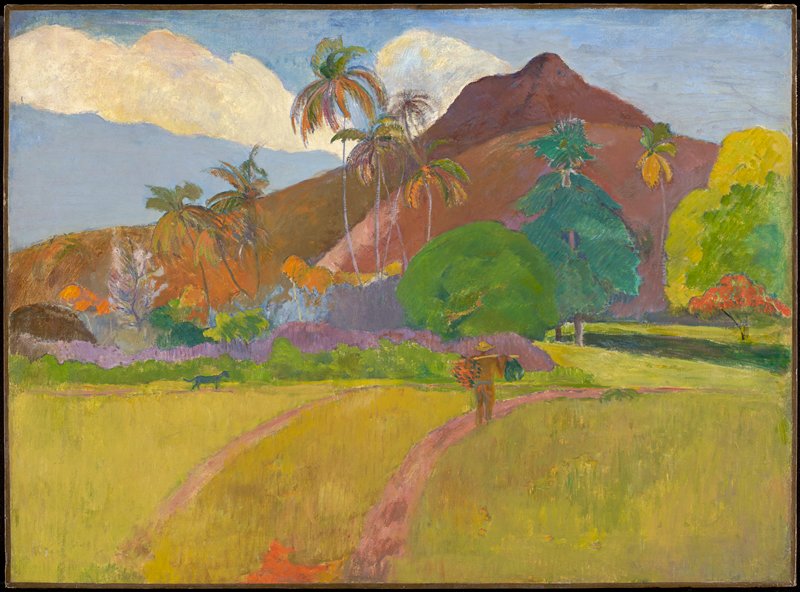
Tahitian Landscape, Paul Gauguin, 1891

Tahitian Landscape

1891 · Minneapolis Institute of Art

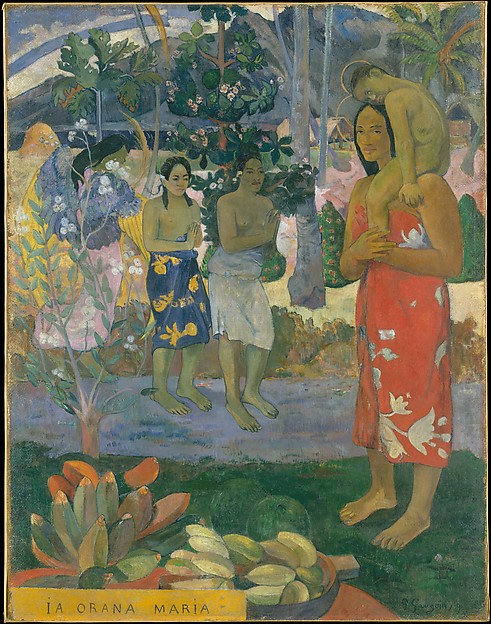
Ia Orana Maria (Hail Mary), Paul Gauguin, 1891

Gegrüßt seist du, Maria

1891 · Metropolitan Museum of Art

Emile Gauguin (1874–1955), the artist's son, Paul Gauguin, ca. 1877–78

Emile Gauguin (1874–1955), the artist's son

ca. 1877–78 · Metropolitan Museum of Art

Madame Alexandre Kohler, Paul Gauguin, 1887/1888

Madame Alexandre Kohler

1887/1888 · National Gallery of Art

Breton Girls Dancing, Pont-Aven, Paul Gauguin, 1888

Breton Girls Dancing, Pont-Aven

1888 · National Gallery of Art

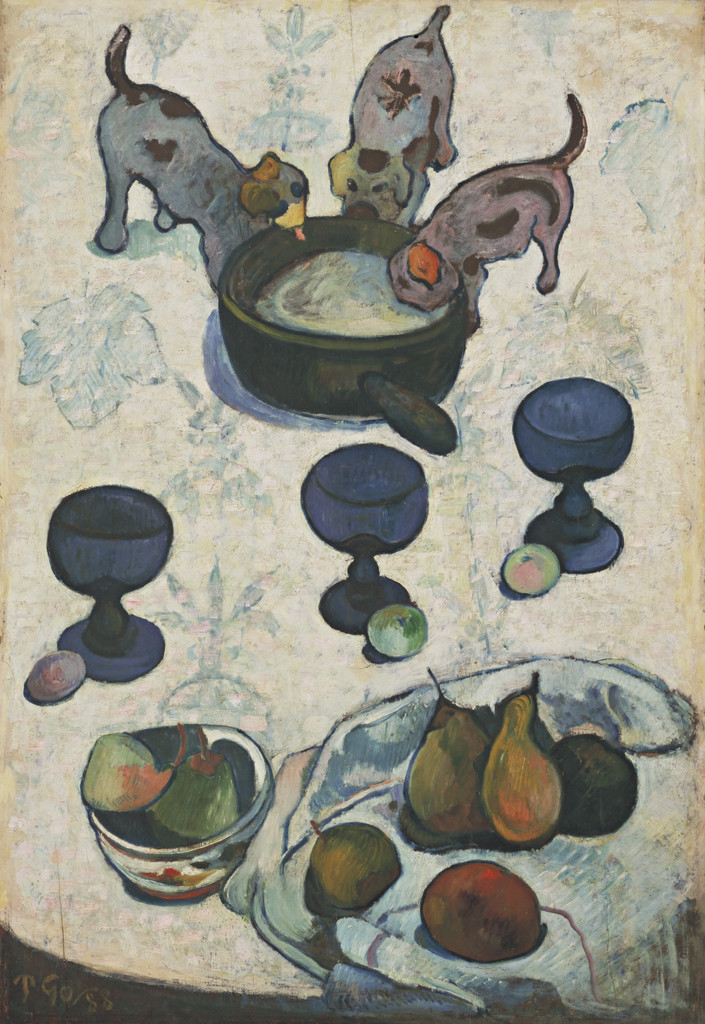
Still Life with Three Puppies, Paul Gauguin, 1888

Still Life with Three Puppies

1888 · Museum of Modern Art

Walking stick with a female nude and a Breton sabot on the handle, Paul Gauguin, ca. 1888–90

Walking stick with a female nude and a Breton sabot on the handle

ca. 1888–90 · Metropolitan Museum of Art

Pair of Wooden Shoes (Sabots) [left], Paul Gauguin, 1889/1890

Pair of Wooden Shoes (Sabots) [left]

1889/1890 · National Gallery of Art

Aus der Sammlung: Puschkin-Museum

Museumsseite
Titus as a Monk, Rembrandt van Rijn, 1660

Rembrandt van Rijn

Rembrandts Sohn Titus in Mönchstracht, 1660

Die Runde der Gefangenen, Vincent van Gogh, 1890

Vincent van Gogh

Die Runde der Gefangenen, 1890

Landschaft bei Auvers im Regen, 1890

Landschaft bei Auvers im Regen, 1890

Пейзаж в Овере после дождя (пейзаж с повозкой и поездом), Vincent van Gogh, June 1890

Vincent van Gogh

Пейзаж в Овере после дождя (пейзаж с повозкой и поездом), June 1890

Porträt des Doktor Felix Rey, Vincent van Gogh, 1889

Vincent van Gogh

Porträt des Doktor Felix Rey, 1889

Seascape at Saintes-Maries, Vincent van Gogh, 06.1888

Vincent van Gogh

Seascape at Saintes-Maries, 06.1888

Roter Weinberg, Vincent van Gogh, 1888

Vincent van Gogh

Roter Weinberg, 1888

Скрипка, Pablo Picasso, 1912

Pablo Picasso

Скрипка, 1912