 Jean-Auguste-Dominique IngresFrankreich, 1780–1867
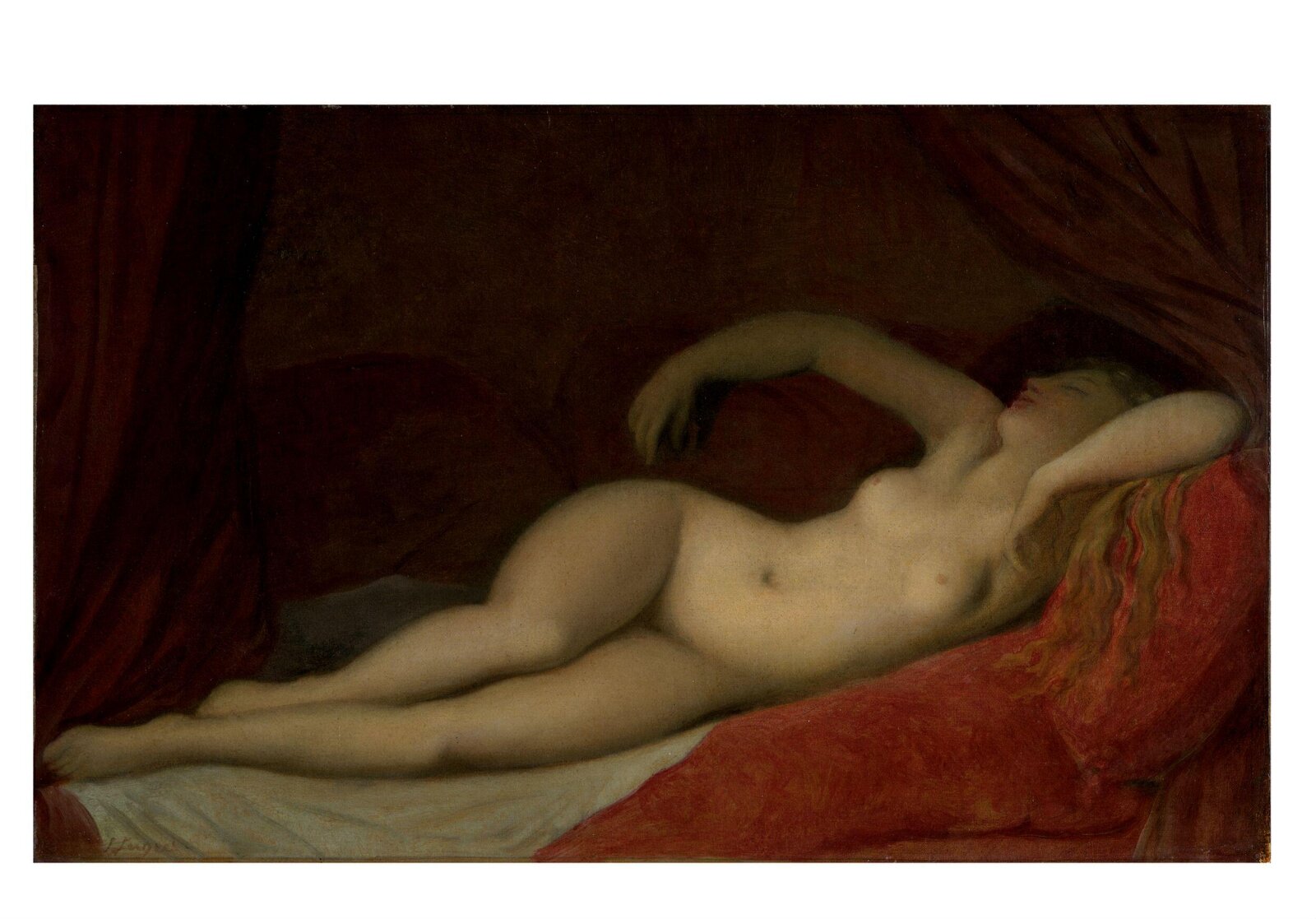
A Sleeping Odalisque
Kann ich es sehen?
Ja, derzeit ausgestellt
Wo ist „A Sleeping Odalisque“ heute? Victoria and Albert Museum, Paintings, Room 81, The Edwin and Susan Davies Galleries, London. Ja, derzeit ausgestellt. Geprüft 25. September 2026.

London, Vereinigtes Königreich
SaalPaintings, Room 81, The Edwin and Susan Davies Galleries
Geschlossen· öffnet morgen um 10:00
Öffentlich ausgestellt.
- Geprüft
- Unverändert seit
- Quelle
- Das Museum
Über das Gemälde
Jean Auguste Dominique Ingres (1780-1867) was born in Montauban. He studied with local painters in Toulouse before entering the Paris studio of David (1748-1825) in 1797. He was soon consider as the champion of the French classical tradition of history painting, traditionally opposed to the art of Delacroix in the early 19th century. Ingres was awarded the prix de Rome in 1801 and alternated long sojourns in Italy and Paris from 1806 but spent the last 9 years of his life in Paris where he died aged 87. His oeuvre also includes portraits paintings which represent a good testimonial of the 19th-century French high society.
Mehr lesen
This painting was probably a preparatory study for one of Ingres' Odalisques, a prototype of female reclining nude which recurs in several compositions. The precise painting for which it was a study is still subject to debate as well as the dating. However it was probably made in Rome between 1810 and 1830.
Victoria and Albert Museum
Angaben
- Inventarnummer
- CAI.57
Was es zeigt
Im Katalog
Quellen
- Victoria and Albert Museum
- Bild: Victoria and Albert Museum — © Victoria and Albert Museum, London
Im Leben von Jean-Auguste-Dominique Ingres
Das ganze Leben1806–1810 · Ausbildung
French Academy in Rome
1813
Marriage to Madeleine Chapelle
The acquaintance began by letter: Ingres drew Madeleine Chapelle's portrait from descriptions in her letters, and when they met in September the drawing matched the original; they married in December. Madeleine wrote to her sister that Ingres was an artist of enormous talent, neither a spendthrift, nor a drunkard, nor a libertine.
1819
Critics condemn the “Grande Odalisque” at the Salon
In 1819 Ingres sent the Grande Odalisque, Philip V and the Marshal of Berwick and Roger Freeing Angelica to the Salon, but critics again condemned his work as gothic and unnatural. The critic Kératry complained that the Odalisque's back was three vertebrae too long.
29 August 1820
The commission for “The Vow of Louis XIII” for Montauban Cathedral
The French Ministry of the Interior commissioned Ingres to paint an altarpiece for the cathedral of his native Montauban on the theme of the Vow of Louis XIII. The commission, which took four years, changed his life and brought him back to the canons of Neoclassicism.
12 November 1824
“The Vow of Louis XIII” at the Salon of 1824
Ingres showed the picture to which he had given four years at the Salon on 12 November 1824, alongside Delacroix's Massacre at Chios, and it was dubbed the “Salon of the Romantic battle”. Admirers and critics alike said the same of him: “the Raphael of our day” and “the best antidote to the Romantic threat”.
1834
The failure of “The Martyrdom of Saint Symphorian”
Ingres worked for ten years on the grand Martyrdom of Saint Symphorian as the summation of all his skill, but at the Salon of 1834 it was attacked by both the Neoclassicists and the Romantics. In anger he announced that he would no longer accept public commissions or take part in the Salon.




![The Barbaric Dance (Before Salomé and Hérod) [La danse barbare (devant Salomé et Hérode)], Pablo Picasso, 1905, published 1913](https://api.nga.gov/iiif/50a2abdc-52b3-49f7-af3f-2ef384c8f1d0/full/!2400,2400/0/default.jpg)