Can I see it?
Where to See John Singer Sargent: Madame X, the Boit Sisters and a Dance in Boston
Isabella Stewart Gardner prepared a home for a Sargent she did not yet own. The paintings in Boston, New York and London have other surprises, including a husband who took a dog's place.
2. november 2026 · 7 min. læsning · ART WIKI’s redaktion
Isabella Stewart Gardner finished an elaborate setting for El Jaleo in December 1914, while the painting still belonged to somebody else. She showed the result to its owner, Thomas Jefferson Coolidge, and he gave her the canvas. It was an acquisition campaign conducted through architecture. The painting belongs to Boston's Isabella Stewart Gardner Museum; its history makes a good starting point for Sargent, whose apparently effortless scenes so often depended on elaborate arrangements outside the frame.
Boston: the dance and the children who will not line up
Sargent based El Jaleo on drawings made in southern Spain in 1879. The title suggests a noisy commotion as well as a dance. Gardner's historical installation used an arch and a mirror to extend the performance beyond its painted limits. Even on a reproduction, try looking away from the dancer towards the accompanying figures. The white skirt draws you back, but the people around it supply the rhythm. Their presence keeps the picture from becoming a portrait of a single performer.
At Boston's Museum of Fine Arts, The Daughters of Edward Darley Boit offers a less obliging group. Sargent painted the four sisters in their Paris apartment in 1882. The youngest sits on the floor, while the older girls recede towards darkness. In 1919 the sisters gave the canvas to the museum in memory of their father. Keep that later act beside the painted moment. The children who seem half lost inside this room eventually decided where the room should go.

New York: a shoulder strap and an unexpected husband
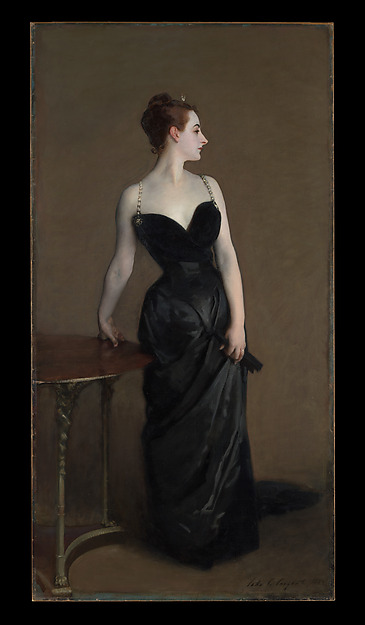
Virginie Gautreau did not commission Madame X. Sargent sought her out, hoping her appearance would help his reputation. At the Paris Salon of 1884, viewers saw the right shoulder strap slipping down her arm. Ridicule followed. He repainted it upright and kept the picture for more than thirty years before selling it to the Metropolitan Museum in 1916. The strap you see belongs to the aftermath of the scandal, not to the painting's first public appearance.
Gautreau and her mother had asked him to take the portrait out of the exhibition. Sargent nevertheless defended it and kept it in his studio. That stubborn attachment changes the familiar story of a career disaster. The canvas was not simply an embarrassment to be hidden. At the Met, Madame X was recorded in Gallery 771 during our autumn 2026 check on 29 September. Give the painting a little time after the anecdote; its turned head and twisting pose remain after you have found the repaired strap.
An absent dog changed Mr. and Mrs. I. N. Phelps Stokes, another Met painting recorded in Gallery 771 at that check. The commission began as a wedding present for Edith Minturn. Sargent exchanged an evening gown for daytime clothing and intended to put a Great Dane beside her. When the dog was unavailable, Isaac Newton Phelps Stokes volunteered to occupy its place. Knowing this, look at the balance of attention between husband and wife. The double portrait began as somebody else's single portrait.
Above The Wyndham Sisters, also recorded in 771, another woman looks down from a painting. She is their mother, portrayed by George Frederic Watts. The daughters sat in their family's London drawing room; Sargent included an older painter's work within his own. Instead of treating the dresses as the whole subject, follow that exchange between generations. The room contains a family history before anyone explains its genealogy. It also places Sargent in conversation with a predecessor whose picture he has made part of the setting.
London: dusk had to be caught twice
For Carnation, Lily, Lily and Rose, in Tate's collection, Sargent returned to his outdoor painting across two seasons in 1885 and 1886. The desired evening light lasted only minutes. Dolly and Polly Barnard posed with lanterns; the finished stillness was assembled through repeated attempts. Look between the light inside a lantern and the light on a white dress. They belong to the same evening, but the painter had to make two different kinds of illumination coexist on canvas.
Conservation research found that Sargent changed lilies into roses and altered a lantern's shape and position. A family story claimed that a pitchfork accident forced him to cut away a large portion of the canvas. Examination found a small old puncture, but did not support that explanation of the picture's format. The distinction matters. This garden was revised through decisions, not simply rescued from a single accident. The flowers are worth a second look once you know some replaced earlier flowers.

Tate also owns Ellen Terry as Lady Macbeth. Sargent attended the production and then invented the pose of Terry raising Duncan's crown above her head. It did not occur in the performance. The green dress, decorated with beetle wings, belongs to the theatre; the gesture belongs to the painter. Read the portrait as a new performance made for the canvas, and the temptation to treat it as a straightforward record of an evening at the Lyceum falls away.
Choose the Met for several conversations within one recorded room; choose Boston if the children's uncertain spacing and Gardner's determination interest you more. For London, save the lanterns and the actress together, then confirm each painting's availability before travelling. Wherever you start, leave the anecdote behind for a moment and look at where Sargent has put the hands.
På forsiden: Madame X (Virginie Amélie Avegno Gautreau) — John Singer Sargent. Open Access (CC0)
Mere at læse
Where to see an artist →Can I see it?
Where to See François Boucher: Diana, Madame de Pompadour and a Palace Scattered Abroad
Boucher's sunrise and sunset once had another job: telling weavers what to make. Follow the paintings from a royal bedroom project to a Paris breakfast table and two separated Venuses in America.
Can I see it?
Where to See Henri Rousseau: The Sleeping Gypsy and the Jungles Made in Paris
A lion finds a sleeping woman and leaves her alive. Rousseau's paintings keep making such improbable arrangements, from a sofa in the jungle to a quiet walk beside a polluted river.
Can I see it?
Where to See Van Dyck: Charles I, a Plague Saint and the People Behind the Silk
Van Dyck could make a king look at ease and a teenager look entitled to the world. A painting made during a Sicilian plague reveals another use for the same persuasive skill.