Can I see it?
Where to See Martinus Rørbye: An Open Window, a Prison and a Shipwreck
To paint an Italian square, Rørbye first had to hire someone to keep the spectators away. His pictures reward the same curiosity that made working outdoors so difficult.
2. november 2026 · 7 min. læsning · ART WIKI’s redaktion
On 18 August 1835, Martinus Rørbye began View of the Square in Amalfi with a hired guard. Andre, the son of a local guide, kept boys and other onlookers away while he painted. Rørbye noted in his diary that he sat almost like a king. By the afternoon he was ill with a cold. The authority lasted longer on the page than it did in the square.
Four days later, he recorded what pleased his spectators most. They liked being able to see prisoners behind the bars and the shop selling fresh water. The painter’s difficult arrangement of buildings had become a place whose smallest activities the locals could recognise. That exchange is a good introduction to Rørbye. The architecture can be exact, yet a person glimpsed through a window may be what holds the picture in memory.
Copenhagen: Amalfi’s prisoners and a Danish warning
View of the Square in Amalfi belongs to SMK, Denmark’s national gallery, and was in room 219 on our autumn 2026 check. The square faces the cathedral of San Andrea. A broad staircase gathers the surrounding buildings into one complicated view. Although long called a study, Rørbye treated the picture as a finished painting and exhibited it after returning from Italy. Its immediate look did not make it a disposable preparation.
SMK bought the picture at auction in November 2018. Its earlier ownership leads back to Rørbye’s widow, Rose, and the sale of her estate in 1860. The little Italian square had remained in the family before travelling through private collections. Knowing that history makes the painted bystanders seem doubly distant. They were present for the work’s making, while its later audiences had to wait for it to emerge from someone else’s home.
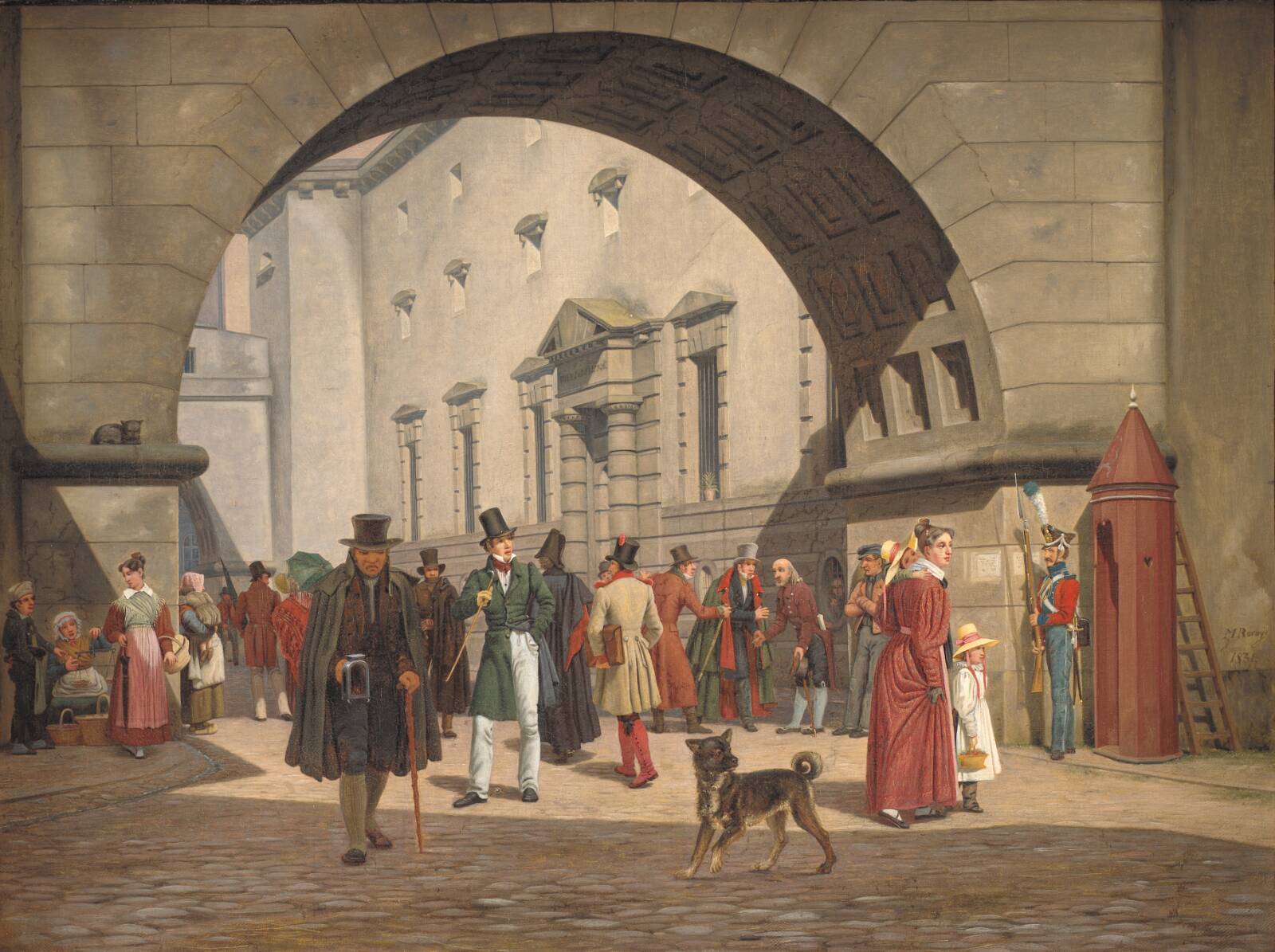
Room 219 also held The Prison of Copenhagen on our autumn 2026 check. A young borrower approaches a moneylender while another man points towards the debtors’ prison. Nearby, a dandy eyes a young mother. C. F. Hansen’s severe building supplies the warning that the people seem ready to ignore. The old man in front keeps a light burning even in daylight, a sour observer of the scene around him.
The prison picture and the Italian square make an absorbing pair because they ask different things of their passers-by. In Copenhagen a gesture becomes a moral clue. In Amalfi a barred window was something the first spectators delighted in recognising. Neither painting is simply a building portrait. Follow the small encounters before tracing the larger architectural lines; the apparent order of a street can hide several competing stories.
Copenhagen: the harbour beyond the flowerpots
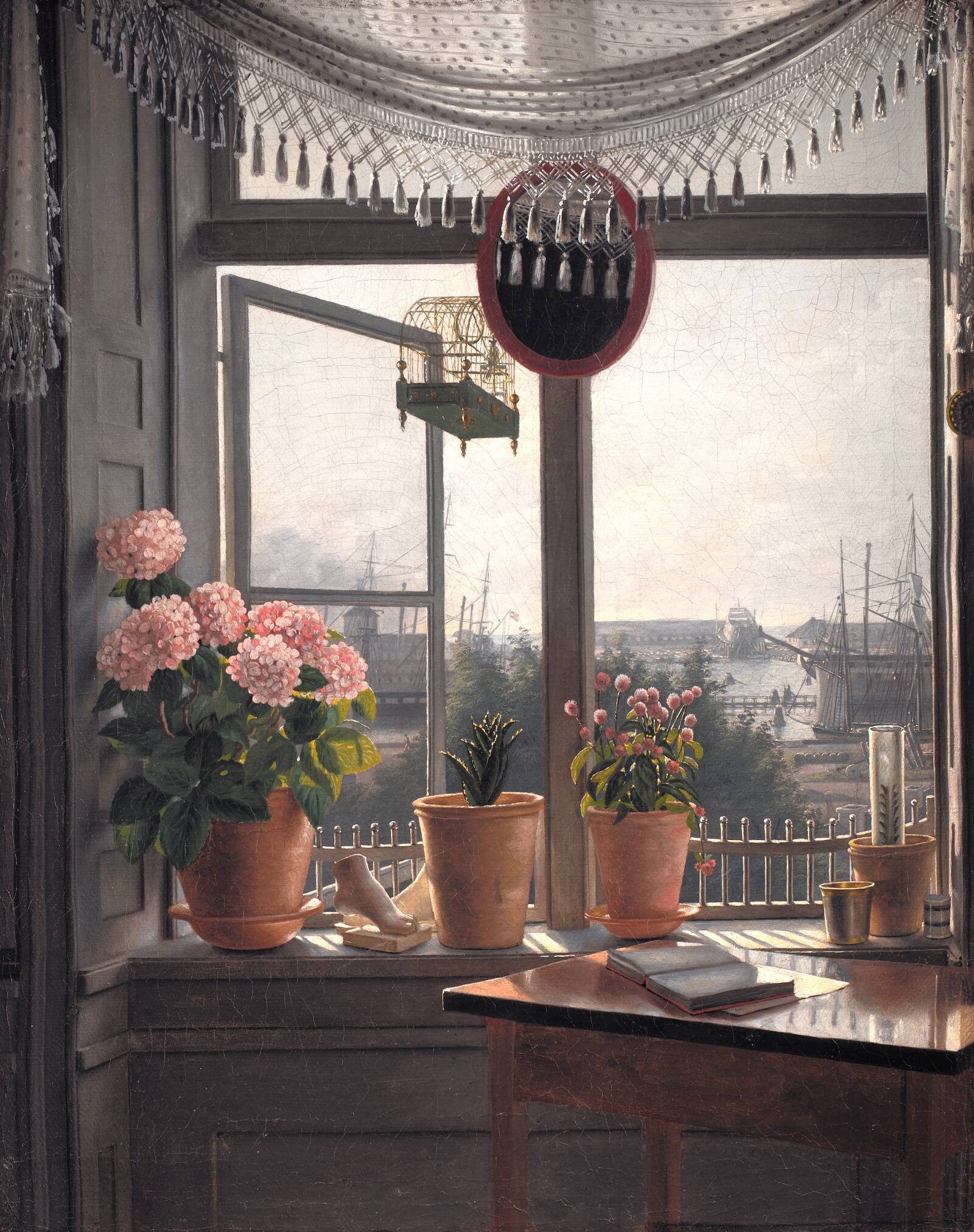
The better-known View from Rørbye’s Window belongs to the same museum, but was marked not on view in our autumn 2026 check. Rørbye painted the view from his parents’ Copenhagen home. Ships and the harbour appear beyond a crowded windowsill. Plants in different stages of growth occupy the near space, with a cutting in a glass tube among them. The room is a sheltered place from which to imagine departure.
Art historians have read the plants as an allegory of growing up, and the open window as a threshold between home and a wider world. A more recent study also treats them as evidence of the new fashion for houseplants in Danish interiors. These readings need not be alternatives. A plant can be a symbol and still require someone to water it. The domestic labour implied by the pots keeps the promise of travel anchored to a household.
Paris: sand caught in the paint
The Louvre’s A Large Ship Being Caulked at Frederikshavn shows the aftermath of a wreck. The schooner Ann of Sunderland had run aground in November 1846; fishermen saved all six crewmen and the grain cargo. Sold at auction, the vessel was partly dismantled and repaired. Rørbye painted the work in August 1847. Sand trapped in the paint records the wind on the beach as directly as any diary entry.
The hull makes this an unusual maritime picture. Its subject is the work required before a ship can become an image of movement again. With the vessel out of the water, there is time to look at its material life. The sea has stopped being a destination glimpsed through a window and become a force that damages wood. Repair is less spectacular than disaster, but it gives the people on the shore something concrete to do.
The Louvre acquired the painting in 2023. On our autumn 2026 check it was in room 862, Richelieu wing, level 2. Its small scale suits a close inspection. Imagine the difference between a brush mark deliberately placed and a grain blown onto the wet surface; the picture contains traces of looking and of simply being outside.
Skagen: a journey made before the colony
Rørbye first travelled through Jutland with Hans Christian Andersen in 1830, although they separated before he reached the far north. His brother Ferdinand worked at Frederikshavn and dealt with shipwrecks. A visit to Skagen followed in 1833, and Rørbye returned late in his life. The coast was connected to family and work as well as to the search for subjects.
Men of Skagen on a Summer Evening in Fair Weather, from 1848, was bought for the royal collection by Frederik VII. It belongs to SMK, whose record marked it not on view in autumn 2026. For a trip now, build the Copenhagen visit around the two room-219 pictures and check the window painting separately. In Paris, leave the harbour view for last: a rescued ship makes a fitting destination after all those imagined departures.
På forsiden: Udsigt fra kunstnerens vindue — Martinus Rørbye. Public domain
Mere at læse
Where to see an artist →Can I see it?
Where to See Carreño de Miranda: A King Repainted and a Child at Court
Charles II grew taller inside his own portrait. In Madrid and Paris, Carreño’s paintings preserve the work that went into making people look powerful, obedient or strange.
Can I see it?
Where to See Fra Bartolomeo: Minerva, a Diplomatic Gift and a Return to Painting
A Florentine altarpiece became a present for a French ambassador. Follow it to Paris, then follow its painter back to the years when taking religious vows seemed to mean putting down his brushes.
Can I see it?
Where to See Paolo Uccello: Saint George and a Battle Split Across Three Cities
A princess has already put the dragon on a leash, but the knight is still attacking. Uccello’s pictures make chronology, horses and even ownership behave in unexpected ways.