Can I see it?
Where to See Giovanni Battista Moroni: The Tailor and the People Behind the Portraits
A pair of shears can tell you as much about Renaissance status as a sword. Follow Moroni from a London cutting table to a widow in New York and a Florentine portrait that spent years under the wrong name.
2. november 2026 · 7 min. læsning · ART WIKI’s redaktion
The scissors have not yet closed. A man has looked up from black cloth marked with chalk, and Moroni leaves him there, between greeting a customer and making the cut. In The Tailor, owned by London's National Gallery, work does not happen somewhere outside the portrait. It happens inside it. Even so, the tool in his hand is only half the story. Look at his waist before deciding who this man might be.
London: the shears and the sword belt
His belt has a fitting for a sword. That was a marker of standing, and the pale doublet and red breeches are hardly clothes chosen to advertise poverty. His precise occupation remains debated. He could be a tailor, a cloth merchant or someone holding office in a guild. The Frick's study of the portrait points out that the expensive costume is wool, whereas Moroni's grander clients wore silk. A profession and a position in society occupy the same body.
Moroni came from Albino, near Bergamo, and made portraits for people in that region. His London pictures let you follow how carefully he listened to the claims a sitter wished to make. Man holding a Letter acquired the nickname The Lawyer, but that occupation is not established. The address on the folded sheet may have been misread; it names a Giulio or Giuliano. A hand points, a face waits, and a later viewer supplies the career.

A letter gives firmer evidence in Canon Ludovico di Terzi. It identifies the churchman by name and office. Unlike many Moroni sitters, he looks away. Spend time with the black clothing, where wool, velvet and silk remain distinguishable. The canvas has never been lined with a second fabric backing, a rare survival among sixteenth-century paintings. Here the condition of the object helps preserve distinctions that a small reproduction can swallow.
New York: a founder loses her title
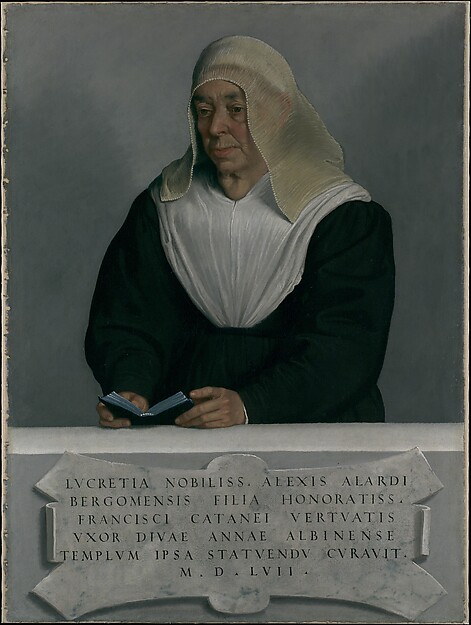
Lucrezia Agliardi Vertova founded a Carmelite convent in Albino, and her portrait stayed there for centuries. That much is secure. The familiar description of her as its abbess is less secure: the Frick's research found no documentary support for the title. In Lucrezia Agliardi Vertova, the widow wears clothing appropriate to her standing, rather than an identifiable nun's habit. The inscription records what she built. Later descriptions have been less careful about what she was.
Her face and hands also raise different questions. The face is furrowed, the hands smoother; this disparity has been taken as evidence that Moroni sometimes painted faces separately and used another model for the remaining figure. It is a proposal, not a recovered account of the sitting. The portrait dates to 1557. On our autumn 2026 check it was on view in Gallery 612 at the Metropolitan Museum of Art, where looking at those hands gives you something more specific to do than hunt for a famous name.
The same gallery held Bartolomeo Bonghi on that autumn check. His book is no anonymous sign of learning. Its author dedicated the treatise on Roman civil law to Bonghi in 1553. The scholar holds evidence of a professional relationship, while a Bergamo tower appears beyond the window. Compare the book with Lucrezia's inscription. One sitter brings a publication, the other a building; Moroni leaves their claims legible, alongside faces that do not require flattery.
Florence: the man who was mistaken for a saint
A portrait can survive while its identity changes. The Uffizi's Portrait of Pietro Secco Suardo was once thought to show Ignatius of Loyola. The view behind the man was interpreted as Pamplona. Identification eventually turned towards a Bergamo family, helped by a flame and a Latin motto that could be read as a play on the name Secco Suardo. A painted riddle outlasted the knowledge needed to solve it.
He stands at full length in black, one hand near the sword, the other pointing towards the fire. Set that gesture beside the London man's shears. Moroni could give equal attention to a tool and an emblem, but they asked different things of their first viewers. For Florence, keep the portrait's present name in your notes: searching only for the saint would lead you into its old biography. The painting in our selection is dated 1563.

If you can choose just one collection, London offers the encounter with the man at work; New York offers two named people whose accomplishments can still be read in their portraits. Before travelling, reopen the individual artwork pages and check for a newer display update. Once in front of a Moroni, leave yourself time for the hands. They often tell you what the sitter brought to the appointment.
På forsiden: The Tailor — Giovanni Battista Moroni. Giovanni Battista Moroni · Public domain · Wikimedia Commons
Mere at læse
Where to see an artist →Can I see it?
Where to See Simone Martini: An Interrupted Reader and a King’s Borrowed Crown
Mary draws back from a message written in gold; a saint hands his brother a kingdom. Simone Martini’s paintings carry intimate gestures and political claims, sometimes on panels small enough to travel.
Can I see it?
Where to See Valentin de Boulogne: Musicians, Soldiers and a Tired Samson
A soldier plays a love song; Samson sits with the evidence of his violence. Valentin’s figures have somewhere to rest their elbows, but very little peace.
Can I see it?
Where to See Salvator Rosa: Philosophy, Grief and the Trouble with Fortune
Rosa painted animals receiving the rewards that artists wanted, and put the picture before a Roman public. His museum trail follows a man who wanted recognition as a thinker and had reasons to distrust good fortune.