Can I see it?
Where to See Modigliani: Alice, the Nudes and the Friends Who Paid
A sculptor once persuaded Modigliani to keep working on a finished portrait so he could pay him more. Follow that small act of friendship into paintings now in Chicago, Paris, Copenhagen, London and Washington.
2. november 2026 · 7 min. læsning · ART WIKI’s redaktion
Jacques Lipchitz had a problem with his wedding portrait: Modigliani finished it too quickly. According to the sculptor's recollection, a first day of drawings was followed by a second day that produced the painting. The agreed fee was ten francs a sitting, plus alcohol. Lipchitz, who wanted to help his friend, persuaded him to continue for another two weeks. In Jacques and Berthe Lipchitz, now at the Art Institute of Chicago, an apparently formal commission contains a private arrangement for keeping someone afloat.
Chicago: the couple who bought more time
Berthe sits while Jacques stands behind her; their bodies almost fill the narrow space. The difference between their positions matters more than any convincing illusion of depth. His upright figure makes a shelter, though her face remains the picture's firmest point of contact. This is one of only three double portraits Modigliani painted, according to the Art Institute. On our autumn 2026 check, Jacques and Berthe Lipchitz was in gallery 391. Spend a moment with the hands before moving to the faces: friendship has acquired an unusually stiff public costume.

Paris: a young dealer and a canvas with several lives
Paul Guillaume was twenty-three when Modigliani painted Paul Guillaume, Novo Pilota, now in the Musée de l'Orangerie. The poet Max Jacob had introduced them in 1914; Guillaume rented him a studio in Montmartre. The inscription calls the dealer a new helmsman. With his hat, dark suit and assured gaze, this young man looks ready to steer. Yet the hand is scarcely worked out. Modigliani invests the face with authority while letting the apparatus of respectability dissolve into paint.
Nearby in the Orangerie's collection, Antonia offers much less biography. Only her first name is known. Her ears, hair and nose suggest slightly different viewpoints, while the window behind her supplies geometry without supplying daylight. The absence of pupils makes her gaze difficult to return. Where the dealer's portrait announces an ambition, this one leaves a name attached to a person we cannot recover. Looking longer does not solve that uncertainty; it makes the carefully arranged face more peculiar.
Conservation research reported in 2020 found four earlier compositions beneath Antonia, potentially spanning 1908 to 1915. Among them were an upside-down head and one or possibly two caryatid figures. Modigliani had retained and reused this canvas across years of changing ideas. Its apparently settled surface conceals a succession of abandoned beginnings. That discovery gives the portrait a second timescale: the woman seems motionless, but the material beneath her has been repeatedly turned, covered and reconsidered.
Copenhagen: Alice holds the centre
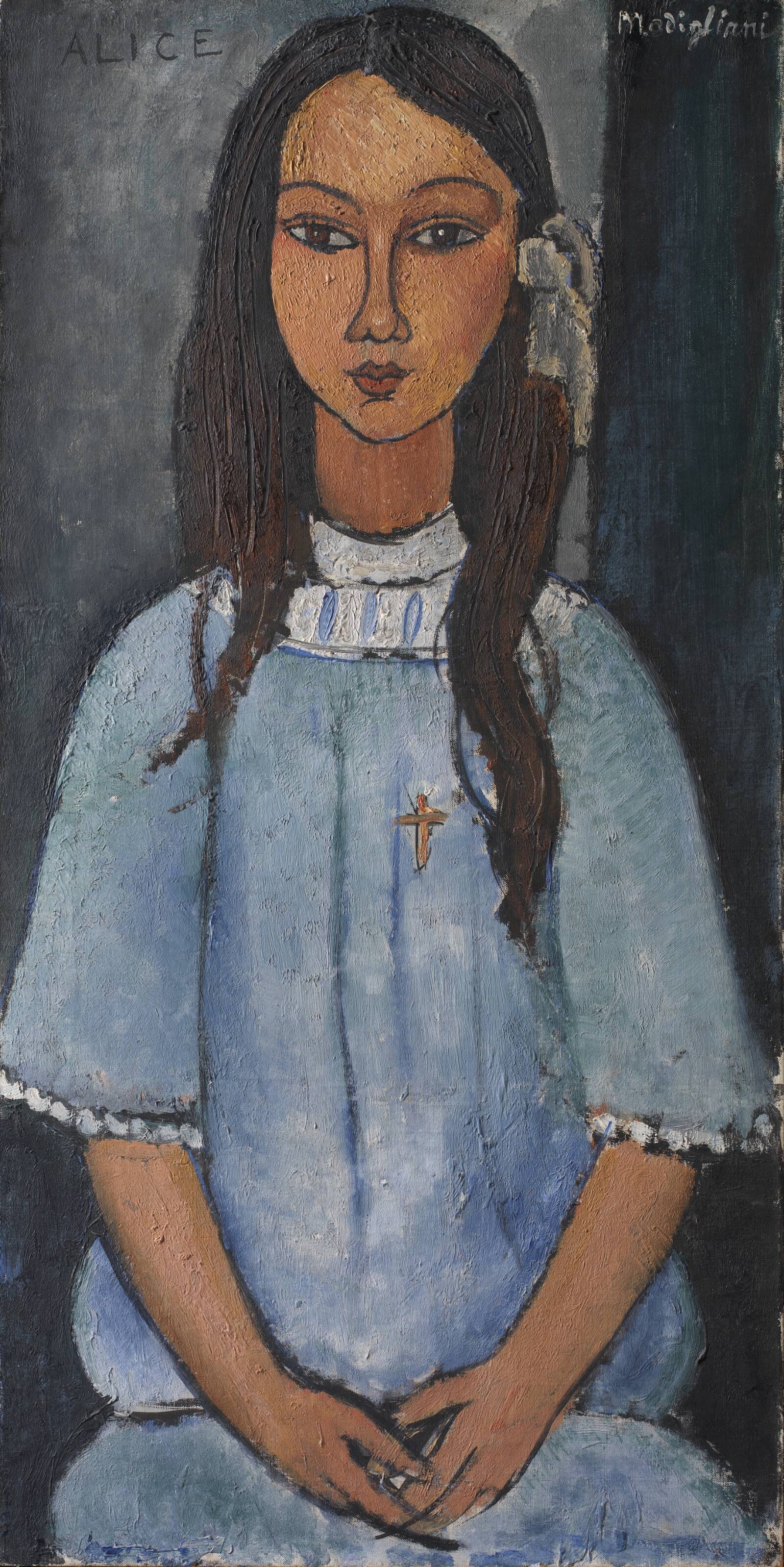
A painting barely forty centimetres wide can occupy a surprising amount of attention. In Alice, at Denmark's national gallery, SMK, Modigliani makes the narrow format work with the long face, neck and upright body. The museum relates this simplified geometry to African masks and medieval art. Those sources are useful to know, but try looking first at how the figure fits her enclosure. Small departures from symmetry keep an almost architectural arrangement from becoming an ornament. On our autumn 2026 check, the painting was in room 215.
London: a nude that keeps the marks of making
Police intervened in Modigliani's 1917 exhibition at Berthe Weill's gallery, where his nudes offended contemporary expectations. The Courtauld's Female Nude, painted around 1916, helps explain the discomfort without requiring us to pretend that the picture still causes the same scandal. Pubic hair and rough paint resist the polished finish of an academic nude. The elongated head also carries lessons from sculpture. This body belongs to a particular encounter between model, painter and paint, however drastically its proportions have been altered.
Look along the boundaries in Female Nude and the surface becomes surprisingly physical. The Courtauld identifies lines scratched into wet paint with the end of a brush and a background worked with a stiff brush. The outline was made by pressure as well as colour. A reproduction can turn Modigliani into a designer of elegant silhouettes; these interruptions restore the hand that scraped and pushed. Allow enough time for the beautiful contour to become a less comfortable, more interesting thing.
Washington: friendship passes through the dealer's hands
Chaim Soutine benefited from Modigliani's introductions. In 1916 Modigliani urged the dealer Léopold Zborowski to represent his friend. At Washington's National Gallery of Art, Chaim Soutine sits with awkwardly gathered hands and uneven eyes, far from Guillaume's professional confidence. The portrait makes a useful counterweight to the Paris dealer: one man seems to command the transaction, the other to endure being looked at. Both positions belong to the same small world of painters trying to make a living.
Guillaume also bought Nude on a Blue Cushion, directly from Modigliani in 1917 according to the National Gallery's provenance record. It passed to Chester Dale in 1928 and eventually entered the museum through his bequest. On our autumn 2026 check, both this painting and Chaim Soutine were in room EG-103-A. Washington therefore offers a compact visit with two very different kinds of exposure: a reclining model and a friend sitting for his portrait. Give them equal time, then decide whose gaze was harder to meet.
På forsiden: Alice — Amedeo Modigliani. Public domain
Mere at læse
Where to see an artist →Can I see it?
Where to See Rossetti: Proserpine, Beata Beatrix and the Women Behind Them
A girl draws back on her bed; a goddess holds the fruit that keeps her captive. Rossetti's pictures turn old stories into encounters that feel uncomfortably close.
Can I see it?
Where to See Claude Lorrain: The Queen of Sheba and His Imaginary Harbours
Claude sends the Queen of Sheba by sea, although the Bible gives her camels. His landscapes begin with places he knew and take considerable liberties with where the journey ends.
Can I see it?
Where to See Filippo Lippi: The Smiling Angel and the Medici's Painter
The angel looks out as if he knows something we do not. Around that small smile, Filippo Lippi built pictures for nuns, bankers, brides and the rooms in which they lived.