Can I see it?
Where to See Giotto: The Ognissanti Madonna and Paintings That Changed Homes
A wartime evacuation helped identify an altarpiece; changing taste kept another in Paris. Follow five surviving paintings through Florence, the Louvre and two American museums.
2. november 2026 · 7 min. læsning · ART WIKI’s redaktion
An evacuation helped return a painting to its history. In 1940, Ugo Procacci noticed a polyptych being carried out of Santa Croce in Florence for wartime protection. It led him back to an altarpiece recorded at the Badia Fiorentina, whose identity had become obscured by moves and alterations. The Badia Polyptych now belongs to the Uffizi. Giotto’s museum paintings have often survived by changing churches, frames or names; finding them means following those changes as well as looking at their gold.
Florence: a throne that has to carry someone
The Uffizi’s Ognissanti Madonna was made for the church that gave it its name, though its exact position there remains uncertain. Mary sits inside a pointed architectural enclosure with coloured marble inlays. Saints partly disappear behind the structure and one another’s halos. That obstruction matters: these figures occupy places where other bodies can block your view of them. Christ raises a hand in blessing and holds a rolled scroll in the other. The throne must accommodate a mother and child with weight.
The kneeling angels bring flowers, not just symmetry. Their vases contain lilies and roses; white flowers refer to purity, red roses to charity and Christ’s future suffering. The wings differ in colour, red and blue, possibly distinguishing seraphs and cherubs. An angel carries a crown, another a covered vessel associated with the Passion. Once you notice the offerings, the gathering stops looking like a row of attendants. Each has arrived carrying something for the central figures.

Before it reached the museum, the Badia Polyptych had already been displaced by changing taste. In 1568 a painting by Vasari replaced it at the high altar, and Giotto’s work moved to the convent’s refectory vestibule. French suppression of the religious house brought further transfers, first to San Marco and then to Santa Croce. Its saints remain arranged in separate compartments, but the central exchange between mother and child draws the eye across a smaller distance: the space between their faces.
Restoration in 1958 removed repainting and a later upper section that had hidden the pointed tops. The polyptych also survived Florence’s 1966 flood and underwent further treatment in 2000. Those changes are worth remembering when a gold-ground painting seems to have arrived from the Middle Ages untouched. You are seeing a shaped wooden object whose outline was once altered to fit another age’s expectations. The recovered gables restore five separate peaks above the figures.
Paris: a saint who was not sent home
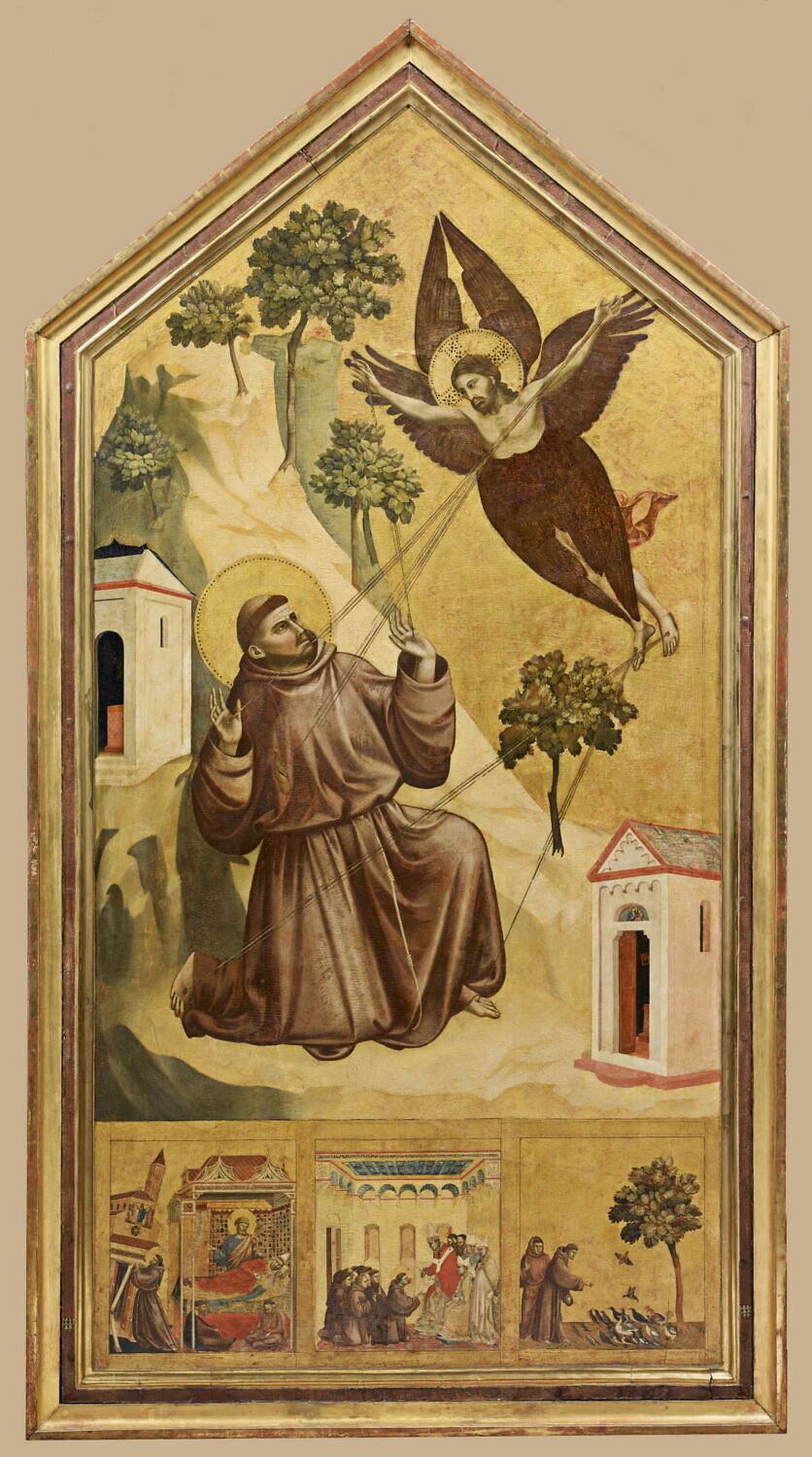
The Louvre’s Saint Francis Receiving the Stigmata came from San Francesco in Pisa during the Napoleonic seizures. Its continued presence in Paris has an unflattering explanation in the history of taste. When restitution followed Napoleon’s fall, early Italian paintings were less valued than works of later centuries and this one was not reclaimed. On our autumn 2026 check it was in Room 708, Denon wing, Level 1. A museum route here passes through decisions about what earlier generations thought worth recovering.
Francis kneels in a rocky landscape as the miracle marks his body. Below the main image, three smaller scenes move between papal authority and creatures with no earthly rank. A sleeping pope dreams of a collapsing church supported by Francis; another scene concerns approval of the order’s rule; the last shows the sermon to birds. Look down after looking up. The panel connects the solitary vision on the mountain with the practical establishment of a religious community and the small listeners gathered at the saint’s feet.
Washington: an uncertain past and a firm little grip
When Madonna and Child emerged into scholarly discussion in 1917, recognition was far from immediate. Bernard Berenson first assigned it to Bernardo Daddi; other scholars proposed an assistant of Giotto. Acceptance of Giotto’s authorship gradually broadened, though dissent did not disappear. The National Gallery of Art catalogues it under his name. Its original altarpiece has been dispersed, and restoration altered the panel’s outline and removed the old surface of its back, taking useful evidence with it.
The Washington Madonna was in M-001 on our autumn 2026 check. The child holds Mary’s index finger and reaches towards the rose in her other hand. A translucent cloth crosses his lower body; the blue mantle around his mother turns back to show a green lining. The exchange is small enough to miss if you stop at the gold. Stay with the fingers for a moment. The blessing gesture familiar from an enthroned Christ has given way to a baby securing his grip on his mother.

New York: a king picks up the baby
A visitor breaks the ceremony in the Met’s Adoration of the Magi. The kneeling king lifts the child from Mary’s lap, and her expression registers concern. This panel belonged to a sequence of seven scenes from Christ’s life. Its stable is viewed slightly from below, so the shelter has a constructed presence above the figures. On our autumn 2026 check the painting was in Gallery 601. The subject is a formal act of homage, but the decisive event is one person reaching for another person’s child.
Let the city you are already visiting decide the route. Florence offers the throne and the multi-part altarpiece; Paris offers a story told on two scales; the American paintings reward attention to hands. Ask about your chosen panel when planning the visit. In the Uffizi, make room in your visit for the Badia panel as well as the larger Madonna: its pointed tops were once hidden under a later addition.
På forsiden: Madonna Enthroned — Giotto. Giotto · Public domain · Wikimedia Commons
Mere at læse
Where to see an artist →Can I see it?
Where to See Carel Fabritius: The Goldfinch and His Other Survivors
A chained bird, a painted nail and a street with improbable perspective lead through the surviving work of a painter killed at thirty-two. Begin in The Hague, then follow the clues to Amsterdam, Rotterdam and London.
Can I see it?
Where to See Sebastiano del Piombo: Lazarus, Rivalry and Uncertain Faces
He kept an altarpiece from Raphael’s eyes and borrowed drawings from Michelangelo. His surviving paintings lead from that rivalry to portraits with disputed names and a stone that failed to stay whole.
Can I see it?
Where to See Luca Signorelli: Repainted Bodies and Stories in the Background
A baby replaced by another painter, a census behind a Nativity, a lizard beneath a cross. Signorelli rewards the visitor who looks beyond the main event.