Can I see it?
Where to See Thomas Eakins: The Gross Clinic, Rowers and a Singer’s Rehearsal
A singer repeated one phrase; surgeons worked before an audience. In Philadelphia and New York, Eakins follows people absorbed in what their bodies can do.
2. november 2026 · 7 min. læsning · ART WIKI’s redaktion
Weda Cook had to sing the same passage again. Thomas Eakins wanted to watch her mouth and throat as she sang, so a portrait sitting became a rehearsal with no prospect of reaching the next song. The opening bars of the Mendelssohn piece were eventually carved into the frame of The Concert Singer. The Philadelphia Museum of Art holds the painting. Before looking at her gown, look at the open mouth; that small shape cost someone a great deal of singing.
Philadelphia: the performance and the operation
Cook was twenty-three when work began, and the sittings continued for two years. Eakins loved music, although he did not play an instrument and apparently had a poor singing voice. His wife Susan played the piano. That puts the painter in an unusual position beside his model: he understood the pleasure of listening, but needed her to keep producing the physical evidence of how it was done. In The Concert Singer, the pause between inhaling and releasing a note becomes the subject of a portrait.

Another professional body at work fills The Gross Clinic, also in the Philadelphia collection. Samuel Gross and his colleagues operate on a patient’s thigh before a lecture audience. Eakins made the picture for the 1876 Centennial exhibition, but the art jury rejected it, perhaps because of the blood. It was shown instead in a model army hospital. The woman covering her face is traditionally identified as the patient’s mother. Eakins placed himself behind the railing, making notes or a sketch, while the surgeon holds up his stained fingers.
Give that enormous painted audience some attention. One response to the operation is to recoil; another is to watch, and a third is to write down what matters. The mother, students and painter supply different ways of looking at the same exposed flesh. You are allowed to move between them. Start with the bright forehead of Gross, follow the hand into the operation, then look back into the dark rows of witnesses. The picture offers no clean separation between an educational demonstration and something happening to a person.

New York: a father signs through his son
Benjamin Eakins appears in The Chess Players at the Metropolitan Museum of Art, watching two friends consider their moves. A Latin inscription on the table drawer identifies the painter as Benjamin’s son. Above the mantel hangs a reproduction after Gérôme, under whom Thomas studied. Family and artistic schooling share this crowded room without interrupting the game. When Eakins gave the picture to the Met in 1881, it became the first work the museum accepted directly from a living artist. On our autumn 2026 check it was in gallery 730.
Benjamin had his own exacting occupation. In The Writing Master, recorded in gallery 766 on the same check, the calligrapher leans over his desk and attends to the page. The surrounding darkness gives the working hand little competition. Compare that hand with the surgeon’s, or with the fingers holding a chess piece. You do not need to treat them as symbols of one grand idea. Each belongs to a different task, with its own pace and its own risk of an error. Here the subject is the painter’s father doing his job.
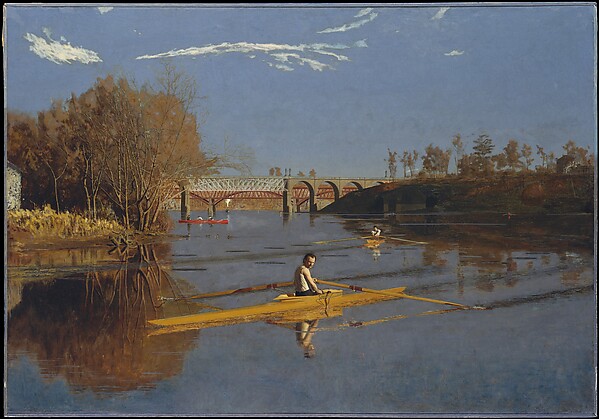
The river offers more room to breathe. Max Schmitt in a Single Scull is thought to commemorate the October 1870 racing victory of Eakins’s school friend, a lawyer and amateur rower. Eakins had returned from Europe that year; the rowing pictures helped launch his professional career. He also put himself into this one, pulling a scull in the middle distance. On our autumn 2026 check the painting was in gallery 763. The foreground boat has stopped competing, and its occupant turns towards the spectator while the painter continues rowing behind him.
Susan enters this New York route in Portrait of His Wife and Setter Dog, recorded in gallery 764 in autumn 2026. She was herself a painter and photographer, formerly Eakins’s student. Their dog was called Harry. An 1886 reproduction shows Susan looking more robust than she does in the final painting, evidence that her husband altered it. The changes may belong to the distress surrounding his dismissal from teaching after he removed a male model’s loincloth in a class attended by women. The possibility remains an interpretation, not a diagnosis of the sitter.
Philadelphia again: the bell has not rung
For Between Rounds, return to the Philadelphia Museum of Art’s collection. The boxing arena stood across from the academy where Eakins had taught. His wife recalled that the figures posed individually; the canvas combines observations rather than reporting a single bout. A separate episode gives the boxer Billy Smith a voice. After receiving a portrait from Eakins, Smith complained that paint above his lip looked like a moustache and asked for it to be removed. Eakins refused. The man who could take a punch still wanted a say in his painted face.
If your time permits only New York, let the sitters guide your route through Eakins’s work. Move from the chess spectators to the rower, then spend the last few minutes with Susan and Harry. Keep the autumn room numbers as starting points and check the day’s arrangements before setting off. The Met route puts a father’s profession, a friend’s recreation and a marriage within one museum visit; the calligrapher was recorded in gallery 766.
På forsiden: The Gross Clinic — Thomas Eakins. Thomas Eakins, American, 1844 - 1916 (1844 - 1916) – Artist/Maker (American) Born in Philadelphia, Pennsylvania, United States. Died in Philadelphia, Pennsylvania, United States. Details on Google Art Project · Public domain · Wikimedia Commons
Mere at læse
Where to see an artist →Can I see it?
Where to See Berthe Morisot: The Cradle and the Sister Behind It
A friend repainted her canvas; a buyer could not be found for her cradle. Follow Morisot through the family encounters and public arguments behind her quiet rooms.
Can I see it?
Where to See Masaccio: A Scattered Altarpiece and a Madonna Who Tickles
A meticulous patron left the paperwork; later centuries scattered the paintings. Follow the surviving panels from London and Naples to Berlin and Florence.
Can I see it?
Where to See Horace Vernet: The Clichy Gate, Napoleon and a Wounded Dog
A regimental dog receives first aid while a future king buys memories of battle. Vernet’s pictures lead from small acts of care to the politics of military spectacle.