Can I see it?
Where to See Camille Corot: The Bridge at Narni, Remembered Lakes and Private Figures
A critic disliked the drawing of Corot’s reading woman. Corot revised the landscape instead, leaving her alone: a useful warning against deciding too quickly what mattered to him.
2. november 2026 · 7 min. læsning · ART WIKI’s redaktion
At the Salon of 1869, Théophile Gautier praised the colour of A Woman Reading but objected to the drawing of its figure. Corot was seventy-two. When he returned to the canvas, he changed the landscape and kept the woman. This encounter with an obstinate late painting is one way into Camille Corot, whose career moved between outdoor studies, pictures made for exhibitions and figure paintings he often kept from public view.
Paris: a bridge before it became an exhibition picture
The broken bridge in The Bridge at Narni belongs to a working journey. Corot painted this study in Italy in 1826, using oil on paper, and subsequently used it for a larger Salon composition. Here you encounter the material gathered before that public performance. The support is only 34 by 48 centimetres. Move close enough to see the strokes, then back far enough for the river and masonry to settle into place.
The Louvre kept the study in Room 949 of the Sully wing, Level 2, on our autumn 2026 check. It entered the collection through Étienne Moreau-Nélaton’s donation in 1906. The room offers a reason to slow down before the grander canvases elsewhere in the museum. A portable sheet made on a journey can hold your attention just as firmly as a painting conceived to command an exhibition wall.
In that same room, Chartres Cathedral contains a much longer interval. Corot began it in 1830 after leaving Paris during the July Revolution, then returned to it in 1872, enlarging the format and adding a foreground figure. The cathedral shares the view with earth and building stones. Think about that delay while looking: what appears to be one afternoon also contains a painter revisiting his own decisions forty-two years later.

Paris again: a lake remembered, then bought by an emperor
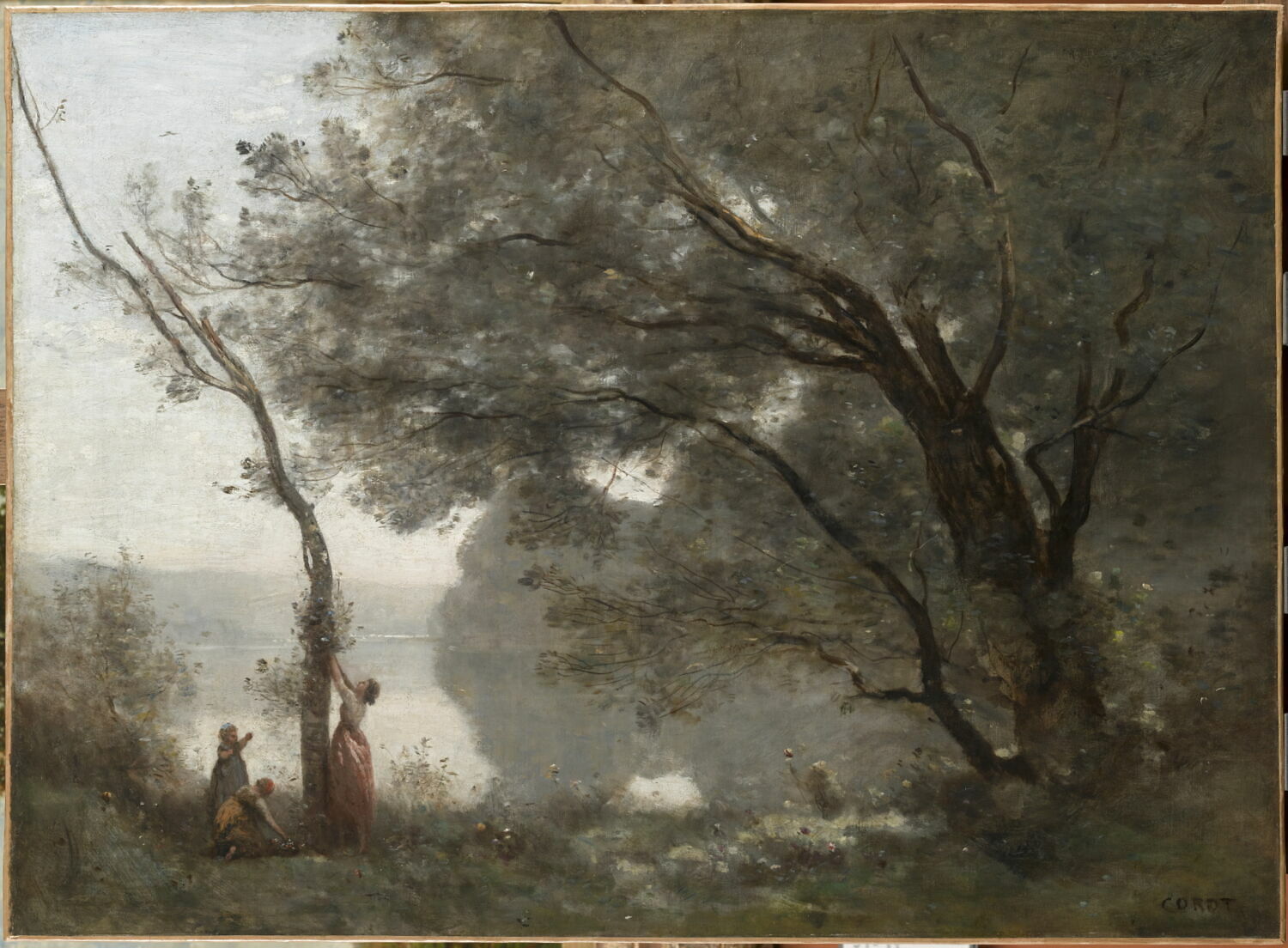
A woman and children gather beside the water in Recollection of Mortefontaine. Corot had visited the place repeatedly to study light and reflections, but the title tells you how to approach the result. This is a recollection. The trees and lake have been brought together through memory; you need not locate the exact spot where an easel supposedly stood. Compare the soft edges with the firmer shapes of the Narni study, keeping the different purposes of the pictures in mind.
Napoleon III bought it through his Civil List at the Salon of 1864. After the fall of the Empire, a judicial decision assigned it to the national museums in 1879; it reached the Louvre in 1889. The painting’s quiet has an administrative history behind it. Our autumn 2026 check placed it in Room 952, also in the Sully wing on Level 2. Save the two room numbers together, then let the changes in paint and pace guide the visit.
New York: the woman keeps her place
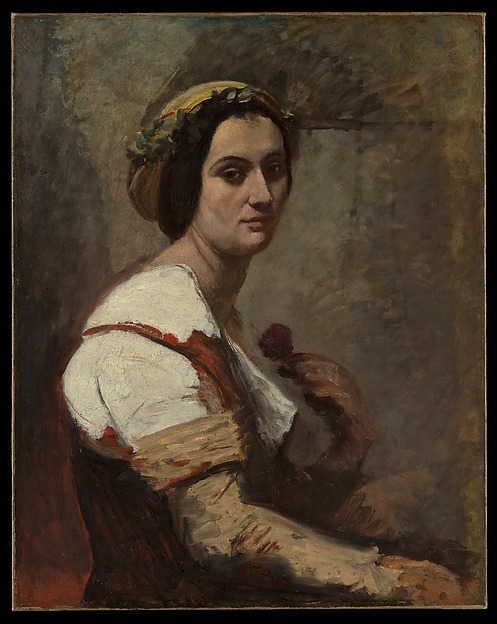
Gautier had seen only a fraction of the painter’s figure studies. Corot had been making them for about a decade before exhibiting A Woman Reading, recorded in Gallery 809 at the Metropolitan Museum of Art on our autumn 2026 check. Gautier’s surprise says something about the gap between the painter’s public reputation and the work accumulating privately. The small canvas is worth a visit on its own terms, without asking it to behave like one of his expansive views.
Another figure in Gallery 809, Sibylle, hides an abandoned performance. X-rays show that the woman originally played a cello. Corot adjusted the instrument and bow, then painted them out, lowered her right hand into her lap and put a flower in the left. Look at the hands after the head. Their less finished passages preserve the difficulty of changing the pose, while the instrument that explained it has vanished.
For a different use of the human figure, go back to Hagar in the Wilderness, recorded in Gallery 802. The mother and Ishmael occupy a vast, dry setting, with an angel bringing the promise of rescue. Corot built this biblical wilderness partly from French nature studies. The figures are small because the landscape must make their isolation felt. Begin with the empty ground around them; only then follow the mother’s gesture towards the help she needs.
Washington: a forest assembled for the Salon
A woman reads beside a stream in Forest of Fontainebleau, but this is no small private study. Corot prepared the large canvas for the Salon of 1834, combining motifs from nature with memories of Dutch landscape painting. It does not reproduce a single identifiable site. The National Gallery of Art recorded it in M-093 on our autumn 2026 check; its Ville-d’Avray was not on view at that check. For a first Corot day, choose the Louvre’s two rooms or the Met’s figures and wilderness. Give each picture its own viewing distance, and check the linked records again before leaving home.
På forsiden: Le pont de Narni. — Camille Corot. © 2015 GrandPalaisRmn (musée du Louvre) / Mathieu Rabeau
Mere at læse
Where to see an artist →Can I see it?
Where to See Whistler: His Mother, the White Girls and London at Night
Whistler called his paintings harmonies and symphonies. The people who stood for them remembered something less abstract: long hours, delayed lunches and a painter who would not let them move.
Can I see it?
Where to See Carpaccio: Venice, a Sleeping Princess and a Knight Without a Name
Carpaccio can hide a miracle behind the traffic on a canal. Follow his pictures from Venice to Madrid and Paris, and the smallest details begin to tell the largest stories.
Can I see it?
Where to See Giorgione: The Tempest and the Pictures That Keep Their Secrets
A woman replaced by a man, a portrait that once had another name, a dragon supplied by a restorer: looking for Giorgione means learning to distinguish a puzzle from a damaged clue.