Zodiaque de Dendéra
Kan det ses?
Ja, udstillet nu
Hvor er »Zodiaque de Dendéra« i dag? Louvre, Salle 325, Aile Sully, Niveau 0, Paris. Ja, udstillet nu. Kontrolleret 16. november 2026.

Åbent nu· til kl. 21.00
Udstillet for publikum.
- Kontrolleret
- Uændret siden
- Kilde
- Museet
Om skulpturen
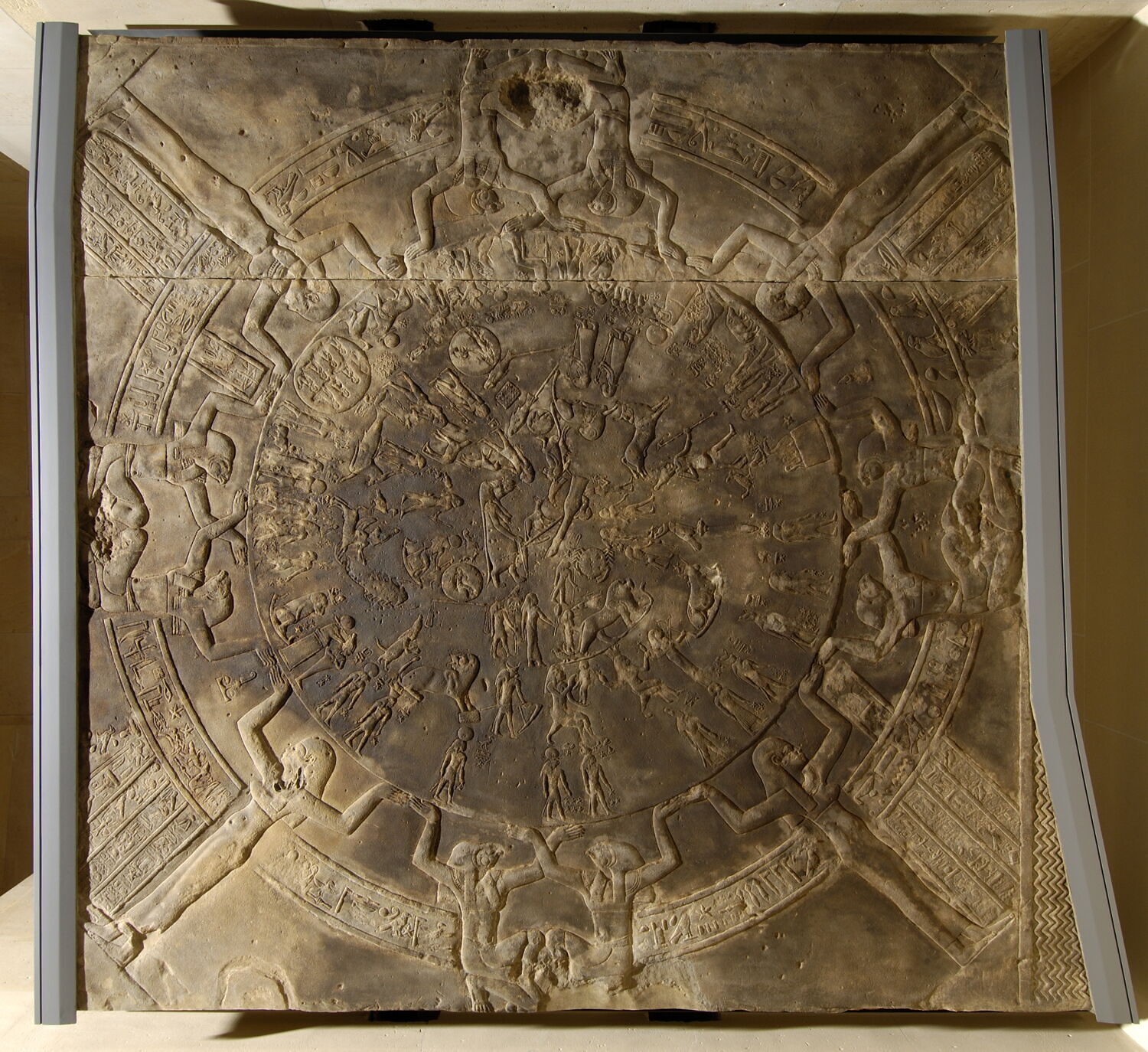
Dyrekredsen fra Dendera, et egyptisk relief af en ukendt kunstner dateret juni–august 50 f.Kr., tilhører Louvre i Paris. Det cirkulære himmelkort udsmykkede loftet i et Osiris-kapel i Denderas tempelkompleks. Dyrekredsens tegn deler skiven med figurer fra egyptisk tradition. Relieffet blev ført til Frankrig i 1821 og kom til Louvre i 1922; det er nu udstillet i sal 325, Sully-fløjen, niveau 0.
The sculptured Dendera zodiac (or Denderah zodiac) is a widely known Egyptian bas-relief from the ceiling of the pronaos (or portico) of a chapel dedicated to Osiris in the Hathor temple at Dendera, containing images of Taurus (the bull) and Libra (the scales). This chapel was begun in the late Ptolemaic period; its pronaos was added by the emperor Tiberius. This led Jean-François Champollion to date the relief to the Greco-Roman period, but most of his contemporaries believed it to be of the New Kingdom.
The relief, which John H. Rogers characterised as "the only complete map that we have of an ancient sky", has been conjectured in the past to represent the basis on which later astronomy systems were based. It is now on display at the Musée du Louvre, Paris.
Oplysninger
- Inventarnummer
- E 13482
I kataloget
Kilder
- Louvre
- Billede: Louvre — © 2008 Musée du Louvre, Dist. GrandPalaisRmn / Christian Décamps