Georg BaselitzTyskland, 1938–2026
Woodman (Waldarbeiter)
Må man se det?
Tager ikke imod for tiden

Art Institute of Chicago
Chicago, USA
Det hører til samlingen, men er ikke udstillet for tiden.
- Kontrolleret
- Uændret siden
- Kilde
- Museets egne samlingsdata
About the painting
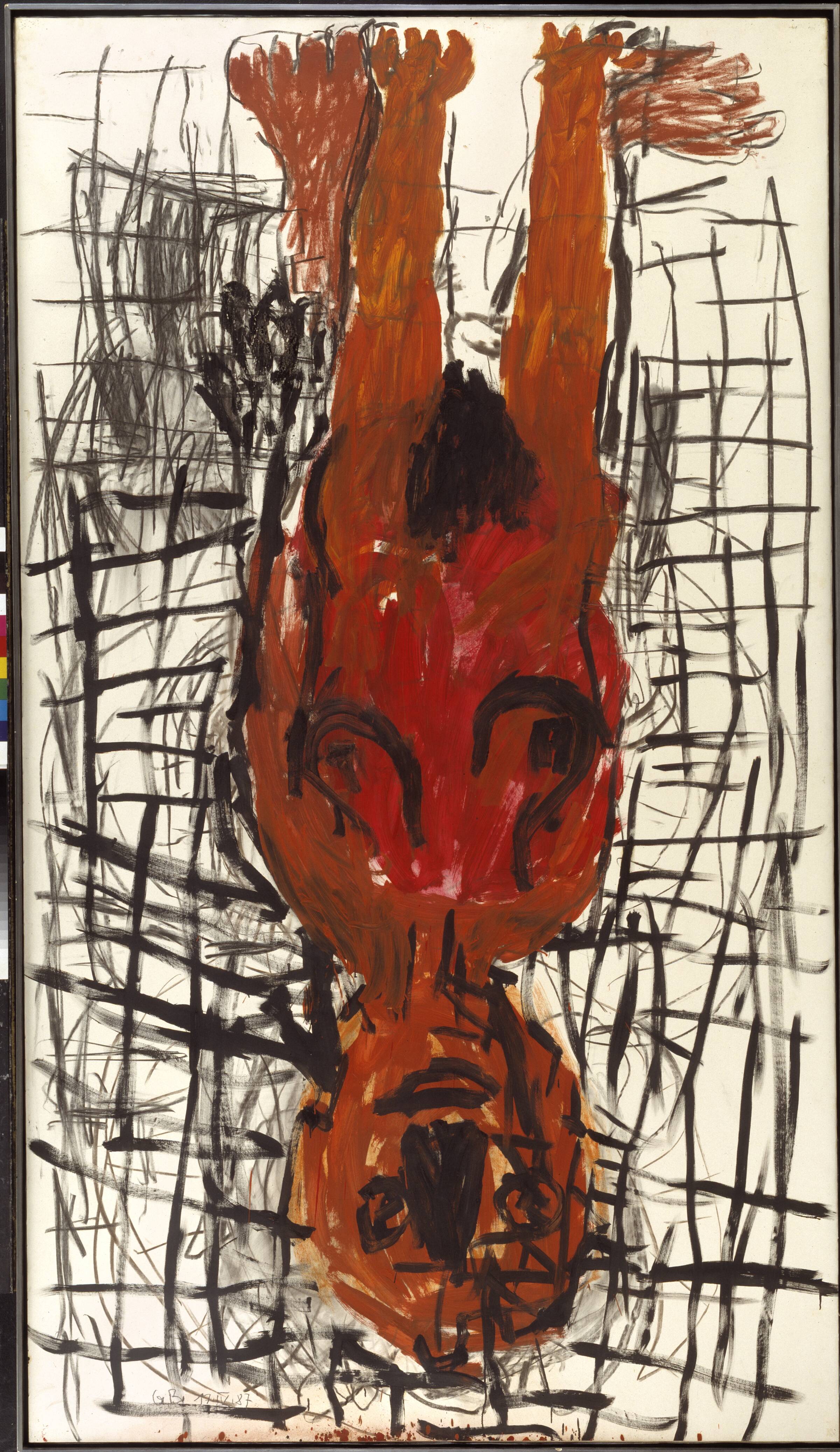
During the early 1960s, Georg Baselitz began producing representational images—characterized by thickly painted surfaces and often emotional and/or tragic themes—that drew inspiration from Germany’s artistic and cultural heritage. Between 1967 and 1969, Baselitz executed a series of Fracture Paintings, in which he segmented his subjects—animals, shepherds, and woodsmen—into horizontal bands or irregular fragments. Strung up sideways against a massive tree trunk, this woodsman heralded the artist’s trademark inverted figures, which first appeared soon after this painting’s completion. Conjuring a world gone mad, Woodman evokes the psychic and physical disorientation Germans experienced after their war-torn nation was partitioned in 1946. Indeed, Baselitz created this work after he left a divided Berlin to reside in a small German village.
Art Institute of ChicagoCC BY 4.0
Oplysninger
- Inventarnummer
- 1987.14
What it shows
I kataloget
Kilder
- Art Institute of Chicago: the museum's own open data · hentet for 7 dage siden
- Billede: Art Institute of Chicago — © the artist or rights holder
Imens i livet hos Georg Baselitz
Hele livet1968
The ars viva prize
In 1968 Baselitz was awarded the ars viva prize of the Cultural Committee of German Business.
1970
The first exhibition of upside-down pictures
At the Galeriehaus on Cologne's Lindenstraße Franz Dahlem put on the first exhibition of pictures with upside-down motifs.
1970
The first retrospective of drawings and prints
At the Kunstmuseum Basel Dieter Koepplin staged the first retrospective of Baselitz's drawings and graphic works.
1971
Moves to Forst an der Weinstraße
The Baselitz family moved again, to Forst an der Weinstraße; the old village school became his studio, and bird motifs began to appear in his paintings.