 Beatrix Potter1866–1943
Watercolour
Må man se det?
Tager ikke imod for tiden

Victoria and Albert Museum
London, Storbritannien
Det hører til samlingen, men er ikke udstillet for tiden.
- Kontrolleret
- Uændret siden
- Kilde
- Museets egne samlingsdata
Om værket
Beatrix Potter (1866-1943) is one of the world's best-loved children's authors and illustrators. She wrote the majority of the twenty-three Original Peter Rabbit Books between 1901 and 1913. The Tale of Peter Rabbit (Frederick Warne, 1902) is her most famous and best-loved tale.
From early childhood Beatrix Potter spent time drawing the many pets that she kept in her schoolroom: over the years, her pets included lizards, snails, bats, mice, rabbits and many other animals. During the family’s long summer holidays to rural areas she also took the opportunity to draw the plants and animals she saw in the countryside. Even her earliest childhood drawings show a serious interest in natural history, her sketches annotated with information about the species concerned.
Read on
As a young woman Beatrix Potter studied natural history with some seriousness, exploring the collections of the Natural History Museum, including the insect cases and fungi specimens. She had a collector’s cabinet full of specimens, from shells to dead butterflies and moths, and used a magnifying glass and a microscope to examine them more closely. She made numerous carefully observed studies of animals and plants from life.
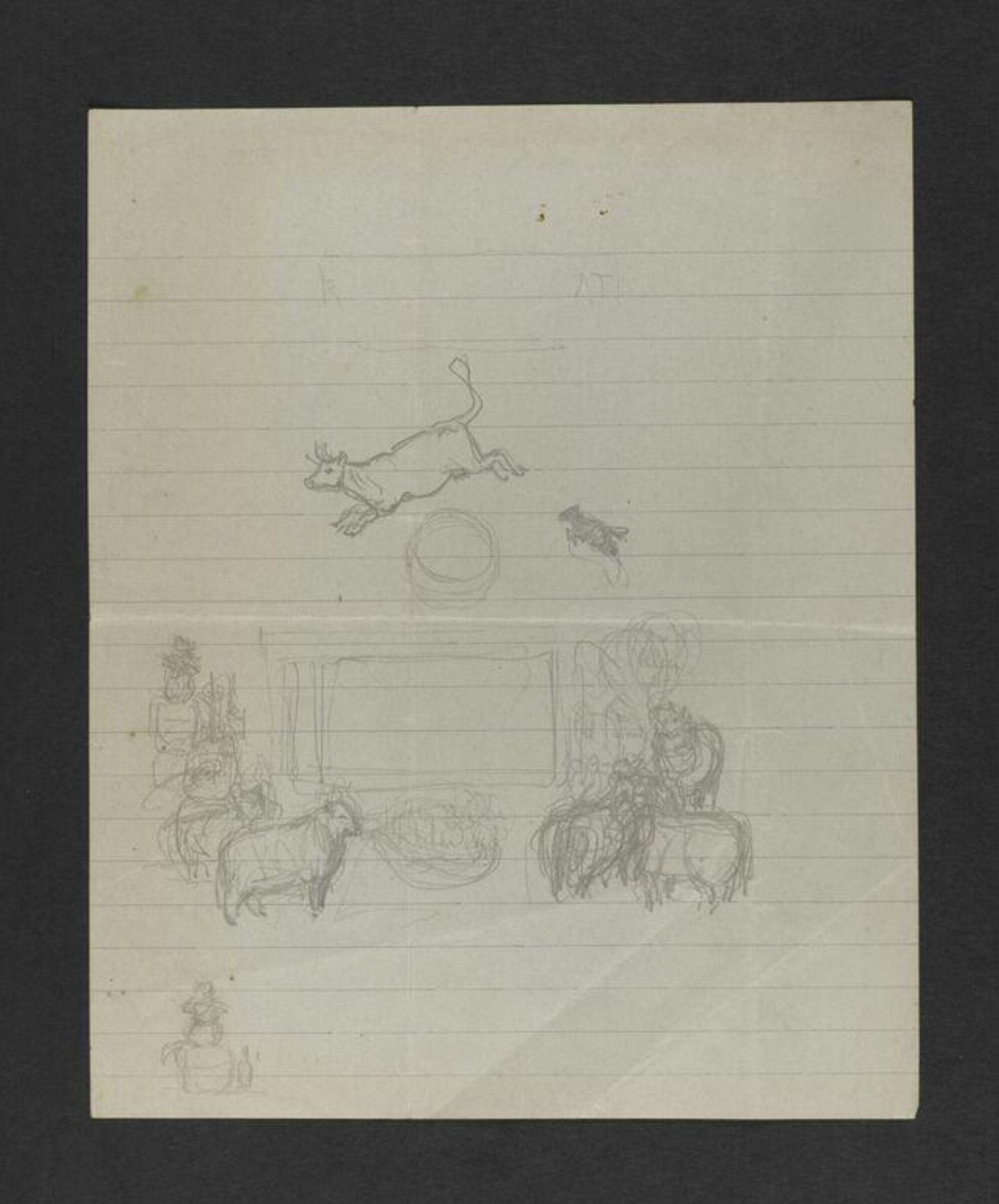
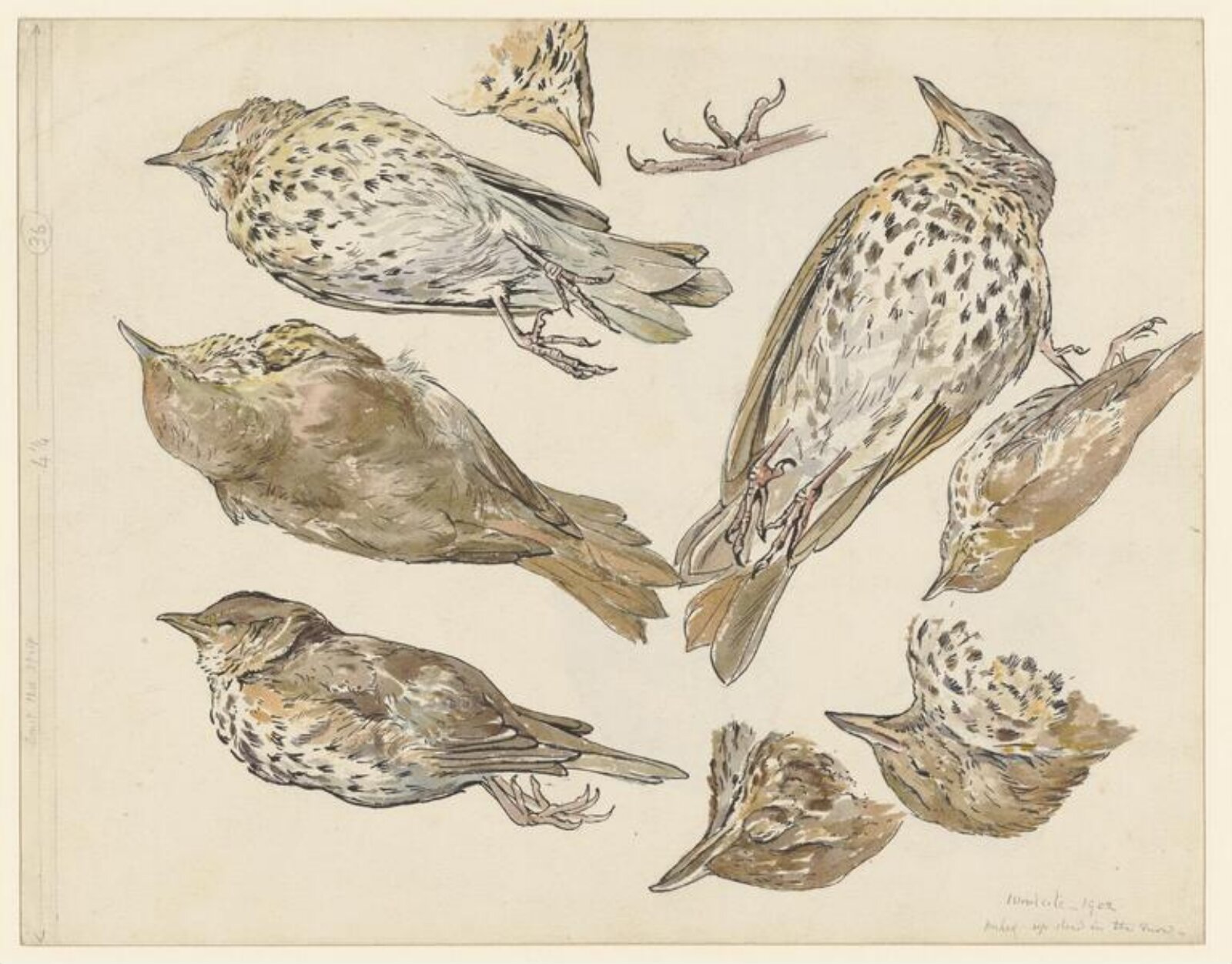
Potter often made sketches of her pets and other animals she came across. This sheet, with studies of a dead thrush ‘found in the snow’ covering one side and studies of a rabbit covering the other, well exemplifies Potter’s desire to study animals from every possible angle. She made the studies at Woodcote, the Surrey home of her uncle, Sir Henry Roscoe. Roscoe supported his niece’s endeavors in the field of natural history, procuring a student reader’s ticket for her at Kew Gardens and encouraging her drawings and research.
Victoria and Albert Museum
Oplysninger
- Inventarnummer
- BP.418
What it shows
I kataloget
Kilder
- Victoria and Albert Museum: the museum's own open data · hentet for 11 dage siden
- Billede: Victoria and Albert Museum — © Victoria and Albert Museum, London
Imens i livet hos Beatrix Potter
Hele livet1900–1901
A dummy book of the rabbit tale, printed at her own expense
In 1900 Beatrix revised her tale of the four little rabbits and made a dummy book of it — it has been suggested, in imitation of Helen Bannerman’s 1899 bestseller; no one would buy it. So in December 1901 she had it printed at her own expense for family and friends — in black and white, with a coloured frontispiece.
2 October 1902
“The Tale of Peter Rabbit” is published
Several publishers had turned the manuscript down, Frederick Warne & Co among them, but the firm, eager to enter the booming market for small-format children’s books, reconsidered on the advice of the artist L. Leslie Brooke; it declined Rawnsley’s verse version in favour of Beatrix’s own prose, and she agreed to colour her illustrations, choosing the new Hentschel three-colour process. “The Tale of Peter Rabbit” appeared on 2 October 1902 and was an immediate success.
1903
A patented Peter Rabbit toy: the birth of character merchandising
In 1903 Beatrix made and patented a Peter Rabbit doll — he became the first fictional character made into a patented soft toy, and so the oldest licensed character. Painting books, board games, wallpaper, figurines, baby blankets and china tea-sets followed under licence from her publisher Warne, earning her an independent income, and Harrods catalogues list Peter merchandise from at least 1910.
1903–1922
Two or three books a year with the editor Norman Warne
“The Tale of Squirrel Nutkin” and “The Tailor of Gloucester” followed “Peter Rabbit” in 1903 — both also began as picture letters to the Moore children. Working with the editor Norman Warne, Beatrix published two or three little books a year — 23 in all in that format, the last, in 1922, being “Cecily Parsley’s Nursery Rhymes”; the royalties gave her a degree of independence, though she still lived with her parents.