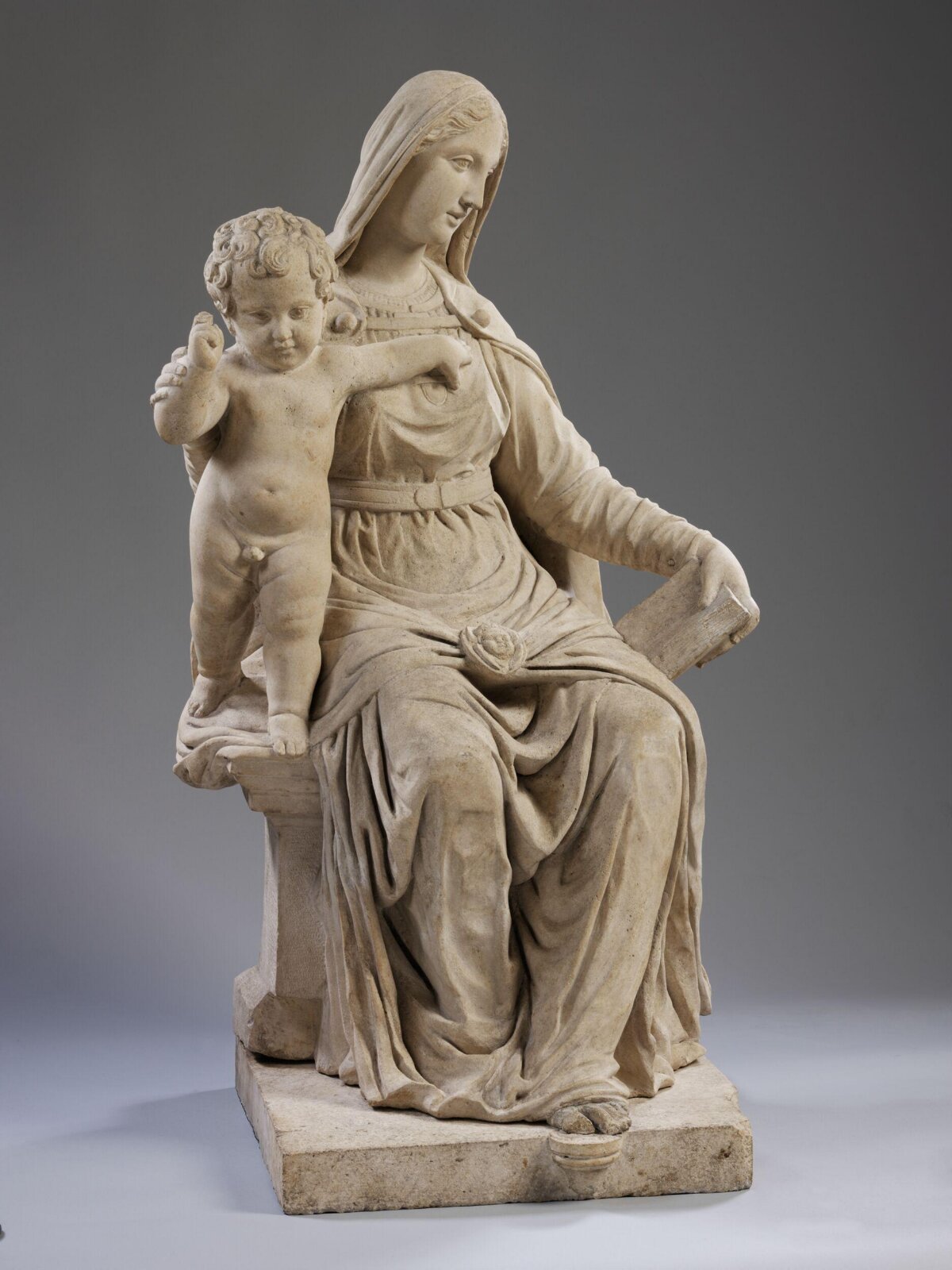
Francesco Cavrioli
Virgin and Child
Må man se det?
Ja, det tager imod

Victoria and Albert Museum
London, Storbritannien
SalMedieval & Renaissance, Room 50b, The Paul and Jill Ruddock Gallery
Udstillet for publikum. Hvem der står inde for det, står nedenfor.
- Kontrolleret
- Uændret siden
- Kilde
- Museet
Om skulpturen
This group was previously thought to be by Girolamo Campagna (1549-1625), dated 1578, and to have come from the church of the Madonna dell'Arsenale, Venice, a small church demolished in 1809. While the Virgin’s provenance has been confirmed, it has now been demonstrated that the sculpture was made by the 17th century sculptor Francesco Cavrioli (c. 1600-1670) (see Siracusano 2014).
Læs videre
The original location of the Virgin, atop the facade of the church of the Madonna dell’Arsenale is recorded in a painting by Canaletto in Woburn Abbey. It was framed by two angels that have not yet resurfaced. When the church was demolished in 1809, the Virgin was first moved to an unknown location and reappeared around 1840, when it was donated by the admiral Amilcare Paolucci to the Scuola della Misericordia. It was then bought by Sir John Leslie in 1878 and installed over a tablet bearing an inscription recording the transfer.
The attribution to Francesco Cavrioli has been made on stylistic comparisons with other documented sculptures, in particular with the high relief altarpiece carved in 1645 for the Battuti altar in the cathedral of Santa Maria Nova in Serravalle (Vittorio Veneto), the sculptor birth town. The Virgin can also be confronted to the Allegory of Venice, also dated from 1645, in San Giorgio Maggiore.
Francesco Cavrioli was active in Venice from the 1630s; he became one of the closest collaborator to the architect Baldassare Longhena (1598-1682).
Victoria and Albert Museum
Oplysninger
- Inventarnummer
- A.15&A-1961
Hvad det viser
I kataloget
Kilder
- Victoria and Albert Museum
- Billede: Victoria and Albert Museum — © Victoria and Albert Museum, London







