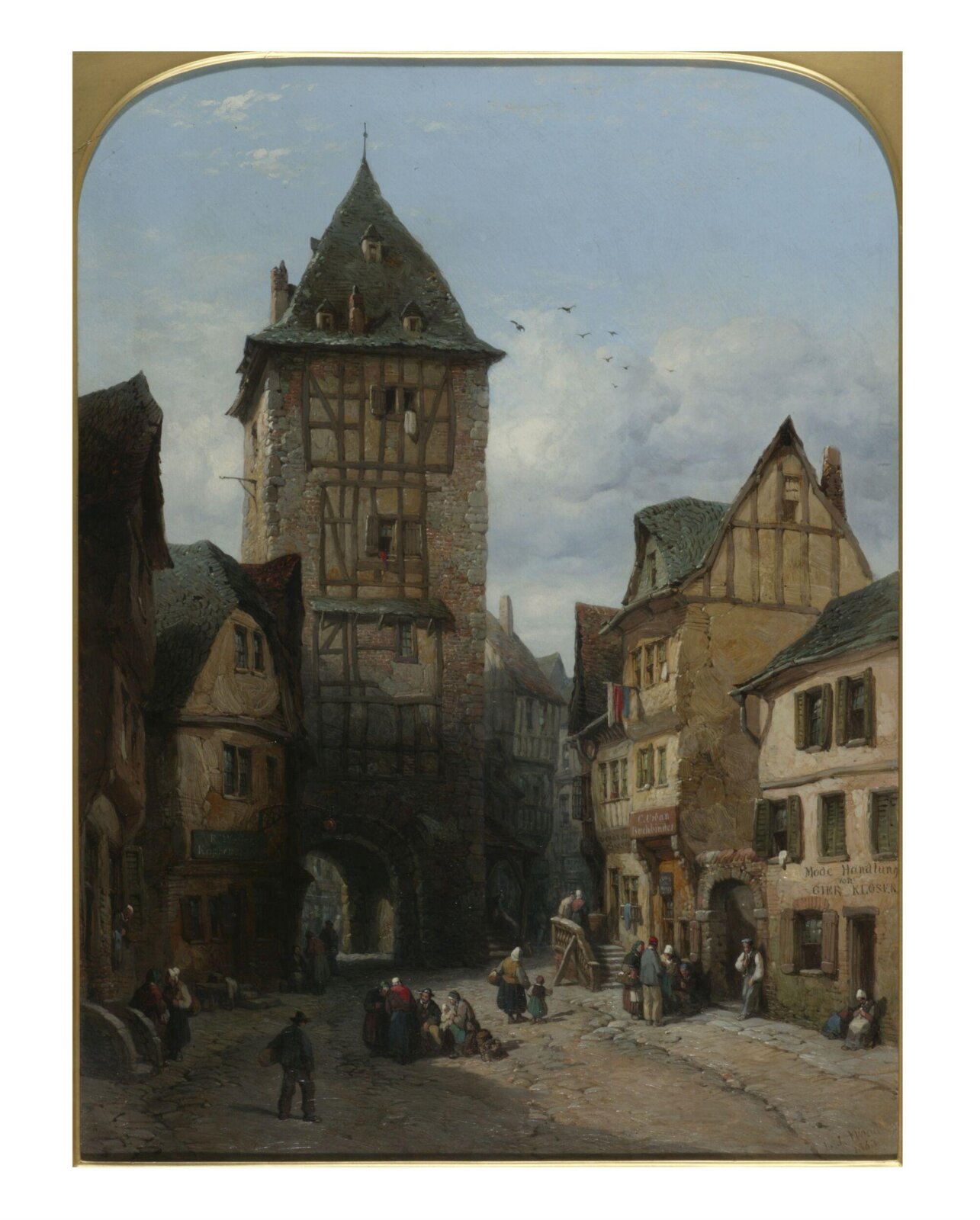
View in Limburg
Kan det ses?
Ikke udstillet lige nu
Hvor er »View in Limburg« i dag? Samling: Victoria and Albert Museum, London. Ikke udstillet lige nu. Kontrolleret 25. september 2026.

London, Storbritannien
Det hører til samlingen, men er ikke udstillet for tiden.
- Kontrolleret
- Uændret siden
- Kilde
- Museet
Om maleriet
Although primarily a landscape and architectural painter, John Lewis Wood (1813-1901) was also known as a lithographer. His work is reminiscent, particularly in early years, of that of the watercolourist and lithographer Thomas Shotter Boys. Wood exhibited at numerous institutions throughout his career, including the New Watercolour Society, at which he exhibited over 200 works, and the Royal Academy. In all he showed 40 works at the Royal Academy, most of which were architectural subjects. For many years he also exhibited English landscape paintings at Burlington House. Wood became an associate of New Society of Painters in Watercolours in 1866, gaining full membership in 1870. He rescinded this in 1888 having exhibited for the last time at the Society the year before.
Læs videre
Wood first visited the Continent in 1836 in an expedition that proved inspiring, and for the rest of his career the small towns and villages of Belgium, Normandy and Brittany became the primary subjects of his work.
This work illustrates Wood’s interest in architecture, particularly that of Northern Europe. This scene has been tentatively been identified as Limburg an der Lahn, Germany. In this painting the artist accentuates the quaint and rustic qualities of the architecture, probably to appeal to a British market.
Sources:
H.L. Mallalieu, The Dictionary of British Water Colour Artists up to 1920 (Woodbridge: Antiques Collectors’ Club, 1976-9), p.283
Bryan’s Dictionary of Painters and Engravers, Volume 5, (London: George Bell & Sons, 1905), pp.392-3
Victoria and Albert Museum
Oplysninger
- Inventarnummer
- 996-1886
Hvad det viser
I kataloget
Kilder
- Victoria and Albert Museum
- Billede: Victoria and Albert Museum — © Victoria and Albert Museum, London