Thomas GainsboroughStorbritannien, 1727–1788
The Watering Place
Kan det ses?
Ukendt
Hvor er »The Watering Place« i dag? Samling: National Gallery, London. Ukendt.

London, Storbritannien
Ejeren er kendt; om værket er udstillet i dag, vides ikke.
- Uændret siden
- Kilde
- Museet
Om maleriet
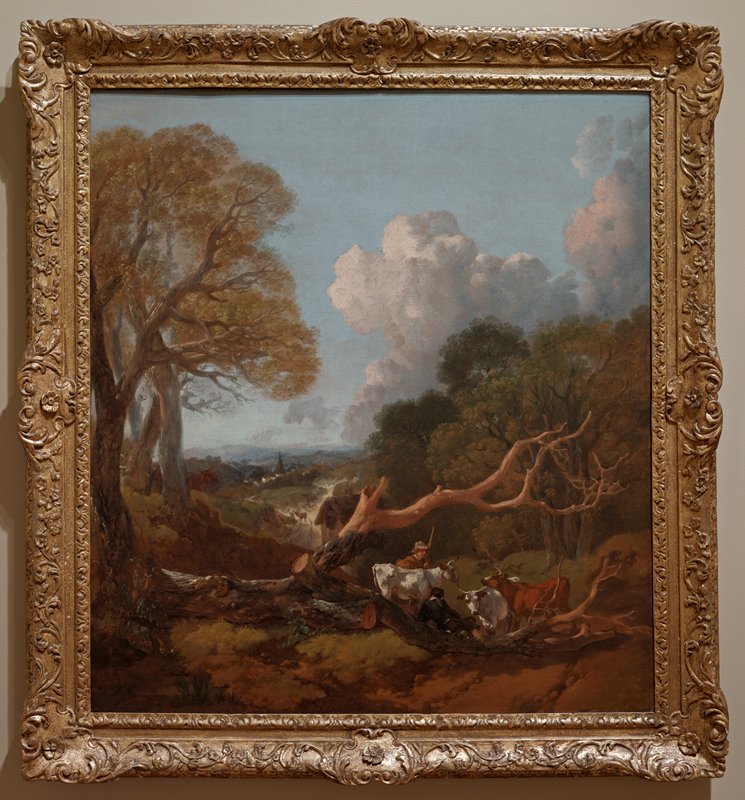
The Watering Place is an oil on canvas landscape painting by the British artist Thomas Gainsborough, from c. 1777. It is held in the National Gallery, in London.
It was shown at the Royal Academy's Summer Exhibition of 1777. It was one seven paintings Gainsborough exhibited at the show, in a comeback after several years boycotting the Academy due to their rejection of his portrait of Countess of Waldergrave at the Exhibition of 1773. It was widely acclaimed. Horace Walpole described it as being "in the style of Rubens and by far the finest landscape ever painted in England and equal to the Great Masters".
It was donated to the National Gallery by Charles Long, 1st Baron Farnborough, in 1827.
Oplysninger
- Inventarnummer
- NG109
I kataloget
Kilder
- Wikidata
- Billede: National Gallery — Thomas Gainsborough · Public domain · Wikimedia Commons
Imens i livet hos Thomas Gainsborough
Hele livet1774–1788
The rivalry with Reynolds
In London Gainsborough sets up his studio next to Christie's auction rooms, which he often visits. His London years are marked by rivalry with Joshua Reynolds, president of the Royal Academy.
1777
Back at the Academy exhibition: “The Watering Place”
In 1777, after a long break, Gainsborough again takes part in the Academy's exhibition, showing “The Watering Place” — his answer to Rubens's “Watering Place”. In the following years he keeps painting landscapes, and even two seascapes appear, one with a calm and one with a stormy sea.
c. 1777
Experiments with aquatint and etching
About this time Gainsborough begins experimenting with printmaking in the then-novel techniques of aquatint and soft-ground etching.