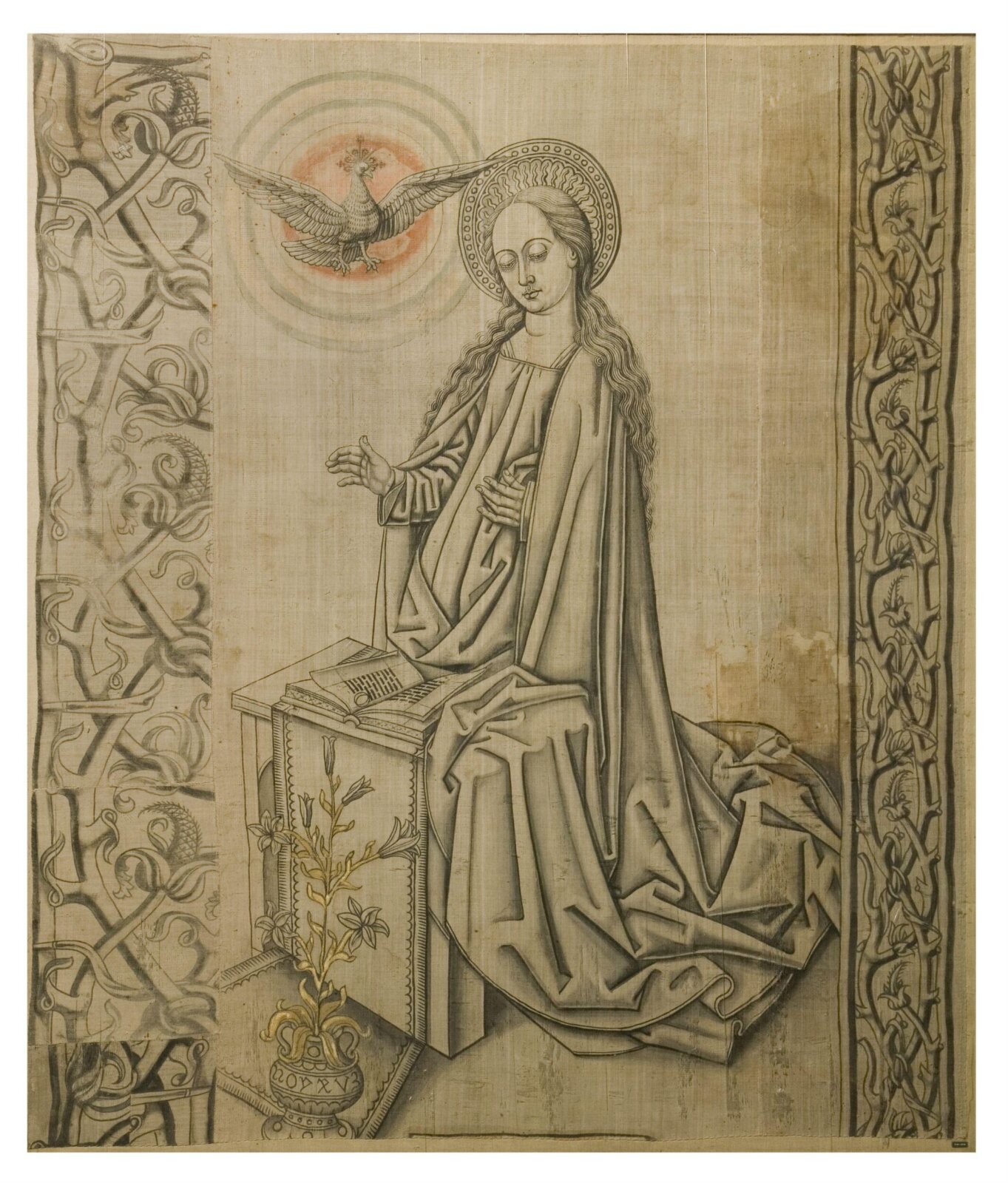
The Virgin Annunciate
Må man se det?
Ja, det tager imod

Udstillet for publikum. Hvem der står inde for det, står nedenfor.
- Kontrolleret
- Uændret siden
- Kilde
- Museets egne samlingsdata
About the painting
This anonymous fragment of around 1500 is painted on cloth. Such works were cheaper and lighter than panel paintings, and had the advantage that they could be rolled for transport or storage. They were sometimes used to cover organ shutters or altarpieces during the 40 days of Lent before Easter. The Virgin kneels before an open book with her attribute of a Lilly in the foreground while the Holy Spirit appears above her head in the form of a dove. The fragmentary border to the left has been moved to this location to mask the gap left by the missing figure of the Archangel Gabriel which originally faced the Virgin.
Read on
The original dimensions of this work may have exceeded 300 x 400cm. This fragment was apparently found in a Spanish convent, and the style of the Virgin's halo suggests that it was made in Valencia. Stylistically, it is based upon Netherlandish paintings of the mid-fifteenth century, which were exported in considerable numbers to Spain and Portugal. Flemish paintings were also copied by German engravers, whose prints disseminated their imagery throughout Western Europe. As a result, most Spanish painters of the later fifteenth century worked in styles which were essentially of Flemish derivation. This is a significant example of the once common but now rare Late Medieval genre of painting in grisaille on cloth.
Victoria and Albert Museum
Oplysninger
- Inventarnummer
- P.19-1928
What it shows
I kataloget
Kilder
- Victoria and Albert Museum: the museum's own open data · hentet for 10 dage siden
- Billede: Victoria and Albert Museum — © Victoria and Albert Museum, London