The Virgin and Child
Må man se det?
Ja, det tager imod

Udstillet for publikum. Hvem der står inde for det, står nedenfor.
- Kontrolleret
- Uændret siden
- Kilde
- Museets egne samlingsdata
About the sculpture
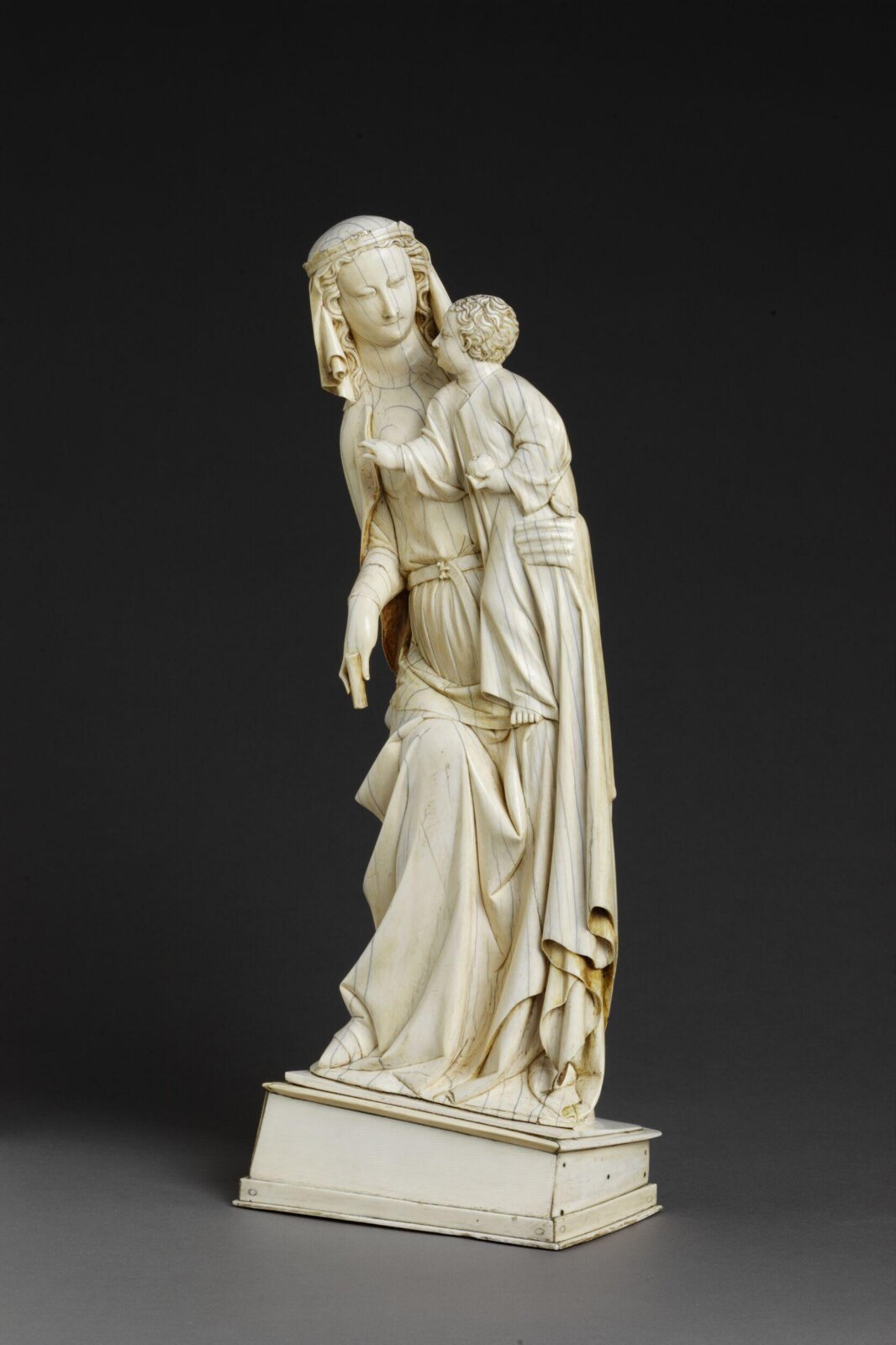
The love of elegance for its own sake increasingly dominated European art at the beginning of the fourteenth century, a development which co-incided with an increasing emphasis on the human qualities of the Virgin Mary. This statuette depicts the Virgin as gentle and maternal, smiling down at her inquisitive son.
In her right hand the Virgin holds a cylindrical object, the stem of a lily (now lost) which symbolised Mary's virginal state when her son was conceived by the Holy Spirit. The crown on her head distinguishes her as the quen of heaven. This Virgin and Child forms part of a now well-known group of similar pieces. These comparatively large ivory sculptures were presumably made for an élite market. They may not all be by the same hand, but they share details of pose and style, which pressupose a common approach and intimately related workshops.
Read on
Three dimensional images of the Virgin and Child were ubiquitous from the twelfth to the fifteenth centuries, produced in a wide range of materials and sizes and testifying the overwhelming devotion to th Virgin. Together with the Crucifixion, statues and statuettes of the Virgin and Child were the pricipal objects of devotion in the Christian Church, and vast numbers were made for ecclesisastical, monastic and private worship.
Victoria and Albert Museum
Oplysninger
- Inventarnummer
- 4685&:2-1858
What it shows
I kataloget
Kilder
- Victoria and Albert Museum: the museum's own open data · hentet for 10 dage siden
- Billede: Victoria and Albert Museum — © Victoria and Albert Museum, London