
 Albrecht DürerTyskland, 1471–1528
Næsehornet
The Rhinoceros
Kan det ses?
Ikke udstillet lige nu
Hvor er »Næsehornet« i dag? Samling: National Gallery of Art, Washington, D.C. Ikke udstillet lige nu. Kontrolleret 29. september 2026.

Washington, D.C., USA
Det hører til samlingen, men er ikke udstillet for tiden.
- Kontrolleret
- Uændret siden
- Kilde
- Museet
Om værket
Dürer's Rhinoceros is the name commonly given to a woodcut executed by German artist Albrecht Dürer in 1515. Dürer never saw the actual rhinoceros, which was the first living example seen in Europe since Roman times. Instead the image is based on an anonymous written description and brief sketch of an Indian rhinoceros brought to Lisbon in 1515. Later that year, the King of Portugal, Manuel I, sent the animal as a gift for Pope Leo X, but it died in a shipwreck off the coast of Italy. Another live rhinoceros was not seen again in Europe until Abada arrived from India to the court of Sebastian of Portugal in 1577.
Læs videre
Dürer's woodcut is not entirely an accurate representation. It depicts a rhinoceros with hard plates that cover its body like sheets of armor, with a gorget at the throat, a solid-looking breastplate, and what appear to be rivets along the seams; there is a small twisted horn on its back, scaly legs and saw-like rear quarters. None of these features are present in a real rhinoceros, although the Indian rhinoceros does have deep folds in its skin that can look like armor from a distance.
Dürer's woodcut became very popular in Europe and was copied many times in the following three centuries. It was regarded as a true representation of a rhinoceros into the late 18th century, and it has been said of Dürer's woodcut that "probably no animal picture has exerted such a profound influence on the arts". Eventually, it was supplanted by more realistic drawings and paintings, particularly those of Clara the rhinoceros, who toured Europe in the 1740s and 1750s.
Med museets ord
In May 1515, the first rhinoceros since antiquity to reach Europe alive arrived in Lisbon, Portugal. The ruler of Gujarat, Sultan Muzafar II, presented the exotic beast to the governor of Portuguese India, Alfonso d’Albuquerque, who then sent it to King Manuel I. Later that year, the king sent the animal as a political gift to Pope Leo X. Sadly, the ship sank on its way to Italy, and the rhinoceros drowned. Dürer and his contemporaries were fascinated with discoveries of the natural world, and as the rhinoceros made its journey, reports of the animal spread across Europe. Although he never saw the rhinoceros himself, Dürer based his woodcut of the animal on a description and a sketch that was sent to Nuremberg. The Latin text at the top of the print describes the rhinoceros to be the color of a speckled tortoise, covered in thick plates, and so well armed that even an elephant could not fend it off.
National Gallery of Art
Oplysninger
- Inventarnummer
- 1964.8.697
Hvad det viser
I kataloget
Udstillingshistorik
Ikke udstillet for tiden
National Gallery of Art · 29. sep. 2026 — nu · Kontrolleret
Var ikke udstillet
The Cleveland Museum of Art · 29. sep. 2026 — 29. sep. 2026 · Kontrolleret
Var ikke udstillet
National Gallery of Art · 29. sep. 2026 — 29. sep. 2026 · Kontrolleret
Var ikke udstillet
The Cleveland Museum of Art · 28. sep. 2026 — 29. sep. 2026 · Kontrolleret
Var ikke udstillet
National Gallery of Art · 28. sep. 2026 — 28. sep. 2026 · Kontrolleret
Var ikke udstillet
The Cleveland Museum of Art · 27. sep. 2026 — 28. sep. 2026 · Kontrolleret
Var ikke udstillet
National Gallery of Art · 26. sep. 2026 — 27. sep. 2026 · Kontrolleret
Var ikke udstillet
The Cleveland Museum of Art · 19. aug. 2026 — 26. sep. 2026 · Kontrolleret
Kilder
- The Cleveland Museum of Art
- Billede: National Gallery of Art — Museum open access
Imens i livet hos Albrecht Dürer
Hele livet1507–1528 · Virkested
Nuremberg
1513–1516
Tre år uden maleri
Dürer beklagede, at maleriet sammenlignet med grafikken ikke gav tilstrækkelig betaling for den medgåede tid, og fra 1513 til 1516 malede han ikke et eneste billede.
1514
Moderens død
I det år, hvor »Melankoli« og »Святой Иероним в келье« blev til, døde kunstnerens mor, Barbara Holper.
1515
Livsvarig pension fra kejseren
Den evigt pengetrængende Maximilian kunne ikke betale til tiden og foreslog at fritage kunstneren for byskatter, men Nürnbergs råd satte sig imod. På Dürers anmodning tilkendte kejseren ham en livsvarig pension på 100 gylden om året af de beløb, Nürnberg indbetalte til kejserrigets skatkammer.
1517
Blandt Nürnbergs reformatorer
Dürer sluttede sig til kredsen af reformatorer i Nürnberg under ledelse af augustinernes vikar Johann Staupitz og Wenceslaus Linck. Omkring 1518 lærte han Martin Luthers skrifter at kende, som efter hans eget udsagn »hjalp ham meget«.
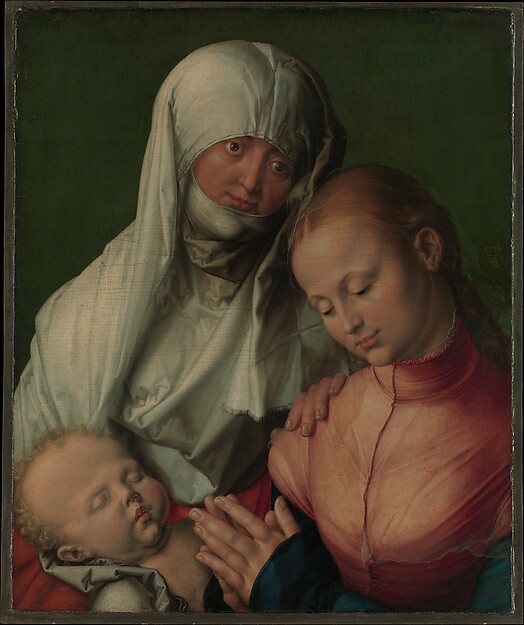
![Madonna and Child [obverse], Albrecht Dürer, c. 1496/1499](https://api.nga.gov/iiif/878db7e6-10ae-4cae-ba5d-6d6f5c413ae8/full/!2400,2400/0/default.jpg)
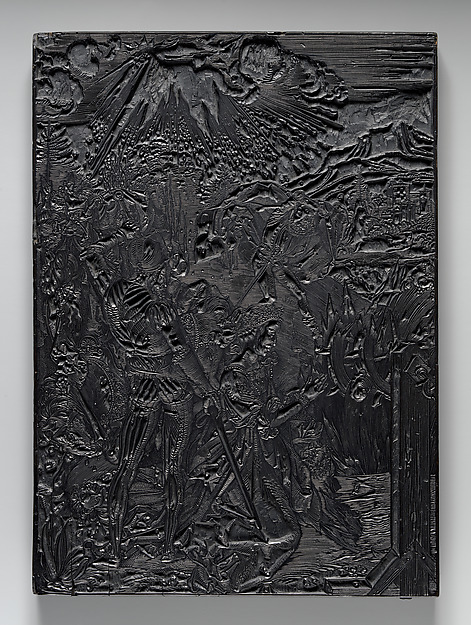
![Lot and His Daughters [reverse], Albrecht Dürer, c. 1496/1499](https://api.nga.gov/iiif/7565a449-f82a-414b-9bda-c93f55a51b4d/full/!2400,2400/0/default.jpg)


![Ginevra de' Benci [obverse], Leonardo da Vinci, c. 1474/1478](https://api.nga.gov/iiif/8f29e3c9-a289-4d53-abf0-31a66e9e98fa/full/!2400,2400/0/default.jpg)
![Wreath of Laurel, Palm, and Juniper with a Scroll inscribed Virtutem Forma Decorat [reverse], Leonardo da Vinci, c. 1474/1478](https://api.nga.gov/iiif/ff62e8d0-45c4-498f-ad36-6358de827e04/full/!2400,2400/0/default.jpg)





